
Quick verdict
The short answer
The XREAL 1S is the best value in wearable displays right now. For $449 you get dual 1200p Micro-OLED displays, a 120Hz refresh rate, 700 nits of brightness, and a 120-inch-plus virtual screen that runs off your phone, laptop, or Steam Deck over a single USB-C cable. It is not “AI glasses” in the camera-and-chatbot sense — it is a private cinema and portable monitor that happens to sit on your face, and at this price nothing else touches it. The honest framing is that this is a $449 wearable monitor, not a computer — if you can live with a USB-C cable and a host device doing the thinking, it’s the easiest recommendation in AR right now.
This is a research-based review. We have not tested the XREAL 1S hands-on; every fact below comes from the manufacturer’s published specs, pricing, and independent reporting. Prices and specs checked September 30, 2026.
Key specs
| Spec | XREAL 1S |
|---|---|
| Display | Dual Micro-OLED, 1200p per eye |
| Field of view | 52 degrees |
| Refresh rate | Up to 120Hz |
| Brightness | 700 nits peak |
| Chip | XREAL X1 spatial computing chip |
| Latency | 3ms motion-to-photon (per XREAL) |
| Tracking | 3DoF (virtual screen can be anchored in space) |
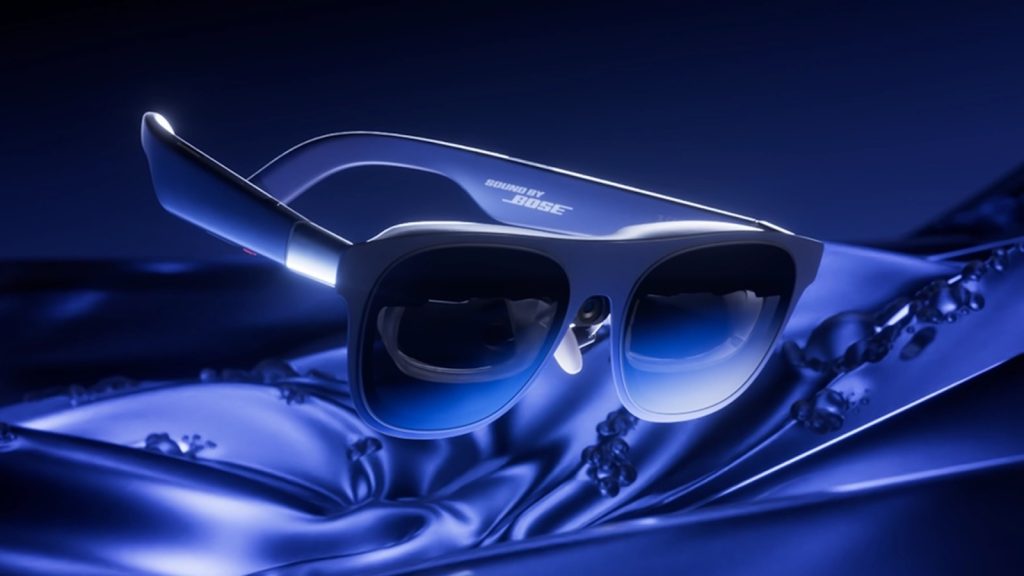
| Audio | Sound by Bose open-ear tuning |
| Dimming | Electrochromic automatic transparency dimming |
| Weight | 82g |
| Connection | USB-C DisplayPort output from the host device |
| Battery | None — powered by the connected host device |
| Special feature | Real 3D: on-glasses 2D-to-3D conversion |
Price and availability
The XREAL 1S sells for $449 through XREAL’s US store, Amazon, and Best Buy. It replaced the original XREAL One (which launched at $499) at CES 2026 with better specs and a lower price — a genuinely consumer-friendly move in a year when most tech got more expensive. The premium XREAL One Pro (57° FOV, 700 nits, 1200p) received a permanent price cut to $599. For handheld gaming with a Nintendo Switch or Steam Deck, the optional XREAL Neo — a 10,000mAh power bank with an integrated DisplayPort video hub — costs $99.
What’s in the box and what it costs to own: the glasses ship with a carrying case and a light shield that blocks ambient light for full immersion. There is no subscription, no app-store tax, and — importantly — no internal battery to degrade over the years, since the glasses draw power from the host device. The companion app handles display adjustments, firmware updates, and the Real 3D toggle. Budget the extra $99 for the Neo hub if you’re a Switch gamer; Steam Deck and most USB-C laptops and phones plug in directly.
What it’s good at
- Picture quality per dollar. Dual 1200p Micro-OLED at 120Hz with 700 nits for $449 is unmatched. The 52° field of view is wide enough for the virtual screen to feel cinematic, and the 16:10 aspect ratio fits modern laptops.
- The screen stays put. The X1 chip powers native 3DoF tracking, so the virtual display can be anchored in space instead of jiggling with your head. Reviewers single this out as the must-have feature that separates usable AR glasses from gimmicks.
- Comfort. At 82g they are the lightest in their class — reviewers weighed them at 85g on a kitchen scale, still lighter than the One Pro (91g) and Viture Beast (96g) — with good weight distribution and thin temple arms. This matters more than any spec: a heavy display you’ll take off in 20 minutes is a paperweight.
- Sound by Bose. Open-ear audio tuned with Bose keeps you from needing separate earbuds on a plane, and keeps your ears open.
- Real 3D conversion. A system-level toggle converts 2D video and games to 3D on the glasses. It’s a party trick that reviewers say genuinely works for movies.
- Gaming. Low latency (3ms motion-to-photon), 120Hz, and Steam Deck/Switch support (with the Neo hub) make this the best portable big-screen for handheld gaming in 2026.
Where it falls short
- No standalone compute or AI. The 1S is a display, not a computer. There is no app platform, no voice assistant, and no camera-based AI on board. If you want Ray-Ban Meta-style “what am I looking at,” this isn’t it.
- No internal battery. It draws power from your phone, laptop, or handheld, which drains the host faster. For long sessions you’re chained to the Neo power bank or a wall.
- Device compatibility varies. You need a host with USB-C DisplayPort output. Some phones and consoles need adapters, and iPhones without USB-C are out of luck.
- Light control is still a compromise. Electrochromic dimming helps, but like all optical-see-through glasses, bright sunlight washes out the image compared to a closed VR headset.
- XREAL One Pro exists. For $150 more, the Pro gets you a wider 57° field of view and an optional $99 camera add-on. If the FOV is what hooks you, the upsell is real.
Who should buy it
Buy the 1S if you travel constantly and want a private cinema on planes, if you game on a Steam Deck or Switch and crave a bigger screen, or if you work on a laptop and want a portable second (or third) monitor. It’s also the cheapest credible way to try AR displays without committing to a headset — and the one we’d hand to a skeptic, because the image quality sells itself in about ten seconds.
Who should skip it
Skip it if you want standalone AI features, a camera, or all-day standalone use — the 1S needs a host device and a cable. Also skip if your phone or laptop lacks USB-C video output; check compatibility before you buy, and budget for the $99 Neo hub if you’re a Switch or Deck gamer. And if field of view is the thing that hooks you most, at least demo the One Pro before deciding — 57° versus 52° is noticeable.
Verdict
The XREAL 1S is the rare sequel that’s better and cheaper than its predecessor. It doesn’t try to be AI glasses; it tries to be the best portable display on your face, and at $449 with 1200p/120Hz Micro-OLED, Bose audio, and 82g of weight, it succeeds. The value story is unusually clean: no subscription, no battery to wear out, and a price that undercuts its own predecessor. The strongest recommendation in the AR display category for most people.
Rating: 4.5/5
FAQ
Does the XREAL 1S work with the Nintendo Switch and Steam Deck?
Yes, with a caveat: both need video-out over USB-C. The Steam Deck works directly; the Switch needs the $99 XREAL Neo hub (which also adds a 10,000mAh battery), and it upgrades Switch output from 720p handheld to 1200p through the glasses.
Does the 1S have a battery?
No. The glasses are powered by the connected host device over USB-C. Heavy use will drain your phone or handheld faster.
Can I wear the XREAL 1S with prescription lenses?
XREAL sells prescription lens inserts through partner opticians. The glasses also ship with a light shield for immersion and a carrying case.
What’s the difference between the 1S and the One Pro?
The 1S is the $449 entry model: 1200p, 52° FOV, 700 nits, 82g. The One Pro ($599 after a permanent price cut) widens the field of view to 57°, and supports an optional $99 camera attachment.
Where to buy
As an Amazon Associate we earn from qualifying purchases.