
Quick verdict
The short answer
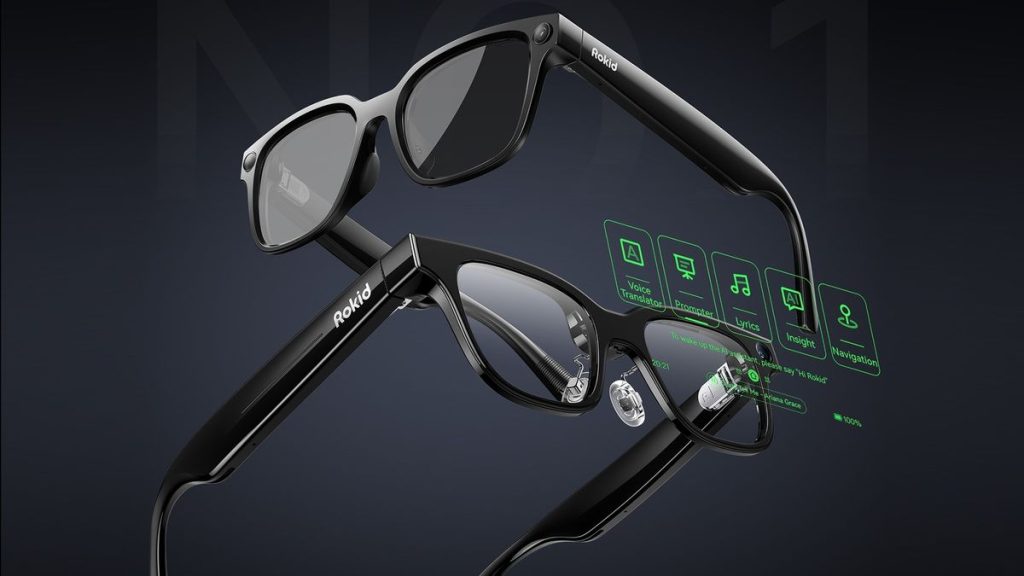
The Rokid Glasses are a strong pick for people who want AR display glasses with AI — not just a private monitor. You get a monochrome Micro-LED HUD in your field of view, a 12MP camera that records up to 10 minutes of continuous video (triple the Meta limit), live translation in up to 89 languages, a teleprompter, and AR navigation, all at 49g. The catch: the design feels bulky for the price, and pricing itself is confusing — the $599 Kickstarter MSRP has given way to listings at $699–$799. Confirm the price on Rokid’s official store before buying. What you’re getting is the most feature-complete AI+display package in the category: nothing else combines a daylight-readable HUD, a 12MP camera with 10-minute recording, 89-language translation, and a teleprompter at this weight. The question is never whether the features impress — it’s whether the design and the price tag let you enjoy them.
This is a research-based review. We have not tested the Rokid Glasses hands-on; every fact below comes from the manufacturer’s published specs, pricing, and independent reporting. Prices and specs checked September 30, 2026.
Key specs
| Spec | Rokid Glasses |
|---|---|
| Display | Dual monochrome Micro-LED, 480 x 398 per eye |
| Brightness | 1,500 nits |
| Camera | 12MP with 10 minutes of continuous video recording |
| Battery | 210mAh; around 8 hours mixed use, up to 12 hours light use (per independent review) |
| Weight | 49g |
| Water resistance | IPX4 |
| AI features | Live translation (up to 89 languages online), teleprompter, AR navigation, voice assistant |
| OS | YodaOS-Sprite |
| Prescription | Magnetic prescription lens support |
Price and availability
Rokid launched the Glasses on Kickstarter in August 2025 at a $599 retail price, raising over $500,000 in 24 hours. Since then the price picture has gotten murky: later coverage lists $699 in some comparisons and a $799 US RRP in one reviewer’s spec table. Availability runs through Rokid’s global store and Amazon. Our advice: the Kickstarter-era $599 is the figure most sources anchor to, but prices now appear to range from $599 to $799 depending on the channel — confirm the current price on global.rokid.com before you buy, and don’t pay $799 without checking what $599 gets you.
Value context matters here because the lineup has a trap in it: the display-free Rokid AI Glasses Style sells for $299 — half the price, 38.5g, same 12MP camera, and the same ambient AI — minus the display, teleprompter, and AR navigation. If your use case is translation audio and voice AI rather than visual overlays, the Style is the smarter buy and you should read this review as an argument for the cheaper sibling. The Glasses justify their premium only if you’ll actually use the HUD: subtitles in your vision, a teleprompter for presentations, navigation without a phone in your hand.
What it’s good at
- Translation at scale. Up to 89 languages online (plus offline modes) with subtitles in your field of view is the best translation story in consumer glasses — better than the Ray-Ban Meta’s audio-only approach.
- Creator-friendly video. 10 minutes of continuous recording beats Meta’s ~3-minute cap, and the 12MP sensor shoots social-ready aspect ratios. For vloggers, that’s a functional advantage, not a spec-sheet one.
- A HUD that works in daylight. 1,500 nits of monochrome Micro-LED brightness means the display is readable outdoors, and monochrome turns out to be the right call for text: crisp, high-contrast, and power-efficient.
- Teleprompter and navigation. The display-first features — teleprompter for speakers, AR navigation for walkers — are genuinely useful in ways a camera-only pair of glasses can’t match.
- Battery life. Around 8 hours of mixed use is solid for display glasses, and light users can stretch toward 12. That’s a full workday of intermittent AR.
- Light enough to wear. At 49g these are heavier than normal glasses but lighter than any headset, and far lighter than the 119g RayNeo X2.
Where it falls short
- Design and materials. Independent reviewers criticize the bulky fit — they sit high on the face — and cheap-feeling plastic that doesn’t match a $599+ price tag. This is the most consistent complaint in coverage.
- Monochrome display. The green-on-nothing HUD is great for text and terrible for media. If you want to watch movies, get XREAL instead.
- Price confusion. $599 MSRP, $699 in some listings, $799 in one reviewer’s table. Rokid needs a cleaner pricing story; you need to shop carefully.
- AI ecosystem openness is a work in progress. Rokid pitches model-agnostic AI, but the real-world experience depends on which models and services are wired up in your region.
- Privacy optics. A 12MP always-ready camera on your face raises the same social questions as Meta’s glasses — and Rokid is the less-known brand, so expect more suspicious looks.
Who should buy it
Buy the Rokid Glasses if live translation is your killer app — frequent international travelers, multilingual professionals — or if you’re a speaker who wants a teleprompter and a creator who wants long recording times. They’re the most feature-complete AI+display glasses under $700 when priced right. Business travelers hopping between languages will get more daily value from these than from any camera-only smart glasses.
Who should skip it
Skip them if you care about how tech looks on your face (the design criticisms are real), want full-color media, or need prescription lenses beyond the supported magnetic options. And if the price has crept to $799 in your region, the value equation changes — at that point the XREAL One Pro and Ray-Ban Meta Display are both in play. Also consider the $299 Style first: if you don’t need the visual HUD, it’s the same AI brain in a lighter, cheaper body.
Verdict
The Rokid Glasses pack more practical AI features into 49 grams than almost anything else on the market — translation, teleprompter, navigation, and best-in-class recording time. But the bulky design and muddled pricing hold them back from a full recommendation. At $599 they’re a strong buy for travelers and creators; at $799, shop around first. And whatever the price, try the $299 Style in your mental math: for many buyers, the display-free sibling is the better product. Buy for the HUD you’ll actually use daily — that’s the only part of the premium that pays off.
Rating: 3.7/5
FAQ
What’s the difference between Rokid Glasses and Rokid AI Glasses Style?
The Rokid Glasses have a monochrome Micro-LED display for translation subtitles, a teleprompter, and AR navigation. The AI Glasses Style ($299) are display-free, lighter at 38.5g, and focused on ambient voice AI — choose the display model for visual features, the Style for comfort and price.
How many languages can the Rokid Glasses translate?
Rokid advertises translation in up to 89 languages online, with a smaller set available offline. Confirm current offline language support on Rokid’s site, as it varies by update.
How long can the Rokid Glasses record video?
Up to 10 minutes of continuous video recording per clip — roughly triple the ~3-minute limit on Ray-Ban Meta glasses.
Do the Rokid Glasses support prescription lenses?
Yes, through magnetic prescription lens attachments. Check Rokid’s store for your prescription range before ordering — the magnetic system makes swapping between clear and tinted lenses easy, which is a nice touch for travelers moving between indoors and out.