
Quick verdict
The short answer
The Amazon Echo Frames (3rd Gen) are the most discreet way to keep Alexa on your face. There is no camera, no display, and no augmented-reality trickery: just open-ear audio, good call quality, and hands-free voice control for music, messages, and your smart home. If you want AI glasses that are fashionable first and useful second — and you live in Alexa’s world — these are a genuine bargain at their usual $199.99 street price. If you want a camera, visual AI, or a display, look elsewhere.
This is a research-based review. We have not tested the Echo Frames hands-on; every fact below comes from the manufacturer’s published specs, pricing, and independent reporting. Prices and specs checked September 30, 2026.
Key specs
| Spec | Echo Frames (3rd Gen) |
|---|---|
| Type | Audio smart glasses (no camera, no display) |
| Audio | Open-ear speakers with 3x more bass than the previous generation (per Amazon) |
| Battery life | Up to 6 hours of continuous media playback or talk time on a full charge (per Amazon) |
| Voice assistant | Alexa, hands-free |
| Connectivity | Bluetooth to your smartphone |
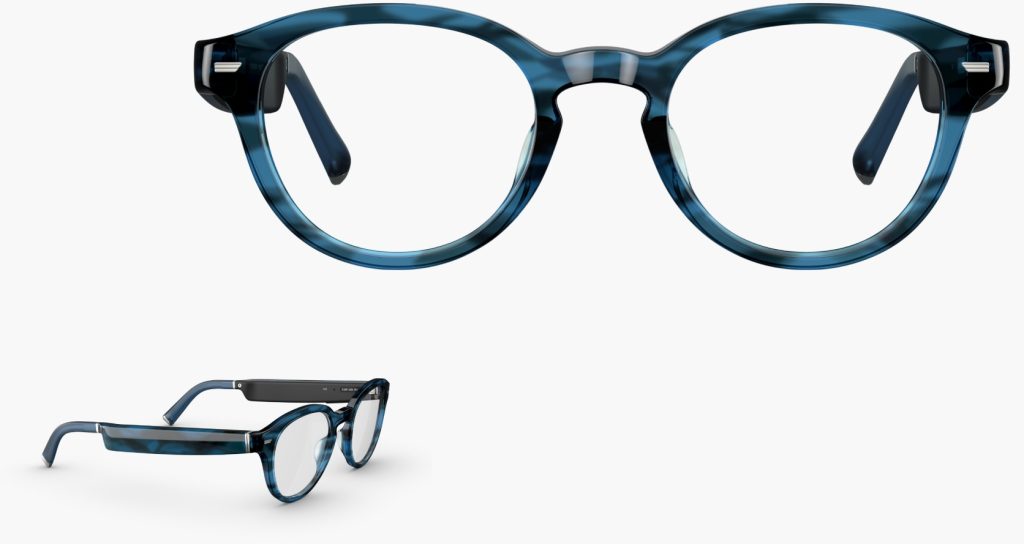
| Frame styles | 5 styles: black rectangle, black square, blue round tortoiseshell, brown cat eye tortoiseshell, gray rectangle |
| Lens options | Prescription-ready, blue-light-filtering, or sunglasses (lenses not included in base price) |
| Design | Arms 15% slimmer than the previous generation; Carrera co-branded designs also available |
| Noise handling | Up to 10x better voice recognition in loud or windy environments than the previous generation (per Amazon) |
Price and availability
The Echo Frames (3rd Gen) launched at $269.99 and that remains the list price, but Amazon has kept them at an effective street price of around $199.99 for most of their life — one recent September 2026 roundup listed them at $199.99 with no sale banner attached. Prescription lenses, blue-light lenses, and sunglass lenses cost extra on top of the base frame price. Carrera-branded Alexa frames carry a premium over the standard five styles. Availability is straightforward: Amazon’s own storefront, and they ship widely in the US.
One note on pricing history: Amazon ran an introductory period at $194.99 before settling on the $269.99 list price, so the “discount” to $200 has been more or less permanent. Treat $269.99 as the MSRP and $200 as the real price. If you see them above $200, you’re overpaying.
On the practical side: charging happens through a proprietary dock — you fold the glasses and set them down so the contacts on the temples meet the stand — rather than through a USB-C port on the glasses or a pocketable charging case. Reviewers describe it as functional but less elegant than the Ray-Ban Meta’s charging case, so expect a small desk ritual rather than a drop-in-and-go experience. The package ships with the frames and the charging stand; prescription, blue-light, and sunglass lenses are ordered as separate configurations at higher price points.
What it’s good at
- Discretion. These look like ordinary glasses. There is no camera bump, no LED that screams “recording,” and no chunky display housing. For anyone who finds camera glasses socially awkward, that is the entire selling point.
- Calls in noisy places. Reviewers consistently praise the microphone quality: multiple reports describe surprisingly clear voice calls, and Amazon claims 10x better voice pickup in loud or windy conditions than the previous generation. For walking-and-talking commuters, this is the killer feature.
- Hands-free Alexa. Music, podcasts, timers, smart-home control, and reading messages all work by voice, including while your phone is in your pocket. Amazon’s VIP filter keeps notifications sane by limiting alerts to chosen contacts and apps. If your home already runs on Echo devices, the Frames extend that ecosystem onto your face.
- Audio that stays out of your ears. Open-ear speakers mean nothing touches your ear canal — good for situational awareness while cycling or walking in a city, and comfortable for people who hate earbuds.
- Prescription-friendliness. Five frame styles with prescription-ready, blue-light, and sunglass lens options (plus the Carrera collaboration) make these far more eyewear-legitimate than most tech glasses, which come in one shape and look.
- The price. At ~$200 street, these are the cheapest mainstream smart glasses from a major brand, and cheaper than Amazon’s own Echo Buds-based alternative paths once you factor in the fashion angle.
Where it falls short
- Sound quality is fundamentally limited. Open-ear speakers cannot compete with earbuds. Reviewers note decent mids and highs but almost no bass, and in loud environments outside noise overwhelms the audio. This is physics, not a bug.
- No camera, no display, no visual AI. While Ray-Ban Meta and other rivals added multimodal AI, the Echo Frames stayed audio-only. There is no “look and tell me” moment here.
- Six hours is the ceiling. Amazon’s official figure is six hours of continuous playback or talk time. Reviewers have reported longer figures with light, intermittent use (some cite up to 14 hours of moderate use), but a heavy music-listening day will kill them before dinner.
- Alexa lock-in. These glasses are only as smart as Alexa, and they require your phone for connectivity. If you are a Google Assistant or Siri household, half the value evaporates.
- Sound leakage. Amazon says audio is directed at your ears with less leakage than before, but open-ear audio is still audible to the person next to you in a quiet room. Don’t take calls in a library.
Who should buy it
Buy the Echo Frames if you already live in the Alexa ecosystem, want voice assistance and audio without anything in your ears, need prescription smart glasses that actually look normal, and take a lot of hands-free calls on the move. Walkers, runners, cyclists, and warehouse or shop-floor workers who need audio plus awareness are the natural audience.
Who should skip it
Skip them if you care about sound quality (buy earbuds), want a camera or any visual AI, don’t use Alexa, or need all-day battery with heavy music use. If you’re choosing between these and camera glasses for “AI,” the Echo Frames are not an AI glasses product in the modern sense — they’re a Bluetooth audio product that happens to sit on your nose.
Verdict
The Echo Frames (3rd Gen) are the best audio-only smart glasses you can buy, and at $200 they’re priced to move. But the category they lead is standing still: no camera, no display, and middling audio mean they’re a refined version of an idea from 2019 rather than a step toward the future. Recommended for Alexa loyalists; everyone else will find better value in either cheap earbuds or proper AI camera glasses.
Rating: 3.8/5
FAQ
Do the Echo Frames have a camera?
No. The Echo Frames (3rd Gen) have no camera and no display — they are audio-only glasses with speakers and microphones built into the temples, plus hands-free Alexa.
How long does the battery last?
Amazon rates them at up to 6 hours of continuous media playback or talk time per charge. With light, intermittent use, reviewers have reported stretching that further across a day.
Can I get prescription lenses for the Echo Frames?
Yes. Amazon sells the frames in a prescription-ready configuration in five styles, plus blue-light-filtering and sunglass lens options. Your prescription lenses are an additional cost on top of the frame price.
Do the Echo Frames work without a phone?
No. They connect to your smartphone over Bluetooth and use your phone’s connection; there is no cellular model.
Where to buy
As an Amazon Associate we earn from qualifying purchases.