
Quick verdict
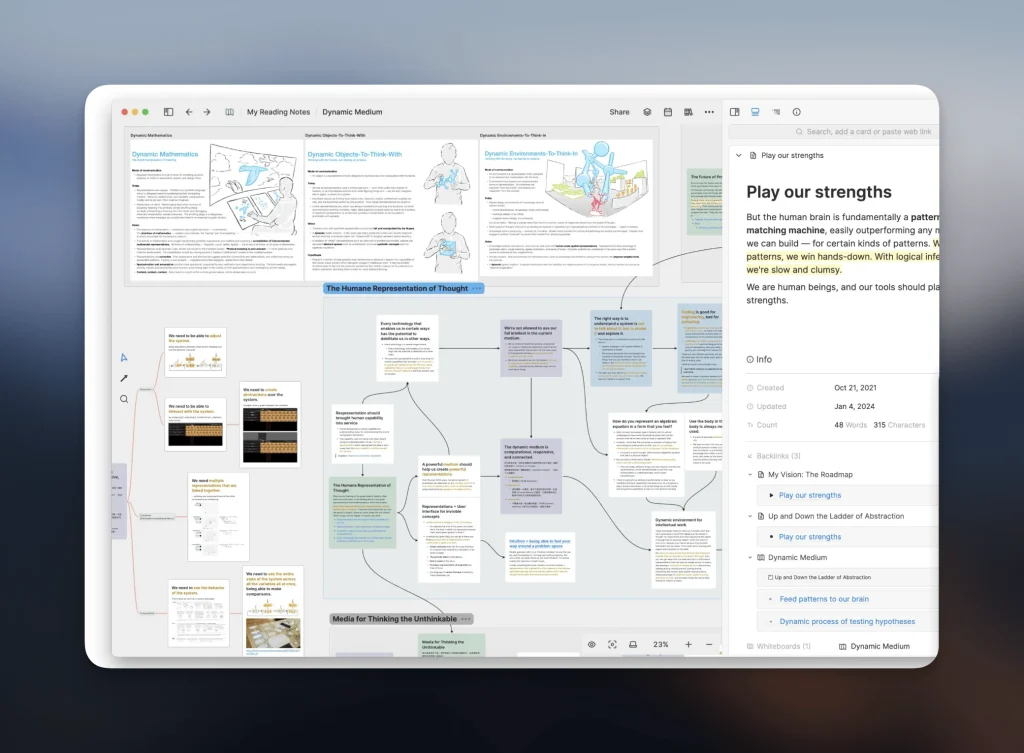
Bottom line up front: Heptabase is a visual thinking tool for people who learn by seeing connections. You break what you read and watch into cards, then arrange those cards on whiteboards — alongside mind maps, tables, and kanban boards — until a messy topic makes sense. At $11.99 a month, or $8.99 a month billed yearly, it is one of the cheaper serious knowledge tools, and there is no free plan, only a one-week trial — so the trial has to do the convincing.
Key takeaway: Heptabase’s unit is the card, not the page. If your notes fail you because everything is buried in long documents, the card-and-whiteboard model is a genuinely different answer. If you think in documents, it will feel like friction.
What does Heptabase do?
Heptabase is built for deep learning and research synthesis. You capture material from PDFs (with highlighting), YouTube videos (with transcripts), articles, audio, and your own journal entries, break it into atomic cards, tag the cards, and then work with them spatially on whiteboards. A literature review, a book’s argument, or a product strategy can live as a board of connected cards you can rearrange as your understanding changes.
The AI layer, Heptabase AI / AI insights, works over your own cards — helping you summarise, connect, and query material you have already captured rather than generating content from the open web. Boards can be published as sites, collaborators can be invited, and everything syncs in real time across web, desktop, and mobile, with offline access.
How much does Heptabase cost?
| Plan | Price | What you get |
|---|---|---|
| Monthly | $11.99/month | Unlimited notes, whiteboards and tags, unlimited file uploads, unlimited collaborator invites and published sites, real-time sync, PDF highlights, YouTube transcripts, AI insights |
| Yearly | $8.99/month ($107.88/year) | The same full feature set at the lower annual rate |
The pricing is refreshingly flat: one product, two billing periods, no feature maze. The catch is at the top of the funnel — there is no free tier, just a one-week free trial before billing starts. A week is short for a tool whose value compounds over months of captured material, so treat the trial as a workflow test, not a value test.
What are Heptabase’s strengths?
- Visual-first: whiteboards, mind maps, tables, and kanban boards built around cards, so structure is something you can see and rearrange.
- Built for source material: PDF highlighting and YouTube transcripts feed cards directly, which suits research and study.
- Unlimited almost everything on one simple price — notes, whiteboards, uploads, collaborators, and published sites.
- Real-time sync across web, desktop, and mobile, plus offline access for working away from a connection.
- AI insights over your own captured material, keeping the AI grounded in sources you chose.
What are Heptabase’s weaknesses?
- No free plan: a one-week trial is the only way in, and deep-knowledge tools rarely prove themselves in seven days.
- A model you must buy into: if you will not break material into cards, you pay $11.99 a month for a worse document editor.
- Capture takes effort: the value comes from disciplined highlighting and card-making; passive collectors get a prettier pile, not understanding.
- Not a team workspace first: collaboration exists, but this is a personal thinking tool at heart, not a Notion replacement for company docs.
Who is Heptabase for?
Researchers managing literature reviews, students mastering complex subjects, readers who synthesise books and articles for a living, and creators organising research for long projects. It suits one person thinking hard about one tangled topic at a time. It does not suit teams looking for a shared document hub, or anyone whose notes are mostly quick captures they never revisit.
Frequently asked questions
Is Heptabase free?
No. There is a one-week free trial, then $11.99 a month, or $8.99 a month billed yearly at $107.88. There is no free tier.
What is the difference between the monthly and yearly plans?
Only the price. Both include unlimited notes, whiteboards, tags and uploads, collaborator invites, published sites, sync, PDF highlights, YouTube transcripts, and AI insights.
Is Heptabase good for academic research?
Yes — it is one of its strongest use cases. PDF highlights become cards you can arrange on a board, which maps naturally onto literature reviews and thesis synthesis.
Does Heptabase work offline?
Yes, offline access is included, with real-time sync across web, desktop, and mobile when you are connected.
Verdict
Heptabase is a specialist tool that knows exactly who it is for. Visual thinkers doing deep learning or research synthesis will find $8.99 a month billed yearly easy to justify. Everyone else should spend the trial week honestly: if you are not making cards by day three, you are not going to — cancel and use a document tool.