
Quick verdict
TyBOT Review 2026: The Autonomous Rebar-Tying Robot for Bridge Decks
Updated November 27, 2026 – Tested Intelligence
Quick verdict: TyBOT, from Advanced Construction Robotics (ACR), is a self-navigating gantry robot that finds rebar intersections with cameras and ties them at 1,200+ ties an hour – no pre-programming, pre-mapping or BIM input required. Pricing is not public, and it only makes sense on big horizontal mats: ACR itself recommends projects starting at 25,000 square feet.
What it is
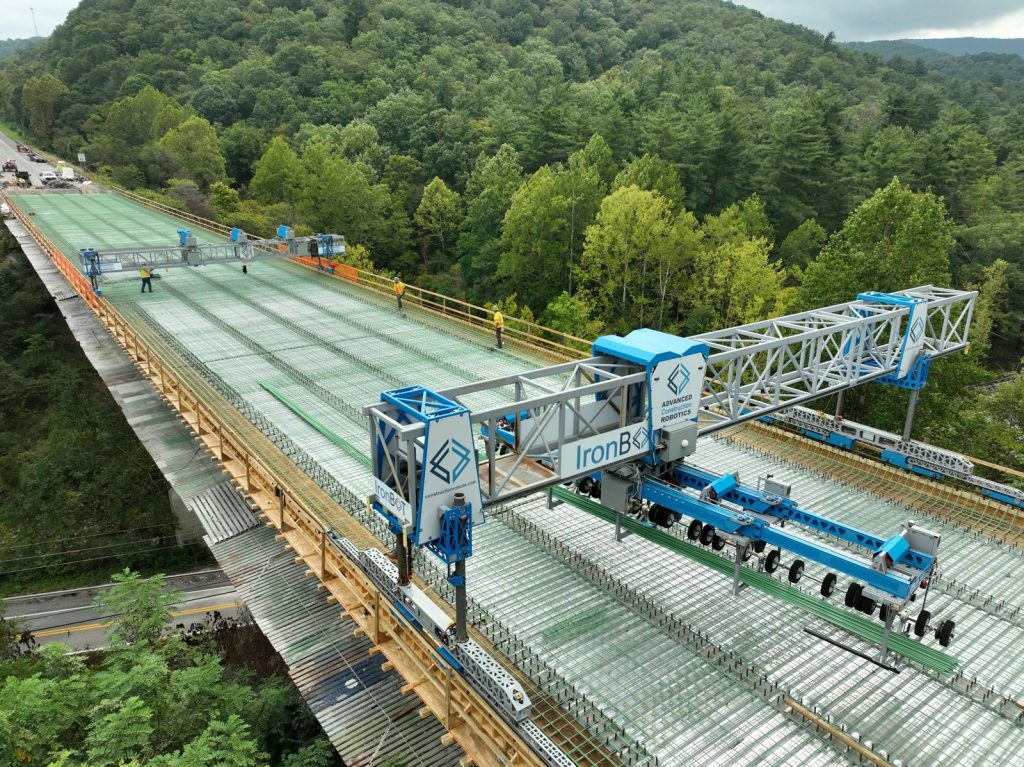
TyBOT is an autonomous rebar-tying robot for horizontal cast-in-place work – bridge decks, highways and precast – built by Pittsburgh-based Advanced Construction Robotics. The gantry travels on the edge form or screed rails already installed for concrete finishing, expanding from 10 to 117 feet wide. Its cameras identify intersections the way a rodbuster’s eyes do, the tram positions the tie module, and it ties – in 100%, 50% or 33% patterns – using 16.5 AWG plastic-coated or 16 AWG black annealed wire from a 15 lb spool good for roughly 3,000 ties. One Robot Supervisor monitors it and reloads wire; the supervisor does not steer it. ACR pairs it with IronBOT, which lifts and places rebar bundles up to 5,000 lb, and sells the pair as a full deck-rebar installation subcontract.
Key features
- Active tie rate of 1,200+ ties per hour – over 9,600 ties in a standard 8-hour shift (vendor figures)
- True autonomy: no pre-programming, pre-mapping or BIM input; it self-finds, self-locates and self-ties
- Expandable 10-117 ft gantry; handles up to #8 x #9 bar intersections and epoxy-coated, black, galvanized, stainless and fiberglass rebar
- Runs day or night, rain or shine, for up to 10 hours without refueling; operational within 2 hours of arriving on site
- Real-time productivity and usage data for planning, estimating and job costing
Pricing
Pricing is not public. ACR sells TyBOT three ways – purchase, a per-tie service engagement, and a per-pound subcontract for full deck rebar installation bundling IronBOT and TyBOT units, Robot Supervisors and a rodbuster crew. Trade coverage of the TyBOT 3.0 launch put purchase at $425,500 standard and $455,500 fully configured to 117 feet – treat those as trade-reported launch figures, not a current quote.
What the pricing page doesn’t make obvious: there is no pricing page, and the cheapest-looking route hides a threshold – ACR’s own FAQ recommends TyBOT only on projects starting at 25,000 sq ft, with benefits growing from there. Below that, mobilization eats the labor saving. The FAQ also notes that crew training (3-5 days of on-the-job basic operations) is included with the per-tie price, and that if your deck has neither edge form nor screed rails, a portable rail system is a separate purchase.
Who it’s for
Bridge, highway and heavy-civil contractors whose decks are large, repetitive and on the critical path – especially firms short on rodbusters. ACR’s published project data is the pitch: 669,142 ties on the I-30 Crossing in Little Rock with three TyBOTs running concurrently, and a Koppel Bridge deck where crew manhours fell 34% (vendor-reported figures).
Who should skip it
Vertical work, small slabs, parking decks under the 25,000 sq ft guidance, and custom or truss-shaped rebar layouts – TyBOT’s spec sheet covers horizontal cast-in-place only and excludes truss-shaped rebar. If your tying is a few days per job rather than weeks, a handheld automatic rebar tier is the right scale of answer.
Pros
- Removes the most injury-prone repetitive task in ironwork – bent-over tying tied to carpal tunnel, tendonitis and back injuries – from human backs
- No programming or model prep: it works off what it sees, so it drops into an existing deck workflow
- Published per-project tie counts and manhour data, not just marketing claims
Cons
- No public pricing on any route – every evaluation starts with a sales conversation
- Horizontal work only, with a real project-size floor; small and vertical rebar work is untouched
- Needs screed rails or edge form in place before it can travel, which can reorder the deck schedule – a friction point contractors themselves flag in trade coverage
- Operating envelope is finite: the spec sheet lists 32-104 F and bar grid spacing from 3 x 3 in to 12 x 12 in
FAQ
How fast is TyBOT compared with a rodbuster?
ACR rates it at 1,200+ ties per hour running uninterrupted. Trade coverage puts a skilled worker at roughly 150-250 ties per hour, so one TyBOT does the bulk tying of a small crew – while that crew moves to placing, singulation and detail work.
Does TyBOT replace the ironworker crew?
No. Crews still place the rebar – ACR says you want at least a shift’s worth laid ahead of it – and handle intersections and items the robot does not cover. It takes the bulk tying, not the whole installation.
Where is TyBOT available?
ACR says a full fleet is available across the contiguous US and Canada, and lists Certified Innovator subcontract work in FL, MD, NC, NY, OH, PA, SC, TN, TX, VA and WV. Confirm coverage for your state when you request pricing.
Bottom line
TyBOT is the rare construction robot with years of production decks behind it and the receipts – tie counts, hours and manhour savings – published per project. For a bridge contractor tying six-figure intersections a year, it is the benchmark autonomous option. For everyone else, the 25,000 sq ft floor says it plainly: critical-path equipment, not a crew gadget.