
Quick verdict
Miller Copilot Review 2026: Cobot Welding Cells Welders Teach by Hand
Updated November 27, 2026 – Tested Intelligence
Quick verdict: Miller’s Copilot family is the entry ramp to robotic welding for fabrication shops: a welder positions the torch by hand, IntelliSet sets the weld, and the cobot repeats it. The newest model, Copilot Builder with Blue iQ powered by Novarc’s NovAI, adds camera-based adaptive control that responds to gaps and fit-up in real time. Pricing is not public, and Blue iQ’s adaptive mode runs inside a narrow published envelope – one wire, one gas mix, listed positions only – plus a required Novarc subscription.
What it is
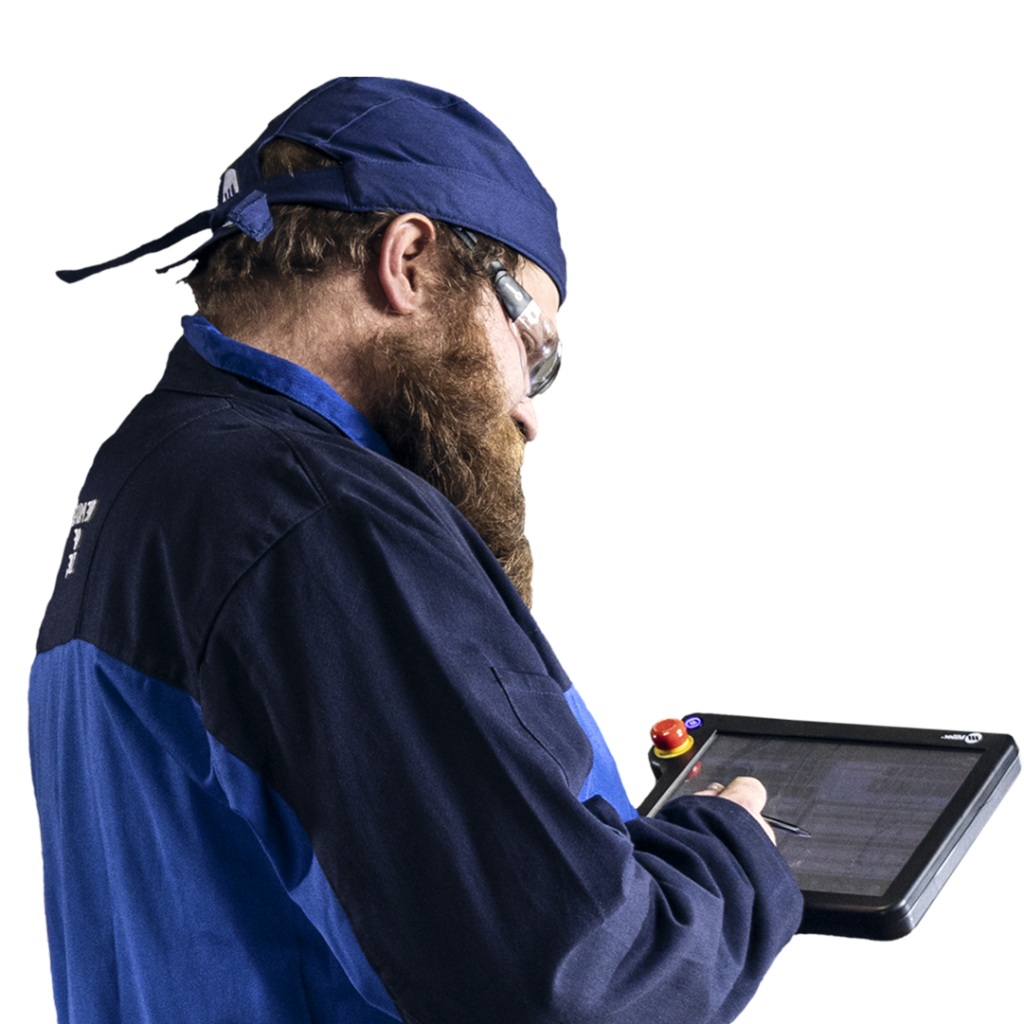
Copilot is Miller Electric’s collaborative robotic welding line. The base Copilot is a complete station: a 48 x 48 inch tooling table on casters and leveling feet (1,500 lb capacity on its feet, 750 lb on casters), a FANUC cobot arm, and an Auto Deltaweld 350 or 500 power source. Copilot Builder ships on a pallet with components that detach and rearrange around your own table or part, including a FANUC CRX-30 long-arm variant with up to 70 inches of reach. The flagship Builder with Blue iQ, launched at FABTECH 2026 with Novarc Technologies, mounts on a magnetic base, track, table or gantry and uses machine vision to adapt the weld as conditions change. Every model is welder-centric: no robot programming language, with online training and 24/7 phone support included.
Key features
- IntelliSet Weld Settings Assistant: enter material thickness and wire diameter and it configures the settings – standard on all systems
- AccuGuide Precision Joystick for fingertip torch positioning while teaching
- Touch sensing: the wire probes the part with voltage sensing and shifts the program to the part’s real location
- Through-arc seam tracking: the robot weaves across the joint and adjusts position from live amperage feedback
- Multipass programming with saved weld recipes for thick, complex joints
- Blue iQ adaptive control (flagship): seam tracking, fit-up adaptation for gaps, bevel variation and mismatch, and tack-weld adaptation, with weld data captured to Novarc’s NovHub platform
Pricing
Pricing is not public; every configuration is quoted through Miller Welding Automation or a distributor. The quote swings with the power source (Auto Deltaweld 350 vs 500), cooling, and which advanced features are switched on – touch sensing, multipass and seam tracking are optional on the base models. Get the configured price in writing, feature by feature.
What the pricing page doesn’t make obvious: there is no pricing page, and the flagship carries a second bill. Miller’s Blue iQ specification sheet requires an active Novarc subscription for the adaptive models, enhancements, updates, remote support and NovHub access – the adaptive intelligence is a subscription service, not a one-time purchase. The same sheet fences adaptive mode to Accu-Pulse with .045 in ER70S-6 wire and 90/10 argon/CO2, in T-joints at 1F/2F/3F, lap joints at 1F/2F and V-grooves at 1G/2G, on the Auto Deltaweld 500, water-cooled only. Outside that envelope you are back to a conventional taught cobot.
Who it’s for
Steel fabrication shops with high-mix, low-volume parts, quick changeovers and a welder shortage – especially shops already running Miller processes (Accu-Pulse, RMD) that want their own welders, not a robot programmer, running the cell. Blue iQ targets larger, heavier fabrications where fit-up varies enough to defeat a fixed taught path.
Who should skip it
Shops whose work is mostly aluminum or stainless in adaptive mode (the published Blue iQ envelope is carbon-steel wire only), overhead-position work, or one-off repair welding where teaching a program costs more time than welding by hand. High-volume, single-part production belongs in a dedicated industrial cell, not a cobot station.
Pros
- Welder-taught, not programmer-taught: Miller says operators are up and running within hours, and the Franklin Fueling Systems testimonial on its own page describes welding within minutes
- Five configurations from one table-based station to a reconfigurable long-arm Builder, so the cell can grow with the work
- Blue iQ attacks the real reason fab shops reject robots – variable fit-up – instead of pretending parts arrive perfect
Cons
- No public pricing for any model, and the feature matrix differs by variant – easy to quote the wrong configuration
- Blue iQ’s adaptive envelope is narrow (one wire, one gas, listed positions) and depends on a continuing Novarc subscription
- Base Copilot’s table caps parts at 48 x 48 inches and 750 lb on casters; bigger work forces the Builder line
- Blue iQ is brand new (FABTECH 2026 launch), so there is no long-term production track record yet
FAQ
Is Miller Copilot the same as Novarc’s own robots?
No. Novarc sells its own Spool Welding Robot for pipe; Blue iQ puts Novarc’s NovAI software and NovHub data platform inside Miller’s Copilot Builder hardware and Miller’s Auto Deltaweld power source. We cover Novarc’s own system separately in our Novarc Technologies review.
Can a welder with no robot experience run it?
That is the design brief: hand-guided teaching, the AccuGuide joystick for fine positioning, IntelliSet for settings, and included online training modules. Miller positions Copilot as its entry-level cell for welders new to robotic welding.
How much does Miller Copilot cost?
Pricing is not public. Budget for a configured quote covering the arm, power source and optional features – and, on Blue iQ, a recurring Novarc subscription on top of the hardware.
Bottom line
Copilot is the lowest-drama way for a Miller shop to start robotic welding: your welders teach it, IntelliSet handles settings, and touch sensing forgives imperfect placement. Blue iQ is the genuinely new idea – adaptive welding for variable fit-up – but buy it with eyes open: a narrow envelope and a subscription behind the intelligence.