
Quick verdict
SenseNC Review 2026: Physics-Based AI That Fixes Feeds and Speeds Before the First Cut
Updated November 4, 2026 – Tested Intelligence
Quick verdict: SenseNC, from UK machining specialist Productive Machines, is a physics-based AI plug-in for Siemens NX CAM and Mastercam that optimizes feed rates and spindle speeds inside the CAM program, before a part ever reaches the machine. It splits the job in two: Feeds adjusts feed rate along the toolpath as cutting loads change, and Finesse finds chatter-free spindle speeds from a 40-second tap test. Pricing for the main plug-ins is not public, and that opacity — plus the CAM seats you must already own — is the main reason to pilot it on one problem machine first.
What it is
Productive Machines is a spin-out from the University of Sheffield’s Advanced Manufacturing Research Centre (AMRC), built on more than two decades of machining-dynamics research. SenseNC is its flagship: autonomous toolpath optimization software that sits inside the CAM systems machinists already run — Siemens NX CAM and Mastercam — rather than asking the shop to adopt another disconnected platform, a design choice Siemens says came directly from what manufacturers asked for.
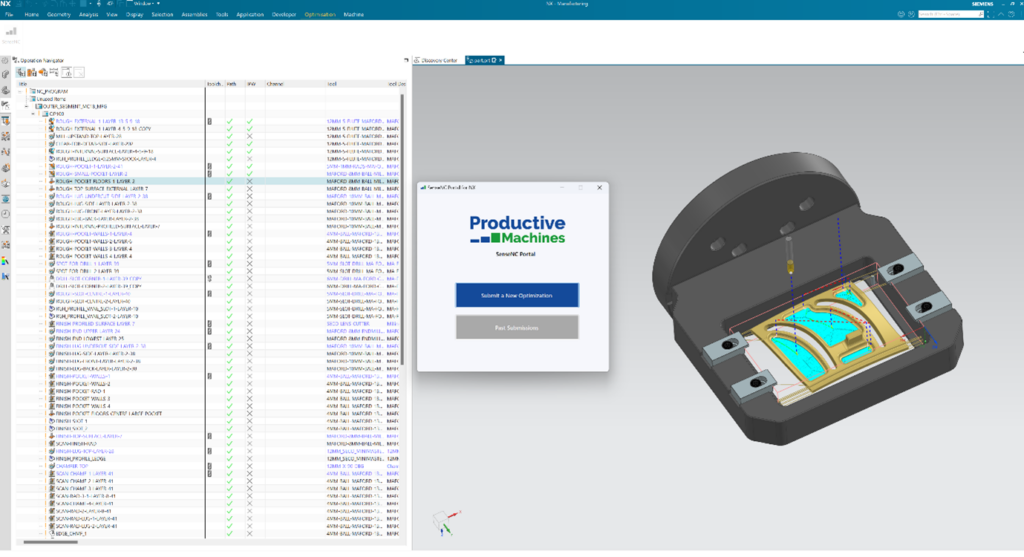
Instead of the usual loop — program, run, check the part, go back to CAM and tweak — SenseNC simulates the cutting physics in advance, modeling cutting loads, tool stress and the machine’s torque and power limits, then rewrites the cutting conditions operation by operation. Siemens’ November 2026 write-up describes the workflow plainly: program in NX CAM, optimize with SenseNC, review, post-process, and machine as usual.
Key features
- SenseNC Feeds: adjusts feed rate along the toolpath, speeding up where conditions allow and backing off when cutting loads rise
- SenseNC Finesse: uses the measured dynamic response of the tool and holder to pick spindle speeds less likely to produce chatter
- 40-second tap test: a quick impact measurement feeds Finesse’s stability analysis before machining starts
- Physics-based AI: optimization is driven by cutting-force and dynamics models tailored to the specific machine, not generic rules
- Lives inside NX CAM and Mastercam: no separate system to learn, and optimized operations follow the normal post-processing route
- On-premises deployment option: Siemens reports an aerospace deployment running inside NX CAM on site
Pricing
Pricing is not public. Productive Machines publishes no rate card for the SenseNC Feeds or Finesse plug-ins; they are sold through Siemens’ Xcelerator Marketplace and direct engagement, so the quote depends on your CAM seats and machines.
What the pricing page doesn’t make obvious: one SenseNC product does carry a public price. The vendor’s TapStarter launch bundle — SenseNC Tap standalone tap-test software plus the tap-testing hardware kit — is listed at £9,750, and it includes one year of the Essential Optimization web apps and tap-test training free. That is the cheapest published way into the SenseNC ecosystem, and it tells you the shape of the real conversation: this is capital-equipment money, not a $49-a-month app subscription.
Who it’s for
CNC machinists and CAM programmers in milling shops where chatter, tool breakage and prove-out iterations eat machine hours — aerospace, medical and other tight-tolerance work especially. Siemens reports one aerospace manufacturer cut a part’s cycle from 4 hours 51 minutes to 3 hours 57 minutes (about 19%) and saved more than 1,000 hours of machine capacity in six months across two production parts; treat those as vendor-reported results, but they show the scale of shop this is aimed at. If your bottleneck is programming time instead, CloudNC CAM Assist, reviewed here previously, attacks a different problem.
Who should skip it
Shops that do not run NX CAM or Mastercam get nothing today — SenseNC is a plug-in, not standalone software, and further CAM plug-ins have only been announced as coming. Turning-only shops should also pass: the published optimization story is milling. And a small job shop whose parts prove out in one quick trial will struggle to justify an unpriced enterprise sale plus tap-test hardware against simply running the trial.
Pros
- Attacks chatter and tool breakage in CAM, where fixing them costs nothing in machine time, material or cutters
- Feed and spindle speed are optimized together, which is how cutting problems actually interact
- Works inside NX CAM and Mastercam instead of forcing a platform switch
- AMRC research pedigree and published case work, including the NMIS and AML Sheffield studies on the vendor’s site
- Finesse is grounded in a measured tap test of your own tool and holder, not a library guess
Cons
- No public pricing for the main Feeds and Finesse plug-ins — every evaluation starts with a sales call
- Requires an existing NX CAM or Mastercam seat; it optimizes programs, it does not create them
- Finesse needs tap-test hardware and a measured response per tool-and-holder setup, an extra step crews must actually do
- Savings figures (roughly 20% cycle time, about 11% tooling cost) are vendor- and partner-reported, not independently audited
- Milling-focused; lathe and mill-turn shops are largely outside the current pitch
FAQ
What does SenseNC’s AI actually do?
It applies physics-based models of cutting forces and machine dynamics to the operations in your CAM program. Feeds varies the feed rate along the toolpath as load changes; Finesse picks stable spindle speeds from tap-test data. The programmer reviews the optimized operation, post-processes it, and machines as normal.
How much does SenseNC cost?
Pricing is not public for the Feeds and Finesse plug-ins. The one published price in the family is the TapStarter bundle at £9,750, which pairs SenseNC Tap standalone software with the tap-test hardware kit and includes a year of Essential Optimization and training.
Does SenseNC work with my CAM software?
Today it integrates with Siemens NX CAM and Mastercam. SenseNC Feeds is sold through the Siemens Xcelerator Marketplace for NX CAM users. Plug-ins for two more CAM platforms have been announced by the vendor but not yet named with dates.
Bottom line
SenseNC earns a pilot in milling shops where the same parts keep coming back from the machine with chatter marks, snapped tools or padded cycle times — the problems it was literally built from AMRC research to predict. Start it on the one machine and part family that wastes the most prove-out hours, price the TapStarter route alongside the plug-ins, and expand only if your own cycle-time numbers move the way the case studies claim.