
Quick verdict
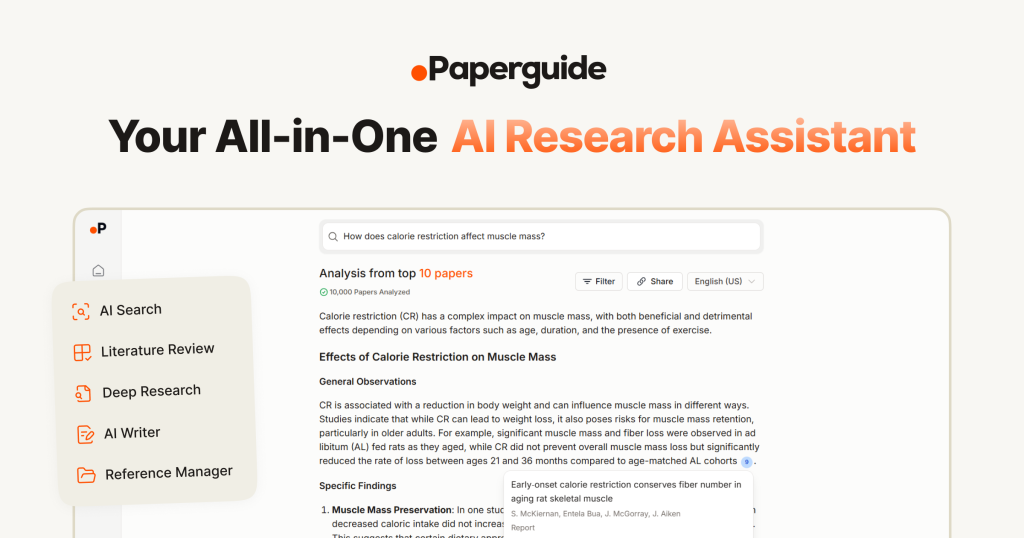
Short answer: Paperguide is an AI research workspace that takes you from searching the literature to a cited draft inside one tool — AI search, Chat with PDF, literature reviews, data extraction, a reference manager and an AI writer that drafts from your own library. The free plan is genuinely usable, and Plus at $12 per seat/month billed annually is priced for individual researchers, not just institutions. The catch: it is a younger, narrower platform than the big reference managers, and its systematic-review machinery is still maturing.
What does Paperguide actually do?
Paperguide is built for scientific research workflows, and it organises everything around your paper library. Its AI Search runs across more than 200 million peer-reviewed papers drawn from sources including PubMed, arXiv, OpenAlex and Semantic Scholar. From the results you can chat with individual PDFs, pull structured data from many papers at once, generate literature review and deep research reports, and then draft in an AI Writer that cites papers from your library in more than 1,000 citation styles.
The reference manager is a real part of the product, not an afterthought: you can import from Zotero and Mendeley, save papers via a browser extension, and collaborate on shared libraries. For teams doing formal evidence synthesis, higher tiers add systematic reviews with screening at scale and, on the Evidence Teams plan, PRISMA-grade dual reviewer screening. If you have used a narrower extraction tool before, our Elicit review covers the closest specialist alternative, and our Consensus review covers the quick-answer end of the same spectrum.
How much does Paperguide cost?
Prices checked October 28, 2026, from Paperguide’s official pricing page. Paid prices below are per seat/month billed annually; a 30% academic discount applies with a valid university email.
| Plan | Price | What you get |
|---|---|---|
| Free | $0 | 2,000 AI credits/month, limited Reference Manager and AI Searches, Chat with PDF, Literature Review and Deep Research reports, extract tables up to 5 columns / 10 papers, plagiarism checker 4,000 words/month |
| Plus | $12/seat/mo, billed annually | 12,500 credits/month, systematic reviews up to 1,000 papers, unlimited Reference Manager and AI Searches, extract tables up to 50 columns / 100 papers, plagiarism checker 20,000 words/month |
| Pro | $29/seat/mo, billed annually | 50,000 credits/month, systematic reviews up to 5,000 papers, plagiarism checker 100,000 words/month |
| Evidence Teams | $89/seat/mo, billed annually | 150,000 credits/month, PRISMA-grade dual reviewer screening, systematic reviews up to 5,000 papers, dedicated support |
| Enterprise | Custom | Systematic reviews up to 20,000 papers, dual reviewer screening, custom limits |
The free plan deserves credit: it includes the core reading and reporting tools rather than locking everything behind a trial. What it does not include is systematic review capacity — that starts at Plus.
What are Paperguide’s strengths?
- The whole workflow in one place. Search, screening, extraction, reference management and cited drafting share one library, so a paper you save is the same paper the writer cites.
- Extraction built for reviews. Custom-column extract tables scale from 10 papers on Free to 100 papers on paid plans — the tedious core of any literature review.
- A literature review flow with stated limits. Paperguide says its Literature Review AI screens up to 200 papers and synthesises the top 50, which is honest scoping rather than an unlimited promise.
- A free plan you can actually evaluate with. 2,000 AI credits a month, Chat with PDF and both report types are enough to test it on a real topic before paying.
- Academic pricing. Plus at $12 billed annually, plus a 30% academic discount, undercuts most research platforms aimed at institutions.
What are Paperguide’s weaknesses?
- Systematic reviews are still maturing. Paperguide’s own comparison pages describe the systematic review module as being in beta, and full PRISMA-grade dual-review screening is reserved for Evidence Teams and Enterprise.
- Screening caps on single runs. The 200-paper screening cap per Literature Review means very large reviews need to be split into themed batches.
- A smaller citation-style library. At 1,000+ styles it covers common journal requirements, but it is smaller than long-established reference managers — a point Paperguide itself concedes against Mendeley.
- Younger brand, narrower focus. It does one job — scientific literature — and will not replace a general chatbot or a quick answer engine for everyday questions. For citation-context checking specifically, a dedicated tool like the one in our Scite.ai review goes deeper.
- Annual-first pricing. The headline prices assume annual billing, so month-to-month budgeting will cost more.
Who is Paperguide for?
Graduate students and postdocs scoping a thesis literature review, researchers who repeatedly extract the same data points from many papers, and small evidence teams that need systematic-review screening without enterprise software budgets. It is a poor fit if you only want fast answers to one-off research questions, or if your institution already mandates a specific reference manager and screening platform.
Frequently asked questions
Is Paperguide free?
Yes. The Free plan costs $0 and includes 2,000 AI credits a month, a limited Reference Manager, Chat with PDF, Literature Review and Deep Research reports, and a plagiarism checker for 4,000 words a month. Systematic reviews require a paid plan.
How much does Paperguide cost?
Plus is $12 per seat/month billed annually, Pro is $29, and Evidence Teams is $89. A 30% academic discount applies with a valid university email.
Can Paperguide do a systematic review?
Paid plans add systematic reviews — up to 1,000 papers on Plus and up to 5,000 on Pro and Evidence Teams. PRISMA-grade dual reviewer screening is limited to Evidence Teams and Enterprise, and Paperguide describes the module as in beta.
Does Paperguide replace Zotero or Mendeley?
It includes its own reference manager and imports from both Zotero and Mendeley, so for many researchers it can. If you depend on a very large citation-style library or an institution-managed setup, check your required styles before switching.
Our verdict
Paperguide earns its place as the broadest research workspace in its class: it is the rare tool that follows a paper from discovery through screening and extraction into a cited draft. The free plan and the $12 Plus tier make it easy to test honestly, and its stated caps are refreshingly specific. Adopt it for literature-heavy work, keep verifying citations against the originals, and step up to Pro or Evidence Teams only when your review sizes — not your curiosity — demand it.
Research-based review; prices and features checked October 28, 2026 from Paperguide’s official site. We do not claim hands-on testing.