
Quick verdict
Owlet Dream Sock Review 2026: FDA-Cleared Pulse Oximetry for Your Baby
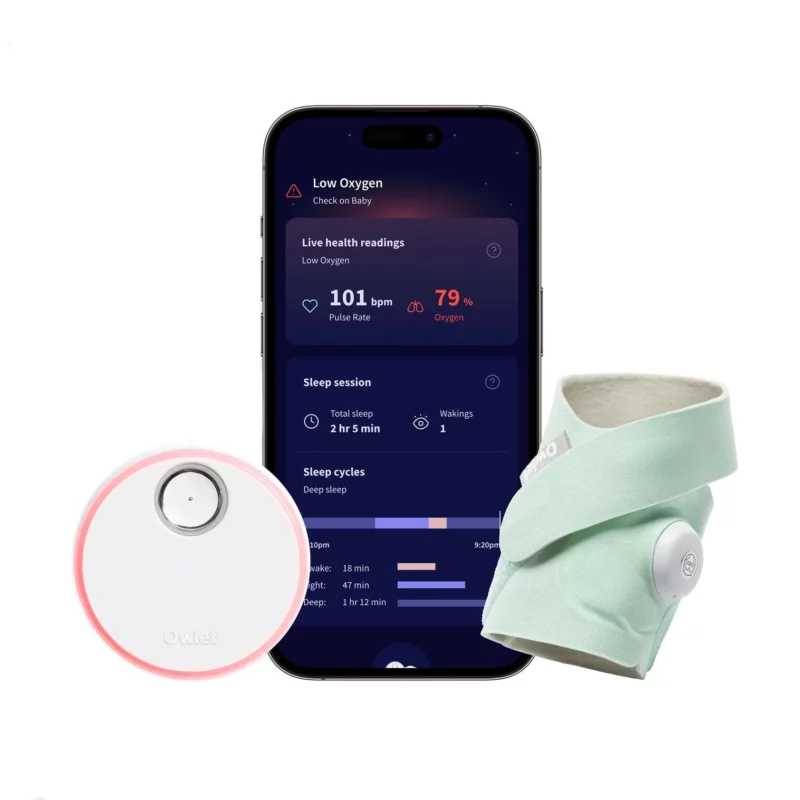
The Owlet Dream Sock wraps hospital-grade pulse oximetry around your baby’s foot and alerts you if pulse rate or oxygen levels leave preset ranges. It earned FDA De Novo clearance in November 2023 — the first and only smart baby monitor to do so — making it the only baby wearable backed by formal regulatory review of its accuracy. This is a research-based review: no hands-on testing, just specs, pricing, and published reviews.
Most baby wearables live in a regulatory gray zone, sold as “wellness” products the FDA has never evaluated. Owlet took the harder path: clinical testing in home and hospital settings, demonstrated accuracy within +/- 3% of gold-standard arterial blood gas measurements — across all skin tones and under motion and non-motion conditions — and formal authorization as a Class II medical device for over-the-counter use.
Key features
FDA-cleared pulse oximetry. The Dream Sock tracks live pulse rate and oxygen saturation (SpO2) using the same pulse oximetry technology hospitals rely on. De Novo clearance means the FDA reviewed and authorized it as a Class II medical device for over-the-counter use, after Owlet submitted clinical data proving safety and accuracy in home and hospital environments.
Real-time health notifications. If your baby’s pulse rate or oxygen level moves outside preset ranges, the included Base Station lights up and sounds an alert while your phone gets an in-app notification. Most unexpected alerts turn out to be fit issues — the sock needs repositioning or the battery is low — so correct placement matters.
Sleep and health trends. The Owlet Dream App shows live readings plus historical pulse rate, oxygen, wakings, and sleep trends, and predicts when your baby is likely to get sleepy — useful for scheduling. An optional Owlet360 upgrade ($99.99/year) adds deeper insights, but the base app is free with no subscription required.
Works through outages. The sock uses Wi-Fi and Bluetooth and keeps sending alerts via Bluetooth plus backup battery during internet or power outages — a thoughtful detail for a device whose whole job is overnight monitoring.
Sizes and comfort. The $299.99 box includes the sensor, the Base Station, and 4 fabric socks (sizes 1 and 2, left and right) for ages 1–18 months. It’s made with biocompatible infant-wear materials and is HSA/FSA eligible.
Who it’s for
The Dream Sock is for parents of healthy infants who want data-driven peace of mind at night. If you find yourself getting up to check on the baby “just in case,” real-time pulse and oxygen readings with automatic alerts can meaningfully reduce that anxiety. The sleep predictions also help parents fine-tune nap schedules and avoid overtired fussiness. It’s also the obvious pick for parents who care about regulatory credibility: unlike most competitors, this one has actually been evaluated.
What to watch out for
Healthy infants only. The FDA clearance covers use with healthy infants ages 1–18 months (6–30 lbs). It is not medical monitoring for preemies, babies with diagnosed conditions, or a substitute for medical care — and Owlet is clear about that. Talk to your pediatrician if your baby has a health condition.
Alerts can rattle you. Review coverage notes that some parents find the alerts anxiety-inducing rather than calming, and fit issues cause most “false” notifications — you have to follow the sock placement guide in the app for accuracy. If you think data will make you calmer, great; if you think a 2 AM low-oxygen ping will send you spiraling, a video monitor may serve you better.
The accuracy caveat. +/- 3% of arterial blood gas is excellent for a consumer wearable, but pulse oximetry isn’t perfect even in hospitals, and the sock’s readings depend on correct fit. It tracks pulse and oxygen, not breathing motion — a different measurement than Nanit’s camera-based breathing tracking.
Pros and cons
Pros
- First and only FDA-cleared (De Novo, Class II) smart baby monitor
- Validated accuracy within +/- 3% of arterial blood gas across all skin tones
- Live pulse rate and oxygen with instant Base Station + app alerts
- No subscription required for core features; free Dream App
- Alerts keep working via Bluetooth and backup battery during outages
- HSA/FSA eligible, 30-night satisfaction guarantee, 1-year warranty
Cons
- For healthy infants 1–18 months only — not medical monitoring for sick babies
- Fit issues cause most unexpected notifications; placement matters
- Alerts can increase anxiety for some parents rather than reduce it
- Measures pulse and oxygen, not breathing motion
- US version only; 2.4 GHz Wi-Fi required for setup
Frequently asked questions
What does FDA clearance mean for the Owlet Dream Sock?
It means the device was reviewed and authorized by the FDA as a Class II medical device for over-the-counter use, based on clinical data proving safety and accuracy in home and hospital settings. It’s the first and only baby monitor to achieve this clearance.
How accurate is the Owlet Dream Sock?
Owlet says clinical testing showed it accurate within +/- 3% of gold-standard arterial blood gas measurements for oxygen saturation, across all skin tones (Fitzpatrick types I–VI) and under motion and non-motion conditions.
Does the Owlet Dream Sock require a subscription?
No. Core live readings, alerts, and sleep trends are free in the Dream App. An optional Owlet360 plan ($99.99/year) adds advanced insights.
How much does the Owlet Dream Sock cost?
$299.99 direct from Owlet, including the pulse oximetry sensor, Base Station, four socks, free shipping, a 30-night satisfaction guarantee, and a 1-year warranty. It’s HSA/FSA eligible.
Price and availability
The Owlet Dream Sock is $299.99 direct from Owlet and widely available on Amazon.
Check price on Amazon
As an Amazon Associate we earn from qualifying purchases.