
Quick verdict
Mira Fertility Tracker Review 2026: Lab-Grade Hormones at Home
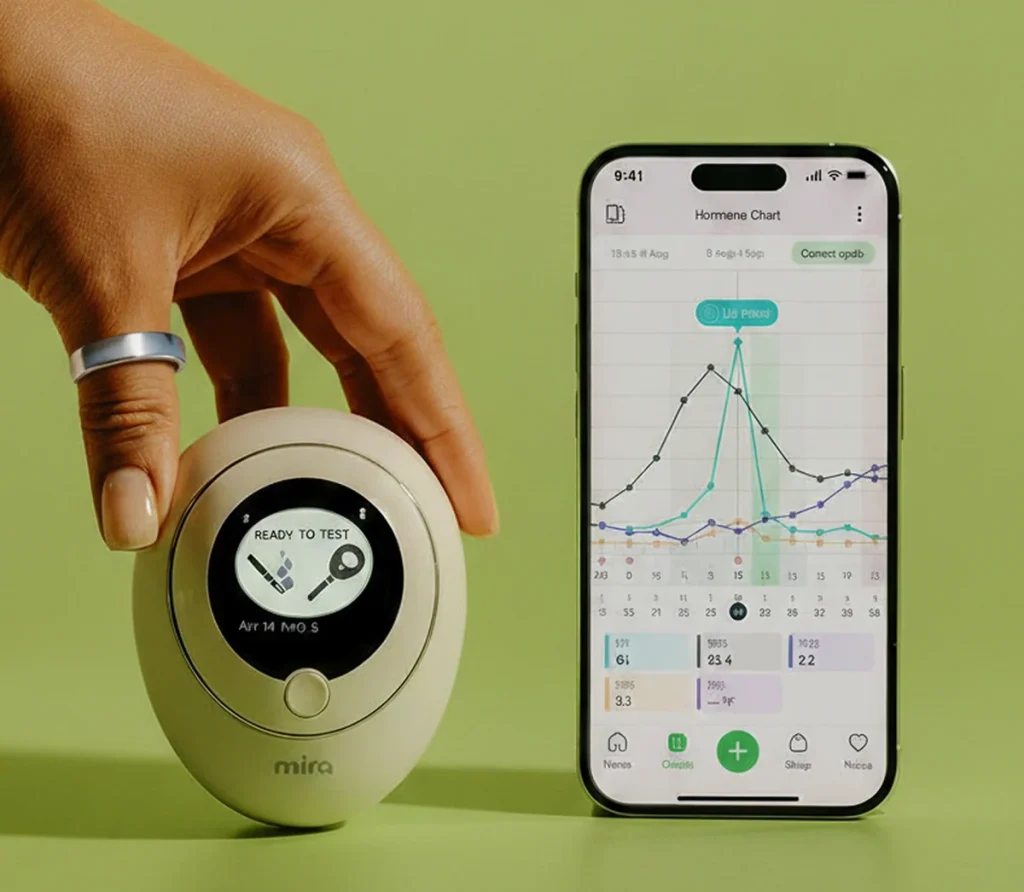
The Mira Fertility Tracker is an at-home hormone monitor that measures actual hormone concentrations in urine with lab-style fluorescent technology — giving numeric LH, estrogen, PdG, and FSH readings instead of simple yes/no strips. It is the most data-driven way to pinpoint ovulation outside a clinic. The catch: the device is just the entry ticket, because single-use wands become a real monthly cost.
Mira’s promise is simple: stop guessing with faint test lines. Instead of camera-scanned strips, the Mira analyzer uses fluorescent immunoassay technology — the same class of method labs use — to detect subtle hormone shifts and report real numeric concentrations. The companion app then layers AI-driven cycle predictions on top, trained on millions of hormone data points. Based on specs, pricing, and published reviews, here is what matters.
Key features of the Mira Fertility Tracker
Real numeric hormone data. Mira tracks up to four hormones depending on the wand type: LH (ovulation surge), E3G (estrogen metabolite), PdG (progesterone metabolite, confirming ovulation), and FSH. Results appear as actual concentrations, not a line to squint at — a meaningful upgrade over classic ovulation strips.
Fluorescent, not camera-based. Unlike trackers that photograph test strips, Mira’s analyzer uses a calibrated optical reader with embedded quality control. The company claims up to 99.5% accuracy in hormone detection (based on an internal side-by-side lab study) and higher sensitivity at low hormone levels — relevant for PCOS or irregular cycles.
AI predictions that learn. The Mira app’s algorithm is trained on millions of hormone data points and builds your hormonal fingerprint over time, predicting your 6-day fertile window and ovulation day with growing accuracy. It tells you when to test for optimal tracking, charting everything automatically.
Clinic-adjacent credibility. Mira is FDA-registered and ISO 13485 certified, FSA/HSA eligible, and — per the company — chosen by 3,000+ healthcare professionals and validated by 50+ universities and clinics. The brand also reports that 84% of users conceive within six cycles.
Who the Mira Fertility Tracker is for
Anyone trying to conceive who wants lab-quality insight at home, especially with irregular cycles or PCOS, where standard strips and calendar apps notoriously underperform. Seeing actual hormone curves validates what you feel each cycle and replaces guesswork with data.
It also suits people who want to understand their cycle beyond conception: tracking estrogen and progesterone patterns gives a window into hormonal health that a simple period tracker cannot. The three kit tiers — Basic ($139, LH + E3G), Max ($185, adds PdG), Ultra4 ($249, adds FSH) — let you match spend to need.
What to watch out for
Ongoing wand costs. This is the real cost of Mira. The starter kit includes 10 wands, which barely covers one cycle — and the app can ask for twice-daily testing around ovulation. Plan on buying extra wands regularly (a 20-pack of Max wands runs about $89). Over a few cycles, wands can cost more than the device.
21-minute waits. Each test takes about 21 minutes from wand insertion to result. That is fine with morning-coffee planning but annoying if you are rushing.
Expectation management. Mira is not a diagnostic or contraceptive device, and company claims (99.5% accuracy, “7x more accurate”) come from internal studies. It is powerful data, not a guarantee — and it works best alongside your doctor’s guidance, not instead of it.
Mira Fertility Tracker pros and cons
- Pro: Numeric hormone results — no squinting at faint lines.
- Pro: Fluorescent technology with lab-grade sensitivity.
- Pro: AI predictions improve with each cycle; handles irregular cycles and PCOS.
- Pro: Tracks up to 4 hormones (LH, E3G, PdG, FSH) on the Ultra4.
- Pro: FDA-registered, FSA/HSA eligible, free app with 24/7 support.
- Con: Wands are a real recurring cost — 10 included wands barely cover a cycle.
- Con: Each test takes ~21 minutes to produce a result.
- Con: Headline accuracy claims are based on the company’s own studies.
- Con: Not a medical diagnostic or contraceptive device.
Mira Fertility Tracker FAQs
How does the Mira Fertility Tracker work?
Dip a single-use wand in urine, insert it into the analyzer, and wait about 21 minutes. The device reads hormone concentrations using fluorescent technology, then sends numeric results to the free Mira app via Bluetooth, which charts them and predicts your fertile window.
Which hormones does Mira track?
Depending on the kit: LH (ovulation surge), E3G (estrogen), PdG (progesterone, confirms ovulation), and FSH on the Ultra4 kit. The Basic Kit covers LH + E3G; Max adds PdG; Ultra4 adds FSH.
Is Mira better than ovulation test strips?
For data quality, yes: strips give yes/no lines, while Mira gives actual hormone concentrations with higher sensitivity at low levels. The tradeoff is cost — strips are pennies, Mira wands are dollars per test.
Can Mira help with PCOS or irregular cycles?
That is one of its strengths. Its fluorescent reader detects subtle hormone shifts and wide ranges that standard strips miss, and the app’s AI adapts predictions to your personal patterns rather than assuming a textbook 28-day cycle.
How much do replacement wands cost?
A 20-pack of Max wands costs around $89, and most users will need regular refills — the app may recommend twice-daily testing near ovulation. Budget for wands as a monthly expense, not a one-off.
Price and availability
As an Amazon Associate we earn from qualifying purchases.