
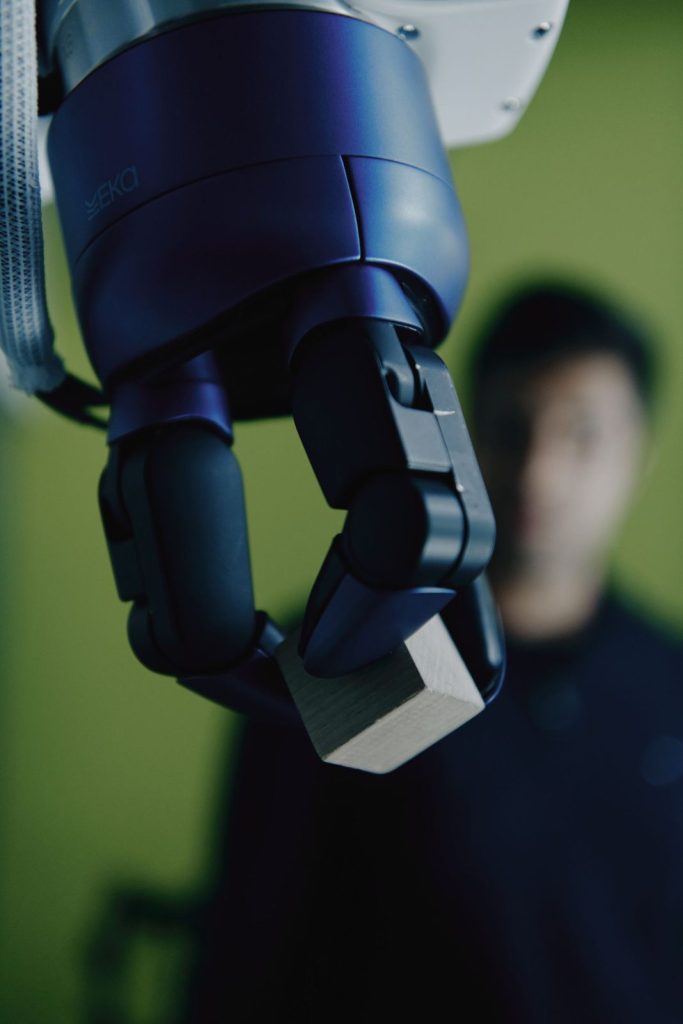
Eka Robotics has closed a $150 million Series A at a $1.45 billion post-money valuation for a robot model that grabs by feel, not just by sight. Why it matters: picking things up reliably is one of robotics’ oldest unsolved problems, and Eka’s investors are betting force, not more video, is the missing sense.
October 20, 2026
What happened
TechCrunch reported on Tuesday, October 20, that Eka Robotics just closed a $150 million Series A led by a16z and F-Prime, valuing the startup at $1.45 billion post-money. Eka was founded by MIT professor Pulkit Agrawal and former Google DeepMind researcher Tuomas Haarnoja, who first met as graduate students at UC Berkeley.
A vision-force-action model
Most robot brains today are vision-language-action models: they look, read an instruction and act. Eka built a vision-force-action model instead, paired with a force-sensitive gripper. Vision tells the robot roughly where an object is; force sensors guide the final grab, so it can feel a part slipping or a connector catching and adjust.
TechCrunch reported Eka says its robot can pick up about 1,500 objects weighing up to 1 kg in an hour, compared with about 600 for a human, and reliably picks up objects more than 95% of the time. Its gripper costs less than $1,000 and is rated for 5 million duty cycles, with a goal of reaching the 20 million cycle bar set by standard industrial arms.
Rather than training mainly on human demonstrations, Eka uses a physics simulator to create a reinforcement-learning environment at scale, generating thousands of hours of robot experience in minutes, according to TechCrunch.
Why it matters
Outside roboticists who saw Eka in action described a wow factor to TechCrunch, including adapting to many different objects without retraining. That generality is the prize: a robot that can pick, arrange, place and handle wires without being rebuilt for each task. The honest caveat is in TechCrunch’s own reporting — Eka is in secretive pilots with industrial customers, and the leap from lab to a production line that must run without breaking for a year is still unproven. If it makes that leap, a $1.45 billion valuation for a Series A will look less surprising.
Frequently asked questions
How much did Eka Robotics raise?
$150 million in a Series A led by a16z and F-Prime, at a $1.45 billion post-money valuation.
What is a vision-force-action model?
A robot model that combines what a robot sees with what it feels through force sensors, then decides how to move — instead of relying on vision and language alone.
Who founded Eka Robotics?
MIT professor Pulkit Agrawal and former Google DeepMind researcher Tuomas Haarnoja.
What can Eka’s robot do today?
Eka says it can pick up about 1,500 objects of up to 1 kg per hour with over 95% reliability, and it is in pilots for pick-and-place and wire manipulation.
Sources: TechCrunch, a16z