
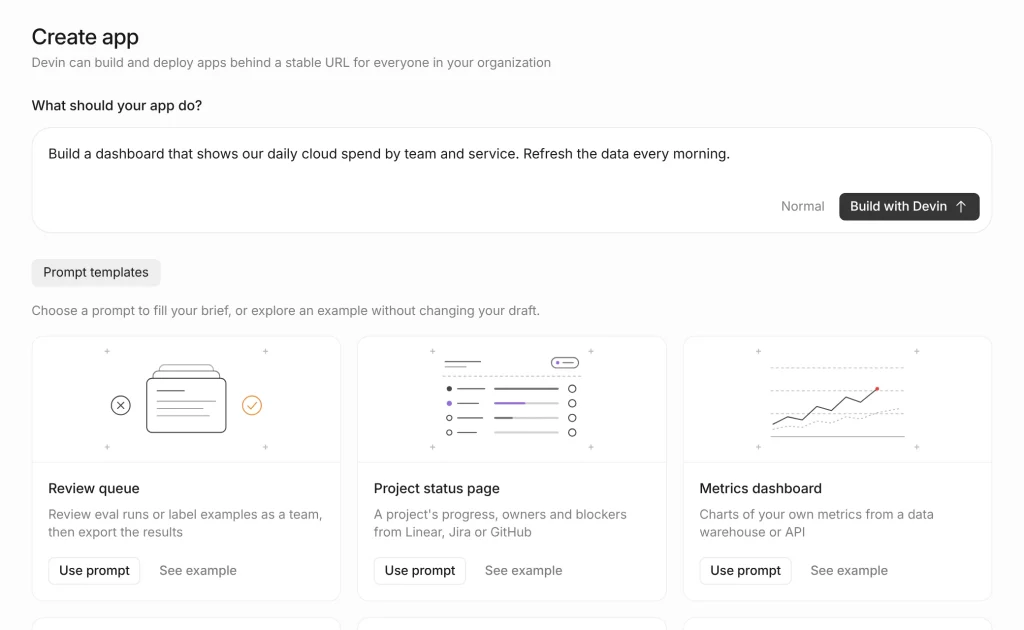
Cognition’s Devin no longer stops at writing code and opening a pull request — it can now build a small web app for your team and host it, too. Why it matters: the long tail of internal tools that never quite justify a hosting setup, a deploy pipeline, and a maintenance owner can now be described in a sentence and opened from a link.
November 14, 2026
What happened
Cognition launched Devin Apps on November 13. Devin Apps are live, private web applications hosted directly on Devin’s cloud computer. You describe the tool your team needs, Devin builds it, and your team opens it from a stable URL. Because the apps run on Devin’s own machine, they have access to your existing MCP servers, integrations, and codebase, and you can build with your own internal tech stack and components or start from a built-in template — the launch templates include a metrics dashboard, a project status page, and a review queue. You can start from the Apps page in the sidebar, ask for an app inside any session, or take a browser preview Devin has already shown you and ask it to publish that preview as an app.
How sharing and updates work
Every app has a stable URL, but the apps are never public: everyone who opens one has to sign in to Devin. Creators can limit an app to named people, open it to their organization, or open it to the whole enterprise, and organization admins can pin an app for everyone. Updates work the way Devin work usually does — open the app, click “Edit in session,” and tell Devin what to change. Each update becomes a new version listed under Deployments, the URL does not change, and if a new version fails to start, the previous version keeps serving. An automation can also keep an app current, pulling fresh data on a schedule or redeploying it each time a branch changes.
How the apps run — and what they are not for
Devin Apps are built on memory snapshots, which let Devin’s machine hibernate between tasks. The machine goes to sleep when nobody is using the app and wakes when someone opens it; the first load after a sleep can take a few seconds, and billing is based on how long the machine is awake. Under the hood, Devin can use any stack that serves HTTP on a port, with a database such as SQLite or Postgres on the same machine, and an app can also call the Devin API. Cognition is plain about the limit: an app runs on one machine, so this is a good fit for internal tools and dashboards, not for high-traffic production services. The company did not announce separate pricing for Apps in its launch post.
Why it matters
Every engineering team has a backlog of small internal tools — an admin panel, an approval queue, a dashboard that replaces a shared spreadsheet — that stall because nobody wants to own the hosting and upkeep. Devin Apps remove exactly that friction: no third-party hosting to configure, no public exposure to worry about, and no bill ticking while the tool sits idle. The honest caveats are in Cognition’s own post: single-machine hosting caps how far an app can scale, and the wake-from-sleep delay is the price of the sleep-based billing. For the internal-tool use case it is aimed at, though, “describe it, share the link” is a genuinely new rung on the ladder from coding agent to software team member.
Frequently asked questions
What are Devin Apps?
Private web applications that Devin builds and hosts on its own cloud computer. You describe the tool, Devin builds it, and your team opens it from a stable URL after signing in to Devin.
Are Devin Apps public?
No. Apps are never public. Access can be limited to specific people, opened to your organization, or opened to your whole enterprise, and every visitor must sign in to Devin.
What does Devin Apps cost?
Cognition’s launch post does not announce separate Apps pricing. Billing for an app is based on how long Devin’s machine is awake — the machine sleeps when nobody is using the app.
What are Devin Apps good for?
Internal tools such as admin panels, request forms and approval queues, dashboards Devin refreshes on a schedule, and beta or staging versions of your product that teammates can open from a link. Cognition says they are not meant for high-traffic production services.
Sources: Cognition (Devin blog, “Introducing Devin Apps,” November 13, 2026), Devin documentation