
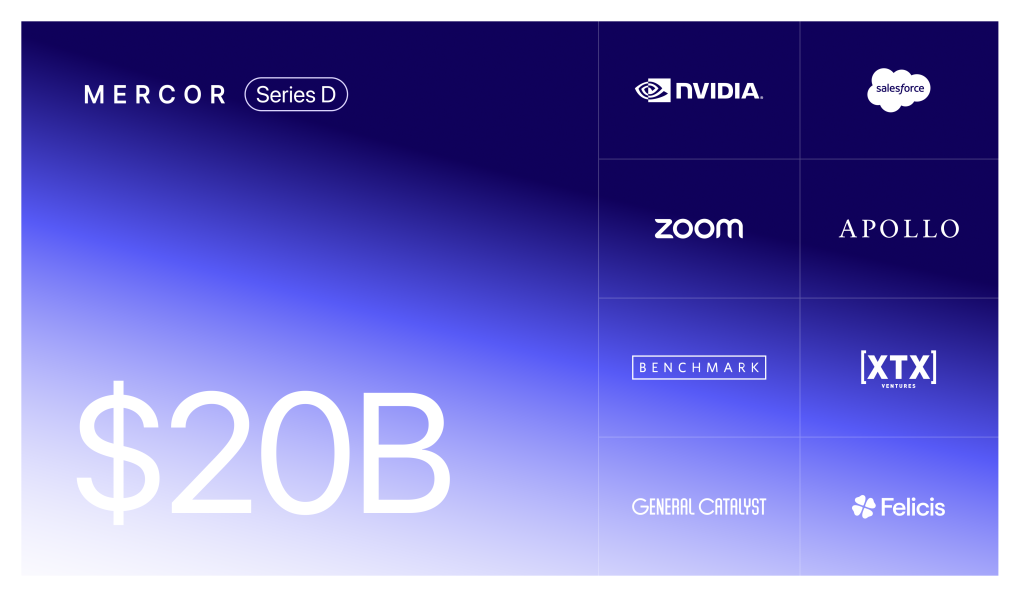
Mercor has raised a $750 million Series D at a $20 billion valuation, doubling what the AI training-data company was worth a year ago. Why it matters: the money is aimed at a new customer — not the AI labs Mercor built its business on, but every large company now trying to find out whether AI agents can actually do its work.
November 10, 2026 — Mercor announced the round on Tuesday, November 10. The company did not name a lead investor. The round included an employee tender offer alongside the new capital, and Mercor has not said how the $750 million splits between the two.
Who put money in
The investor list mixes venture firms and corporate backers: Benchmark, Felicis, Fundomo, funds managed by affiliates of Apollo, G Squared, General Catalyst, Glade Brook Capital, NVIDIA, Salesforce, Sapphire Ventures, StepStone Group, XTX Ventures, and Zoom. NVIDIA, Salesforce, and Zoom are the strategic names — the kind of companies that also sell the models and software Mercor’s evaluations are meant to measure.
The new mark is exactly double Mercor’s last one. In October 2025, Felicis led a $350 million Series C that valued the company at $10 billion. Co-CEO Brendan Foody said on X in July that annualized revenue had passed $2 billion in June — a company-reported figure, but it explains why investors were willing to double the price in thirteen months.
What Mercor actually sells
Mercor runs a network of more than five million domain experts who train and evaluate AI models on real professional work — the lawyer checking a contract review, the doctor judging a clinical summary. Frontier labs have been the main buyers so far. The Series D pitch is that enterprises are next: a model can top a public benchmark and still fail on one company’s systems, policies, and edge cases, so Mercor builds a custom benchmark from each customer’s own workflows and uses it as the starting point for post-training.
Part of that machinery came from Deeptune, which Mercor acquired earlier this year. Deeptune’s team spent two years recreating hundreds of enterprise applications as practice environments where agents can learn a job before touching the real thing. Mercor also maintains APEX, its public benchmark series for economically valuable work, and has opened offices in New York and London this year.
Why it matters
This is the “everything AI, tested” problem at enterprise scale. Companies are being sold agents faster than anyone can verify them, and the verification layer — independent-looking evals built from a company’s own work — is turning into a business worth $20 billion on paper. The honest caveats: the valuation is private-market pricing, the revenue figure is the CEO’s own statement, and an undisclosed share of the $750 million went to employee share sales rather than the company’s bank account. Even so, when NVIDIA and Salesforce write checks to the referee, the referee’s role is real.
Frequently asked questions
How much has Mercor raised and what is it worth?
The Series D is $750 million at a $20 billion valuation, up from $10 billion in October 2025. The round included an employee tender, and the split between new capital and tender has not been disclosed.
What does Mercor do?
It connects AI builders and enterprises with more than five million human experts who create training data, build custom evaluations, and post-train models against a specific company’s real workflows.
Who invested in Mercor’s Series D?
Benchmark, Felicis, General Catalyst, NVIDIA, Salesforce, Zoom, Sapphire Ventures, and others. No lead investor was named.
Sources: Mercor (company blog and Business Wire release), SiliconANGLE, PYMNTS