
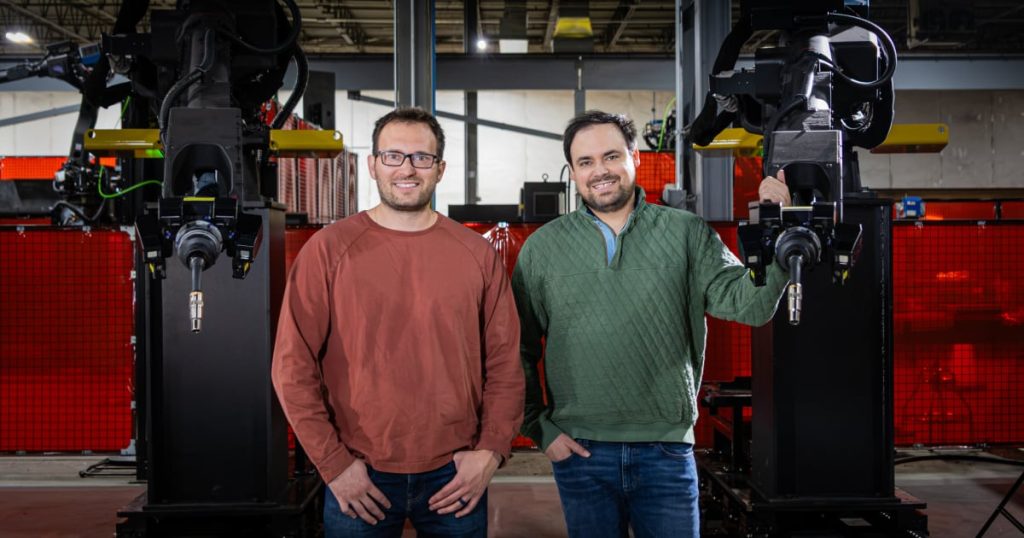
Path Robotics has raised $300 million in Series E financing at a $2.45 billion post-money valuation, led by growth-equity firm Georgian. Why it matters: it is one of the biggest bets yet that “physical AI” — models that let robots see, plan, and adapt on a factory floor — can grow out of its first job, welding, and into manufacturing at large.
November 10, 2026 — The Columbus, Ohio company announced the round on Tuesday, November 10. Existing investors Addition, Drive Capital, IronArc Ventures, Tiger Global, and Yamaha Motor Ventures took part, joined by D. E. Shaw Ventures and NAVER Ventures. Georgian partner Emily Walsh will join Path’s board.
The growth behind the round
Path says its annual recurring revenue grew 17-fold over the past 18 months as deployments scaled with large North American manufacturers. That is a company-reported multiple — Path did not publish the underlying revenue figure — but the customer list is checkable: HII, Lockheed Martin, and Saronic headline it, alongside mid-sized manufacturers EK Machine, Millerbernd Manufacturing Company, TransAmerican Power Products, and TYCROP.
Earlier this year, Path announced a $600 million performance-based production agreement with HII, America’s largest shipbuilder, to put its physical AI into U.S. Navy shipbuilding programs. The company says its workforce has grown 97% year over year and that it plans to reach 400 employees by the end of the year. Founded in 2018, Path has now raised more than $610 million in total.
From welding cells to the whole factory
Path’s core product is Obsidian, a physical AI model trained on real welding data. Instead of following a rigid pre-programmed path like traditional industrial robots, an Obsidian-driven robot identifies weld joints, plans the weld, executes it, and adapts when conditions change — the kind of variable work that has kept complex welding stubbornly manual amid a chronic shortage of skilled welders.
The new capital is explicitly for going further: scaling the welding business while expanding into manufacturing tasks before and after the weld, and into new robotic form factors. One already exists — Rove, a mobile welding system that mounts Obsidian on a quadruped robot so the welder walks to the part instead of the part coming to a fixed cell. Path says the end goal is automating the entire factory, not one step of it.
Why it matters
Most AI money chases software margins. Path is a test of whether investors will fund AI where the output is physical — ships, heavy equipment, energy infrastructure — and where the bottleneck is people, not compute. A $2.45 billion valuation on an undisclosed revenue base is a promise, not a result, and the 17-fold growth claim deserves the “company-reported” label. But signed production work in Navy shipbuilding and a 97% larger workforce are harder to fake than a demo video, and they make Path one of the more credible physical-AI stories of the year.
Frequently asked questions
How much did Path Robotics raise?
$300 million in Series E financing at a $2.45 billion post-money valuation, led by Georgian. Total funding since the company’s 2018 founding is now more than $610 million.
What does Path Robotics make?
Physical AI for manufacturing, starting with Obsidian, a model that lets robots find weld joints, plan and execute welds, and adapt in real time. Rove extends the same model to a mobile quadruped platform.
Who uses Path Robotics?
Named customers include HII, Lockheed Martin, and Saronic, plus mid-sized manufacturers such as EK Machine and Millerbernd. A $600 million performance-based agreement with HII covers U.S. Navy shipbuilding work.
Sources: Path Robotics (Business Wire release), Unite.AI, Pulse 2.0