
Quick verdict
Brilliant Labs launched Halo Glasses on October 27, 2026, priced at $399 and available now at brilliant.xyz. Why it matters: almost every other pair of AI glasses sends what you see and hear to a big company’s cloud. Halo is built the other way round — open-source hardware and software, on-device processing at its core, and a low-resolution sensor that understands what you are looking at without ever storing a photo.
What Halo Glasses are
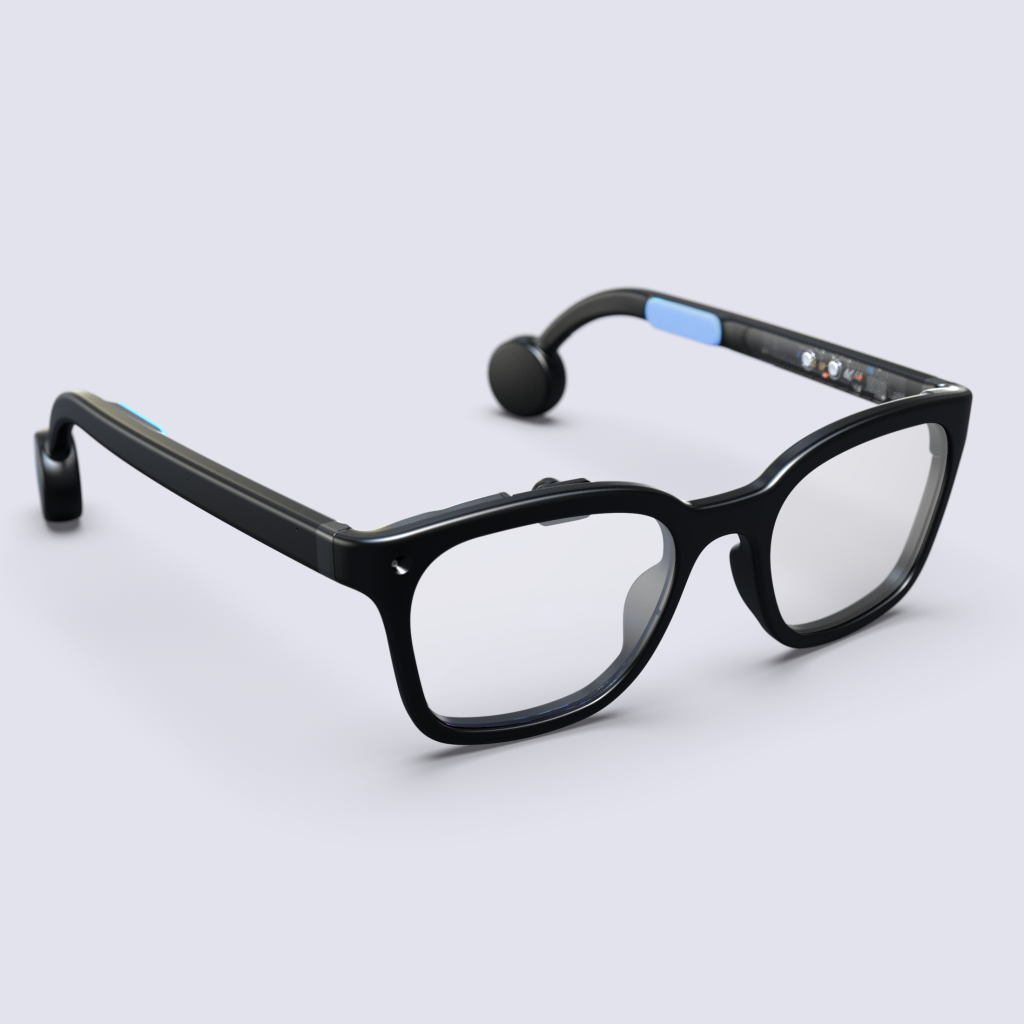
Halo is an all-day wearable weighing just over 40 grams, with a full-color microOLED display, optical-grade lenses (prescription and sunglass options are available), two bone conduction speakers, microphones, Bluetooth 5.3 and up to 14 hours of battery life. The spec list adds an Alif B1 on-device AI processor, a 6-axis IMU with tap detection, and ZephyrOS software.
At the center is Noa, a personal AI companion that builds long-term memory around what matters to you, learns from patterns over time and answers conversationally in real time. Conversations carry forward instead of resetting. That puts Halo alongside display glasses like the Even Realities G2 and camera-free designs like the MemoMind One — with a color display and open platform neither offers.
Ask, Make, Play: the three things Halo does
Ask. Talk to Noa naturally: ask questions, explore ideas and get context in the moment, with memory picking up where you left off.
Make. Build mini-apps and custom workflows using just your voice — no code or technical setup — and share what you make with the Halo community through its App Store.
Play. Narrative, Halo’s flagship experience, is what Brilliant Labs calls adaptive gaming: it turns the real world into an open-world game that evolves with your actions, decisions and discoveries. Treat that as a launch promise for now — it is a brand-new category, not a proven game library.
The privacy trade: a sensor, not a camera
Halo’s low-resolution image sensor gives it visual context without functioning as a traditional camera for photography or video. Brilliant Labs describes it as visual note-taking: images are processed privately on-device, immediately discarded and never stored. That is a genuinely different answer to the question that dogs camera glasses like the Meta Adventurer. The flip side is just as clear: if you want to capture your day in photos or 3K video, Halo simply does not do it.
Pros and cons
- Pros: fully open-source hardware and software; on-device processing with images discarded, never stored; full-color display at just over 40g; up to 14 hours of battery; Noa’s long-term memory; voice-built mini-apps.
- Cons: no photo or video capture at all; Narrative adaptive gaming is unproven at launch; a small company’s hardware and app ecosystem versus Meta’s scale; $399 is mid-premium money for a first-generation platform.
Who is it for?
Privacy-conscious early adopters, developers who like open platforms they can extend and remix, and glasses wearers who want a display and a remembering assistant without a camera pointed at everyone they meet. Camera-first buyers should look at Meta’s line instead.
Frequently asked questions
How much do Brilliant Labs Halo Glasses cost?
$399, available now at brilliant.xyz following the October 27, 2026 launch.
Can Halo Glasses take photos or video?
No. Its low-resolution sensor provides visual context for the AI only; images are processed on-device, immediately discarded and never stored.
How long does the Halo battery last?
Brilliant Labs rates Halo at up to 14 hours of battery life, and the glasses weigh just over 40 grams.
Is Halo open source?
Yes — Brilliant Labs says both the hardware and software foundation are fully open source, so developers can extend and remix the platform.
Price and availability
Halo Glasses launched on October 27, 2026 at $399 and are available now at brilliant.xyz. No verified Amazon listing for Halo was available at publish time, so there is no Amazon link for this one — buy direct.