
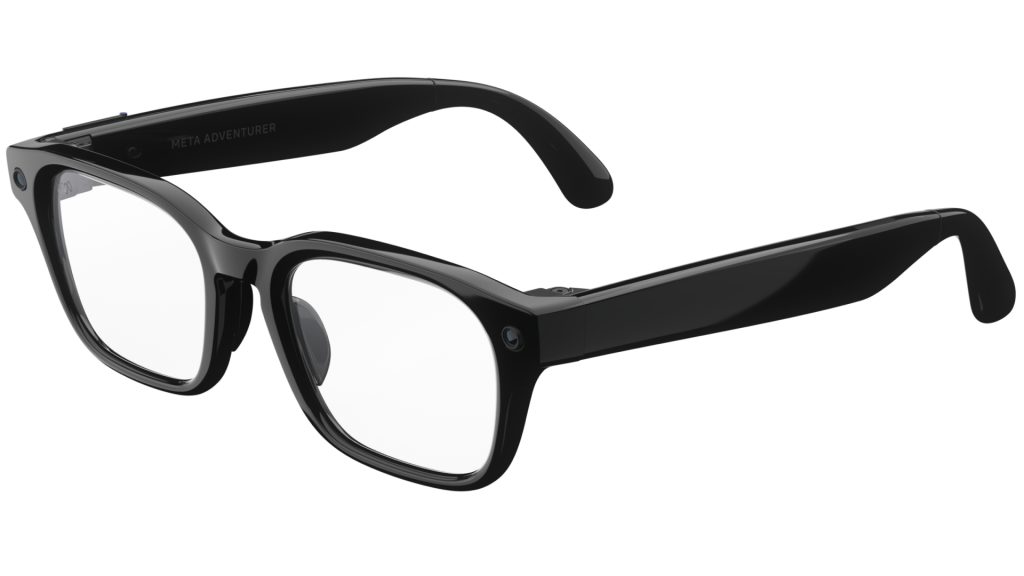
Quick verdict
The Adventurer went on sale on October 23, 2026 as the entry model in Meta’s own-brand Glasses line, announced at Meta Connect in September. At $249 in Classic Black with gray lenses, it undercuts the camera-free Ray-Ban Meta Audio ($349) and the Ray-Ban Meta Gen 3 ($449) while keeping the camera those cheaper-on-paper comparisons suggest it might have dropped. It hasn’t: this is a full camera-and-AI pair of glasses, and the savings come from the charging case and the frame brand, not the electronics.
What the Adventurer does
A 12-megapixel ultra-wide camera (100-degree field of view, 3024 x 4032 stills) shoots video up to 3K Ultra HD at 30fps, with 1080p+ at 30/60fps and a 720p+ 120fps slow-motion mode, plus hyperlapse. Six microphones and open-ear speakers with adaptive volume handle calls, music and voice commands. Onboard storage is 32GB — roughly 1,000 photos or more than 100 thirty-second videos — with tri-band Wi-Fi 6 and Bluetooth 5.4 for phone pairing.
Meta AI is the point of the product: ask questions about what you’re looking at, get live translation, start calls and control music hands-free. Meta says its Muse personal AI agent is also coming to the glasses, turning them into a hands-free interface for tasks and calendars. There is no display in the lens — answers come through the speakers or the Meta AI app — so if you want text in front of your eyes, display glasses like the Even Realities G2 are a different (and much pricier) bet.
The $249 catch: a plug-in case
The headline price buys a plug-in charging case: it refills the glasses to about 90% in roughly 75 minutes, but only while connected to power — it is not a battery bank and isn’t sold separately. The foldable portable case, rated for up to 40 hours of extra charging, pushes configurations to $299 and up (and costs $89 bought later on its own). Meta rates the glasses themselves at more than eight hours per charge. So the real buying decision is simple: mostly charge at home or a desk, take the $249 bundle; travel or shoot video all day, pay for the portable case up front.
Fit, prescriptions and privacy
The rectangular frame comes in standard (53.8g) and large (54.8g) sizes with three-way adjustable nose pads, and supports single-vision and progressive prescription lenses across a wide range (total power -12.00 to +2.25 per Meta’s listing). You’ll need an iPhone on iOS 17+ or an Android phone on Android 10+, the Meta AI app and a Meta account. A capture LED lights when the camera records, and Meta says capture is blocked if that LED is covered — reasonable safeguards that don’t remove the need to ask before filming people.
Pros and cons
- Pros: lowest price yet for camera-equipped Meta AI glasses; full 12MP/3K camera, not a cut-down sensor; six-mic array and open-ear audio; wide prescription range; portable-case upgrade available if you need it.
- Cons: the $249 case must stay plugged in — no charging in a bag; no in-lens display; heavier than ordinary glasses at ~54g; smart features depend on a phone, the Meta AI app and a Meta account; capture-LED privacy debates follow any camera glasses.
Who is it for?
First-time AI-glasses buyers who want the camera, translation and hands-free assistant without paying Ray-Ban brand pricing — and who mostly charge at home. Frequent travelers should budget for the $299 portable-case configuration instead; anyone who wants captions or navigation in view should look at display glasses, not these.
Frequently asked questions
How much do the Meta Adventurer glasses cost?
From $249 for Classic Black with gray lenses and the plug-in case. Configurations with the foldable portable charging case start at $299, and prescription or Transitions lenses cost more.
Do the Meta Adventurer have a camera?
Yes — a 12MP ultra-wide camera recording up to 3K video at 30fps. Unlike the Ray-Ban Meta Audio, the Adventurer is not camera-free.
How long does the battery last?
Meta rates the glasses at more than eight hours per charge. The optional foldable case adds up to 40 hours of recharging away from an outlet; the $249 plug-in case adds none unless it is plugged in.
Do the Adventurer work with iPhone and Android?
Yes — iOS 17 or later, or Android 10 or later, with the Meta AI app and a Meta account.
Price and availability
The Meta Adventurer is on sale now from $249 at Meta’s own store and certified retailers such as Best Buy. We could not verify an exact Adventurer listing on Amazon, so there is no Amazon link for this one — buy from Meta or a certified retailer and confirm the frame, lens and case combination before paying, because the case type is what separates the $249 bundle from the $299 one.