
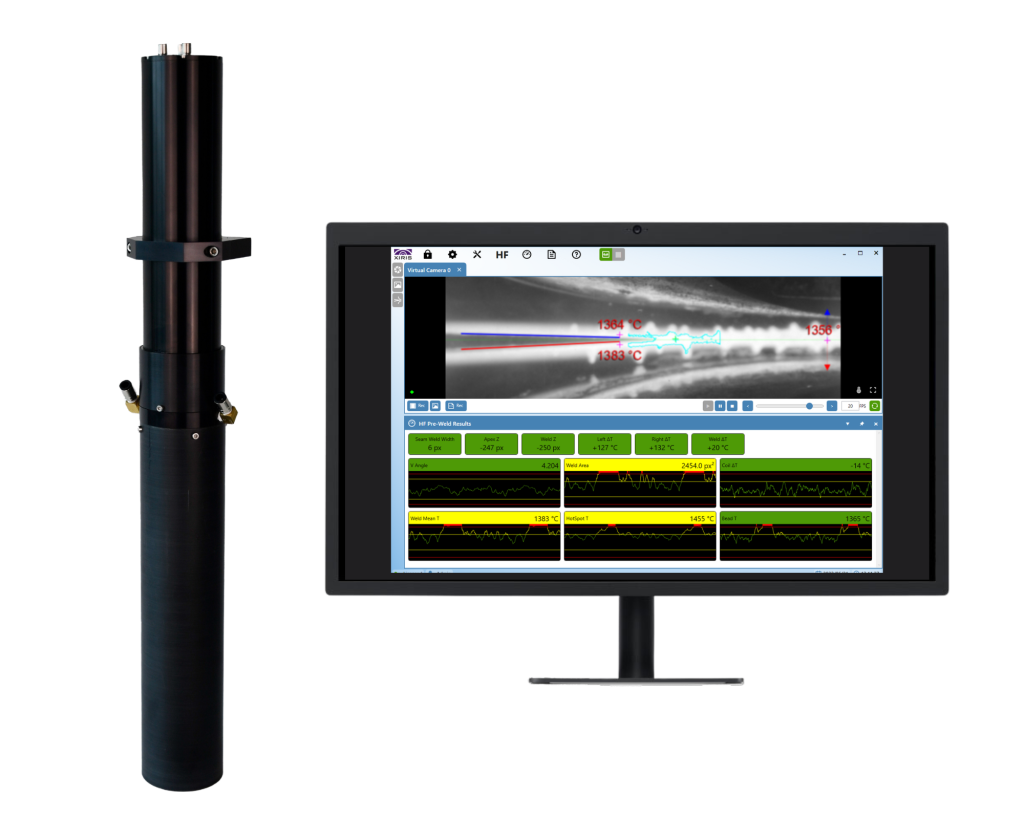
Xiris WeldStudio Tracker Review 2026: AI Seam Tracking and Weld Monitoring From One Camera
Updated November 14, 2026 – Tested Intelligence
Quick verdict: Xiris WeldStudio Tracker is AI machine-vision software that lets one near-infrared HDR weld camera do two jobs in an automated cell: real-time seam tracking at the arc and live weld process monitoring. It suits steel fabrication shops running robotic welding where fit-up varies. The trade-offs: pricing is not public, the AI models must be trained on your specific application, and it only pays off inside an automated cell.
What it is
Xiris Automation, based in Burlington, Ontario, makes camera-based inspection systems for welding, and WeldStudio Tracker is its seam-tracking software for automated and robotic welding. It runs with Xiris near-infrared high dynamic range (HDR) weld cameras — imaging rated at 140+ dB — which show the torch, arc, melt pool and seam in one clear image despite the arc’s glare. Launch coverage in The Fabricator and Canadian Metalworking (September–October 2026) describes the same core idea: consolidate seam tracking and weld monitoring into a single optical device instead of bolting two systems onto the torch.
The AI is not generic. The software uses AI machine-vision tools with models trained on the customer’s own application and welding process, tracking the root, weld bead and joint and providing measurements across multiple weld passes. Because the camera sees both torch and seam in one frame, their positions and any relative movement or distortion are measured directly.
What most coverage doesn’t make obvious is the offset point. Because measurements are made right at the arc, no offset is needed for the distance between the seam measurement position and the electrode arc position — the weakness of laser trackers mounted ahead of the torch, where thermal distortion between sensor and arc can move the real seam. Measuring at the arc also removes hardware from the torch, cutting payload weight.
Key features
- AI seam tracking: models trained on your application and process track root, weld bead and joint in real time
- One camera, two jobs: seam tracking and weld monitoring combined in a single NIR HDR camera
- 140+ dB HDR imaging: torch, arc, melt pool and seam stay visible in one frame
- Measurement at the arc: no sensor-to-electrode offset to calibrate
- Multi-pass tracking: joint features followed across multiple weld passes
- Cell integration: designed for most automated and robotic welding equipment
Pricing
Pricing is not public. Xiris publishes no prices for WeldStudio Tracker or its cameras, and no list price appeared in launch coverage — expect a quote covering camera, software and the model-training and integration work for your cell. Get the training scope in writing: because models are trained per application, a very different joint or process may be additional work, not a settings change.
Who it’s for
Steel fabricators running robotic or automated MIG/MAG cells — structural steel, pipe and tube, high-mix fabrication — where fit-up varies enough that fixed programming drifts off seam. It fits best when the cell already justifies a weld camera for monitoring: Tracker turns that camera into the tracking sensor as well.
Who should skip it
Manual welding shops should skip it entirely — there is no cell to track a seam in. Shops with simple, repeatable, tightly fixtured automated work may find a conventional laser tracker, or none, is cheaper. And if your problem is weld-data and procedure compliance across many stations, an adaptive system like Novarc or ESAB ROBBI AI, both covered by Tested Intelligence for steel fabrication, attacks a different problem.
Pros
- One camera replaces a separate seam sensor and monitoring camera
- At-the-arc measurement eliminates ahead-of-torch sensor-offset error
- AI models trained on your application, not a generic joint library
- 140+ dB HDR imaging keeps melt pool and seam readable for operators too
- Tracks root, bead and joint features across multiple passes
Cons
- Pricing is not public — camera, software, training and integration are quote-based
- Per-application training means new joints or processes can add cost
- No benefit for manual welding — automated or robotic cells only
- A new 2026 release, so long-term field history is still building
FAQ
What does WeldStudio Tracker’s AI actually do?
It runs AI machine-vision models — trained on your specific application and process — over the live NIR HDR image to track the root, weld bead and joint, producing real-time seam-tracking measurements at the arc while operators get a live monitoring view.
How much does Xiris WeldStudio Tracker cost?
Pricing is not public. Xiris quotes camera, software and integration as a system, and launch coverage published no list price. Ask for the model-training scope to be itemized.
How is Tracker different from a laser seam tracker?
A laser tracker is a separate sensor mounted ahead of the torch, so its measurement point sits at an offset from the arc. Tracker measures from the camera image at the arc itself, so no offset is required, and the same hardware provides process monitoring.
Bottom line
WeldStudio Tracker is the steel-fabrication pick for automated cells tired of running two optical systems on one torch. At-the-arc measurement removes a real tracking error, and per-application AI training suits high-mix work. Go in clear-eyed: the price is a quote, training is part of the product, and manual shops should look elsewhere.