
Quick verdict
Vibe Dot Review 2026: A 5-Mic Wearable Recorder Built for Noisy Rooms
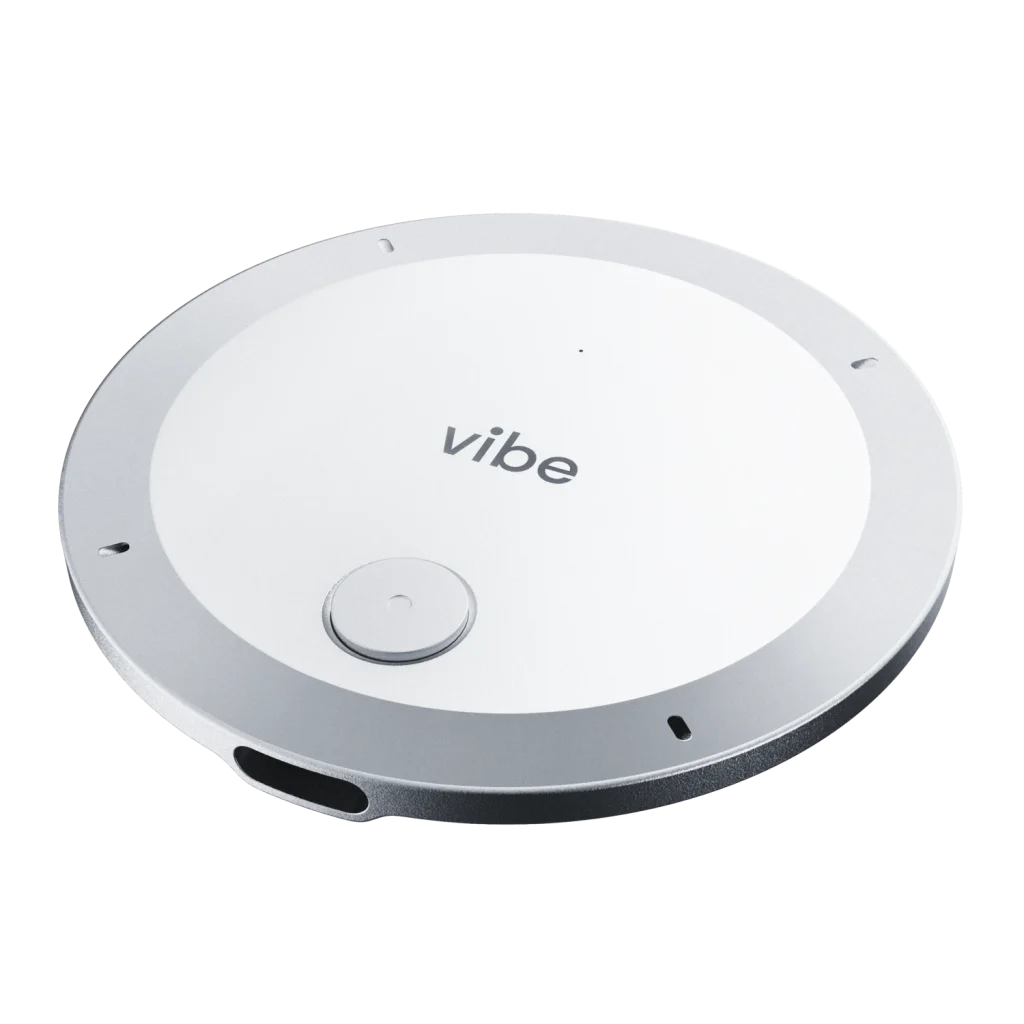
The Vibe Dot is a $199 wearable AI recorder from Vibe: a thin magnetic disk, just smaller than a palm, with five microphones, a 16-foot capture range and about 30 hours of continuous recording, built to turn real-world workplace conversations into transcripts, summaries and action items in the Vibe AI app. The part most coverage skips: the launch line that core features are free without a subscription sits next to a free tier capped at 300 transcription minutes a month. This is a research-based review built from Vibe’s own product pages and launch coverage, not hands-on testing.
What is the Vibe Dot?
The Dot is a round, extremely thin disk that attaches to a lapel, sits on a desk, or snaps to the back of a phone — MagSafe on iPhones, or a magnetic ring for Android. Vibe, which previously built the in-room Vibe Bot meeting device, designed the Dot for the conversations that happen away from a conference-room table. Recordings sync to the Vibe AI app, where they become structured summaries that feed a central knowledge hub, and voice commands can be sent to connected agents. It competes directly with wearables like the Plaud NotePin S and the Pocket recorder.
Why five microphones matter
Most wearable recorders use one or two microphones and struggle once three or four people talk across a table. The Dot uses five — on Vibe’s own comparison pages, four high-fidelity MEMS air microphones plus a bone-conduction vibration sensor that isolates your own voice — with a stated listening range of up to 16 feet. That is a boardroom-table range, not a one-on-one range. The larger disk also fits a bigger battery: about 30 hours of continuous recording, plus 64GB of onboard storage on Vibe’s published specs, so it can be set to listen for a human voice and capture without constant babysitting.
What the pricing page doesn’t make obvious
Vibe’s launch coverage stressed that the Dot’s core features are free without a subscription. Vibe’s own plan details are narrower: the free Starter tier includes 300 transcription minutes a month, and Vibe AI Pro runs $9 per seat per month billed annually, with higher tiers up to $29 a month for advanced agentic features and high-volume processing. Three hundred minutes is five hours — one long workshop can burn a month’s allowance. The honest total is $199 for the hardware plus $108 a year for Pro if you record regularly, which is still competitive, but it is not the no-subscription device the headline suggests.
Key specs
- Price: $199, available for preorder at launch
- Microphones: 5-mic array (4 MEMS air + 1 bone-conduction sensor), up to 16 ft capture range
- Battery: 30+ hours continuous recording; USB-C charging, full charge in about 90 minutes
- Storage: 64GB onboard
- Size: 0.83 oz, 0.17 in thick; MagSafe, magnetic ring and lapel/desk use
- Compliance: SOC 2, HIPAA, FERPA and NDAA, per Vibe’s published specs
- Plans: Free Starter with 300 minutes/month; Pro $9/seat/month billed annually; higher tiers to $29/month
Pros and cons
- Pros: Five-microphone array with bone conduction is genuinely differentiated for noisy, multi-speaker rooms; 30+ hours of continuous recording outlasts most pendants several times over; 64GB storage and a published SOC 2 / HIPAA / FERPA compliance stack suit regulated workplaces; cross-session memory in Vibe AI treats recordings as a knowledge base, not isolated files.
- Cons: Free tier is only 300 minutes a month despite the no-subscription launch framing; the disk is larger than most competitors — smaller than a palm, but not invisible; the AI value depends on staying inside Vibe’s app and ecosystem, unlike the open-source approach of the Omi.
Who it’s for
The Vibe Dot is for professionals whose work is spoken — managers, clinicians, field teams, salespeople — and whose rooms are loud and crowded. If your meetings are one-on-one in a quiet office, the NotePin S or a phone app will capture them just as well for less. Buy the Dot for the microphone array and the battery, and budget for Pro if you record more than five hours a month.
Frequently asked questions
How much does the Vibe Dot cost?
The device is $199. Core features are included, with a free Starter tier of 300 transcription minutes a month; Vibe AI Pro is $9 per seat per month billed annually.
How long does the Vibe Dot record?
About 30 hours of continuous recording on a charge, with 64GB of onboard storage.
How does the Vibe Dot attach?
It clips to a lapel, sits on a desk, or attaches magnetically to a phone — MagSafe on iPhone, or a magnetic ring for Android.
Is the Vibe Dot HIPAA compliant?
Vibe publishes SOC 2, HIPAA, FERPA and NDAA compliance for the Dot, which is why it is pitched at healthcare, education and government workplaces.
Price and availability
The Vibe Dot was announced for preorder at $199, with core features included and paid Vibe AI plans for higher volume. We could not verify an exact Amazon product URL at publish time, so no Amazon link is included here rather than risk linking the wrong listing.