
Quick verdict
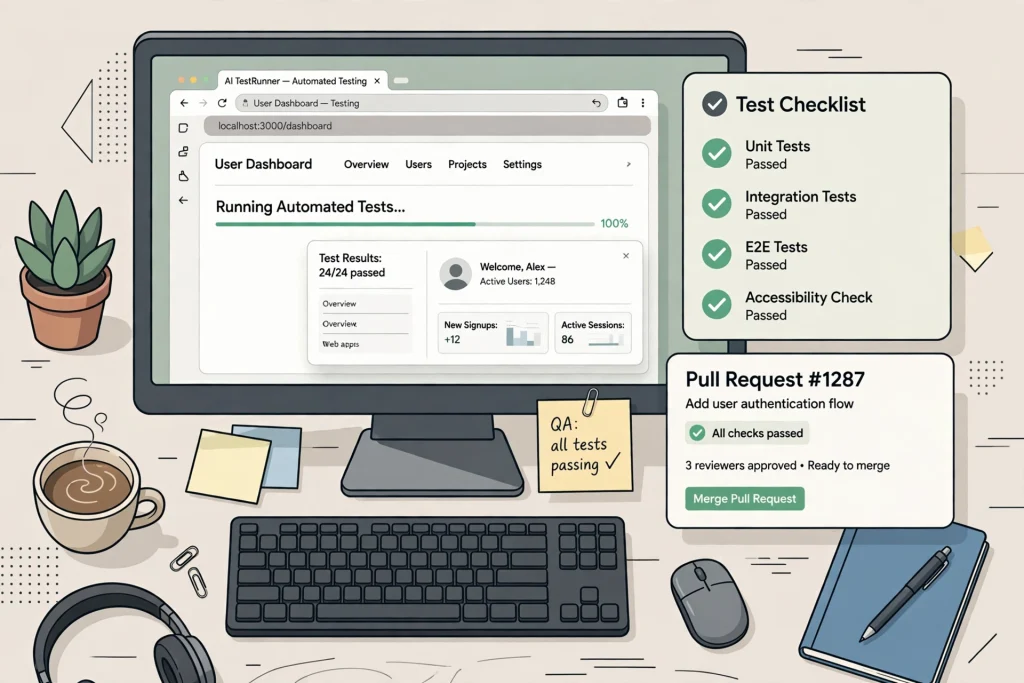
Verdict up front: TestSprite 4.0, launched November 20, 2026, is the most interesting idea in AI testing right now: a separate testing agent that remembers what your app is supposed to do and re-checks every change against that record, instead of letting the coding agent that wrote the code also grade its own work. The free plan is real (150 credits a month, no card), paid plans start at $19/month, and it plugs into Claude Code, Codex and Cursor via MCP and an open-source CLI. The catch is credit math: a busy team will outgrow the free tier fast, and the features that make it hands-off — scheduled runs and auto-heal — only start on paid plans.
What is TestSprite 4.0?
TestSprite is an independent AI testing agent. You tell it what to test in plain words, or point it at your PRDs and tickets, and it writes end-to-end tests, runs them against your running app in real browsers across the frontend and backend, and keeps the suite current as the interface changes. Version 4.0, the release covered here, centers on memory: the agent keeps an approved record of what the product should do, and every later change is checked against it. What a test expects only changes when you approve it, so a failing check cannot be quietly rewritten to pass.
It runs four ways: in the browser for the whole team, from a terminal CLI (open source under Apache 2.0) built for coding agents running unattended, through MCP in IDEs including Claude Code, Cursor, VS Code and Windsurf, and as a GitHub gate on every pull request, posting status checks where the review already happens. Failures can become Linear or Jira tickets in one click, and run summaries post to Slack.
What the pricing page doesn’t make obvious
Three details verified on TestSprite’s own pricing page and free-plan documentation matter more than the headline prices. First, the free plan includes GitHub PR auto-test on only 1 repository and 30 days of run history. Second, Test Schedules and Auto-Heal Rerun are not on the free plan at all — scheduled regression runs start at Starter ($19/mo) — so “it keeps testing while I sleep” is a paid feature. Third, Enterprise starts at $199/month from 10 seats with 5,000+ credits, a seat minimum most pricing roundups omit. TestSprite also says 200 frontend integration tests, generated and run, cost $4.60 in credits — useful for estimating how far 150 free credits actually go.
TestSprite pricing in 2026
| Plan | Price | Credits/mo | Key limits |
|---|---|---|---|
| Free | $0 | 150 | 1 environment, 1 repo PR auto-test, 30 days history |
| Starter | $19/mo (first month free) | 400 | Adds auto-heal, scheduled runs, 3 repos |
| Standard | $39/mo | 800 | 3 environments, 90 days history, Jira/Linear, agent memory per project |
| Pro | $69/mo | 1,600 | Unlimited environments and history, priority execution |
| Enterprise | From $199/mo | From 5,000 | From 10 seats, SSO/SCIM, single-tenant option |
Strengths
- Independence is the point. A separate agent testing against an approved plan avoids the core flaw of self-testing coding agents. It is the same reason teams pair a writer with a separate reviewer like CodeRabbit — fresh eyes catch what the author rationalizes away.
- Evidence, not vibes. Every failure comes with a replay, the failing step, and expected versus actual, classified as a real bug, a test problem, or an environment issue.
- Works where you already build. MCP support for Claude Code, Cursor, VS Code and Windsurf, plus GitHub Actions, means it fits the agent-heavy workflows readers of our Cursor review already use.
- No lock-in on tests. Every test can be read and exported as Playwright code (Python), and it runs alongside an existing Playwright suite rather than replacing it.
- A genuinely usable free tier. 150 credits a month with the full test loop is enough to evaluate it on a real flow.
Weaknesses
- Credits are the real price. Plans are cheap per month but metered; a large suite re-checked on every PR can burn credits quickly, and costs are hard to predict before you run your own app.
- The free plan is manual. No schedules and no auto-heal means free users trigger runs themselves — fine for evaluation, not for a merge gate.
- Vendor-run benchmark claims. TestSprite cites 94% bug-finding accuracy on its own November 2026 benchmark, ahead of Claude Code and Codex — treat that as a vendor claim until independent testing exists.
- Tests run on TestSprite’s machines. You point it at staging or a preview deploy (its own advice), and stored test credentials, though encrypted, are another thing to manage.
Who is TestSprite 4.0 for?
Teams shipping AI-written code daily — especially small teams without a dedicated QA hire — get the most from it: the agent writes, runs and maintains the regression suite a human team has no time for. It also suits teams using stacked-PR workflows like those in our Graphite review, where every merge needs a trustworthy gate. Solo developers should start free and watch credit burn before paying.
FAQ
Is TestSprite free?
Yes. The free plan costs $0, includes 150 credits per month that refresh automatically, 1 environment, GitHub PR auto-test on 1 repository, and no credit card is required. Schedules and auto-heal require a paid plan.
How is TestSprite different from Playwright?
Playwright is a framework where you or your coding agent write the tests. TestSprite is a separate agent that works from an approved record of what your product should do, runs the suite on its own machines, and never changes what a test expects without your approval. Tests can be exported as Playwright code.
Which coding agents and IDEs does TestSprite work with?
Via MCP it plugs into Claude Code, Cursor, VS Code, Windsurf, Antigravity and Trae; the CLI works with any agent that can run a command, including OpenAI Codex, and it runs in GitHub Actions.
Does TestSprite test the backend as well as the frontend?
Yes. On the frontend it drives real browsers; on the backend it tests multi-request flows, handling authentication and carrying data between requests.
Bottom line: TestSprite 4.0 is the right shape for testing in the coding-agent era — an independent verifier with a memory, priced low enough for small teams. Start on the free 150 credits, measure your burn on real pull requests, and expect Standard at $39/month to be the realistic production tier.