
Quick verdict
Skema Review 2026: AI Design Automation That Turns Schematics Into LOD 350 Revit BIM
Updated November 2, 2026 – Tested Intelligence
Quick verdict: Skema is AI design automation for architecture firms whose best work keeps getting redrawn. It turns a firm’s proven past designs into reusable Design Catalogs, generates schematic layouts from them, then produces LOD 350 BIM for Revit without remodeling. Professional costs $199 a month and the five-seat Team Starter Pack is $750 a month. It pays off on repetitive building types; a firm doing mostly one-off designs will feed it too little to learn from.
What it is
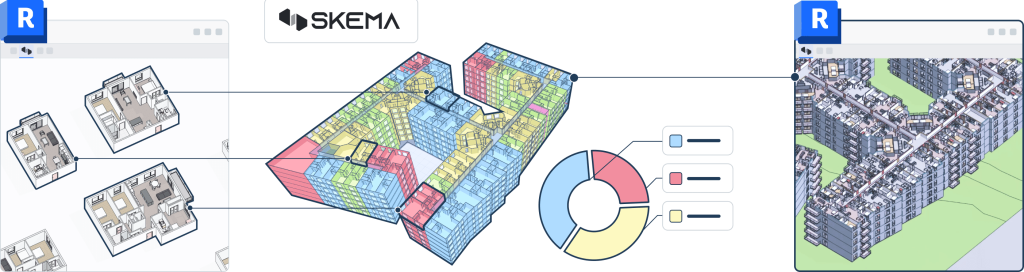
Skema is a cloud design platform from an Atlanta company founded in 2021 and formerly known as Blue Ocean, per CB Insights. Its premise is different from text-to-design generators: your firm’s previous projects are the raw material. Skema interprets completed designs, including Revit work, into Design Catalogs of intelligent, reusable assemblies, then uses no-code generative tools to build new schematic proposals from those pieces. When a scheme is approved, its “BIM in Minutes” workflow generates a detailed model instead of throwing the concept away and starting over in Revit.
AEC Magazine and Architosh covered its 2023 launch as a knowledge-reuse engine for Revit, and the product has since added Rhino integration, announced in May 2025. Skema’s own blog describes units as stretchable 3D puzzle pieces: a designer sets the parametric rules for what may change, and the Morph tool stretches or squeezes apartments, classrooms or patient suites to fit a new floor plan while keeping the embedded BIM data. The vendor says clients report fast-forwarding their process by six to eight weeks; that is a vendor-reported figure, not an independent measurement.
Key features
- Design Catalogs built from your firm’s past projects, in Revit, ArchiCAD or IFC formats
- No-code generative schematic design: auto-layout, blocking and stacking
- Morph tool that resizes catalog elements under rules you set, keeping their data
- BIM in Minutes: schematic designs converted to LOD 350 BIM, ready for Revit
- Real-time metrics while you design, including unit mix and floor area ratio
- Integrations with Revit, Rhino, SketchUp and Miro listed on the pricing page
- Enterprise option: custom development of AI-powered custom configurators
Pricing
Skema publishes its prices. Starter is listed as free for individual architects and includes individual access plus a 30-day trial of Professional. Professional is $199 a month for a full-featured individual plan, including open-source Design Catalogs, native Revit data integration, all integrations, and in-product training and support. The Team Starter Pack is $750 a month for a five-seat team license and adds dedicated onboarding and training. Enterprise is priced by sales contact. The page’s yearly toggle shows a 10 percent saving over monthly billing.
What the pricing page doesn’t make obvious: the free Starter is a trial vehicle, not a free design tool you can run a practice on – its stated substance is the 30-day Professional trial. And the Team Starter Pack is a fixed five-seat license, so its real rate is $150 per seat, a $49-a-seat saving over going solo; it also includes a no-risk two-week pilot for an unlimited number of users before the team commits, a detail buried in the plan card.
Who it’s for
Architecture and design-build firms with repeatable typologies – multifamily housing, schools, healthcare suites, hotels – and a Revit library worth reusing. If your senior designers spend weeks rebuilding variations of units they have already solved, Skema attacks exactly that cost, and the output follows your standards rather than a generic template.
Who should skip it
Firms whose work is mostly bespoke, one-off buildings have too little repetition for catalogs to compound. Practices not centred on Revit gain less, since Revit is the main delivery target. And nobody should treat a generated LOD 350 model as construction-ready without the usual peer review, code checks and client standards – Skema accelerates modelling, it does not stamp drawings.
Pros
- Reuses your own proven design work instead of generating generic layouts
- Schematic work survives into BIM: no redraw between concept and Revit
- Published pricing, a 30-day Professional trial, and a two-week team pilot
- Metrics such as unit mix and floor area ratio update live while designing
- Works alongside Revit, Rhino and SketchUp rather than replacing them
Cons
- Value depends on repetition: unique projects starve the catalog model
- Professional at $199 a month is a real line item for solo practitioners
- Enterprise pricing is not public, and custom configurators are Enterprise-only
- Catalog quality depends on the quality of the past projects you feed it
- Generated models still need full professional review before documents ship
FAQ
How much does Skema cost?
Professional is $199 a month per individual user, and the Team Starter Pack is $750 a month for five seats, on Skema’s own pricing page. Starter is free but is built around a 30-day trial of Professional; Enterprise is priced by contacting sales. Yearly billing is shown saving 10 percent.
Does Skema replace Revit?
No. Skema generates BIM and hands it to Revit, with native Revit data integration on the paid plans, plus Rhino and SketchUp connections. Your team still documents, coordinates and reviews in the tools it already uses.
What does LOD 350 mean here?
Skema and trade coverage describe its generated models as LOD 350: coordinated models built from the BIM data in your catalogs, at a depth suited to coordination. It is a modelling-depth claim about the output, not a guarantee the design is permitted or buildable as drawn.
Bottom line
Skema is one of the more credible AI offers in design because it sells reuse, not magic: your firm’s own solved designs, reapplied in minutes and delivered as real BIM. At $199 a month it needs a steady flow of repeatable work to earn its seat, but for a multifamily or institutional practice redrawing the same units every project, the math is easy to test inside the 30-day trial.