
Quick verdict
Sense Home Energy Monitor Review 2026: Machine-Learning Appliance Detection From Inside the Panel
Updated November 15, 2026 – Tested Intelligence
Quick verdict: The Sense Home Energy Monitor is a small red box an electrician installs inside the breaker panel, where it samples the whole home’s current and uses machine learning to learn which appliance is which — no smart plugs, no per-circuit sensors. For an electrical shop, it is a clean add-on sale for panel upgrades, EV charger and solar jobs: the client gets an app that names their loads, and you get the install. The honest limits matter: detection takes weeks to learn, some devices are never identified, and the hardware only fits split-phase 120/240V North American panels.
What it is
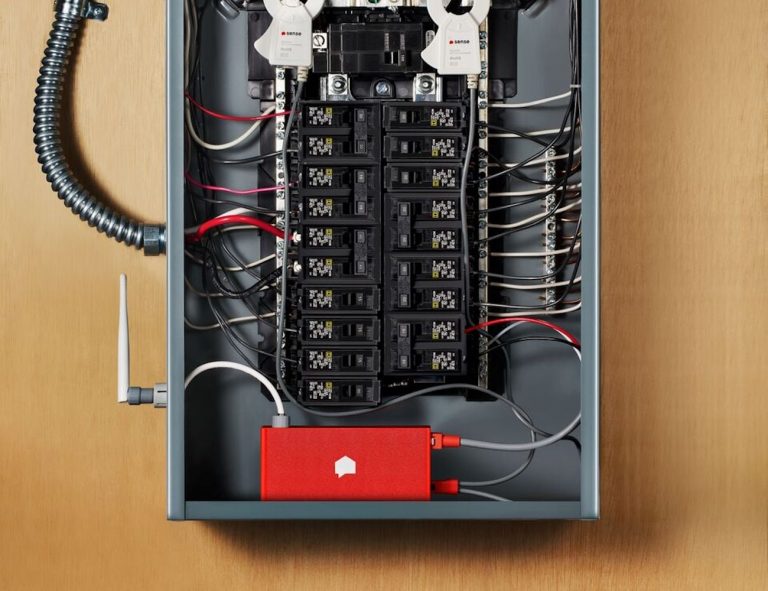
Sense is a home energy monitor built around disaggregation — telling individual appliances apart from one measurement point. Two clamp sensors go around the main service conductors, the monitor draws power from a 240V two-pole breaker, and an antenna brings the panel’s data to the home’s Wi-Fi. Sense’s own documentation puts the sampling at a million readings per second, and its machine-learning models match the electrical signature of each device switching on and off against patterns learned across the Sense user base. The result lands in the Sense app: a real-time power meter, a timeline of what is on right now, per-device usage by day, week or month, and comparisons against similar homes. The Solar model adds a second set of sensors on the solar feed so production and consumption appear in one view; the Flex model uses that second sensor set for a dedicated 240V circuit, a generator, or a 400A split-service home with two panels. Sense has also moved part of the product into software: its site now leads with a free app delivered through select utilities’ Wi-Fi-enabled smart meters, while the panel hardware remains the version an electrician installs and the one covered here.
Key features
- Machine-learning device detection: appliances identified by electrical signature from two main clamps only — no per-circuit CTs or smart plugs
- Real-time app views: Now timeline, live Power Meter and Watt Check for checking a load’s draw and running cost
- Device-level history and insights by day, week, month or year, plus comparison with similar homes in the area
- Notifications and alerts for devices turning on or off and unusual activity at the home
- Solar model tracks production against consumption; Flex sensors monitor one dedicated 240V circuit, a generator, or a second panel on 400A split-service
- ETL/Intertek certified for installation inside the electrical panel, per the product manual
- No subscription required for the core monitoring and device detection in the app
Pricing
Sense no longer publishes a hardware price on its own product pages — sense.com now presents the app and its utility smart-meter program first. Retailer listings checked in November 2026 price the hardware at $299 for the standard Sense monitor and $349 for the Sense Solar and Sense Flex models; treat those as retailer prices, not a vendor list price, and confirm at checkout. There is no required subscription for core monitoring. Professional installation is an additional cost the client should expect: the manual involves opening the panel, landing the monitor on a 240V breaker and clamping the mains, and independent install guides put a standalone electrician install roughly in the $150–$300 range depending on market — which is precisely why this product belongs in an electrician’s catalog rather than a DIY cart.
What the pricing page doesn’t make obvious: the compatibility limits in Sense’s own manual and product documentation decide whether the sale works at all. The monitor is designed only for split-phase 120/240V residential panels in the United States and Canada, with up to 200A service per panel; it is not designed for three-phase or parallel-feed configurations, and a 400A split-service home needs the Flex or Solar model with its second sensor set. It also needs space in the panel and a 240V two-pole breaker position. Check the panel before you quote the job, not after.
Who it’s for
Residential electricians who want a repeatable, high-margin add-on that pairs with work they already do: panel upgrades, whole-home surge and EV charger installs, solar tie-ins and “my bill is suddenly huge” service calls. Sense gives the client a visible, app-based answer to where the power goes, and gives you a reason to be the shop that explains it. It also suits troubleshooting: a failing water heater element or a heat pump short-cycling shows up in device history in a way a clamp meter visit never will.
Who should skip it
Electricians whose clients need guaranteed per-circuit numbers — for a subpanel audit or a code-driven load calculation — should sell a circuit-level monitor with a CT on every breaker instead; Sense’s device figures are machine-learning estimates, not metered circuits. Skip it for three-phase, parallel-feed or non-North-American panels entirely, and skip it for clients who expect a complete appliance inventory on day one: the learning period will disappoint them.
Pros
- Device-level insight from just two clamps — the fastest panel-monitor install in its class
- Machine learning improves over time as the home’s signatures are matched and confirmed
- Natural add-on to panel, EV, solar and high-bill service work an electrician already sells
- No mandatory subscription for core monitoring
- Solar and Flex variants cover solar homes and 400A split-service with one product line
Cons
- Detection takes weeks to build and some devices — especially similar resistive loads — are confused or never identified
- Split-phase 120/240V, US and Canada only; no three-phase or parallel-feed support
- Vendor no longer lists a hardware price directly; pricing is retailer-set
- Device figures are estimates from signatures, not per-circuit metering
FAQ
Does Sense really need an electrician to install it?
Sense’s manual states the monitor is ETL/Intertek certified for in-panel installation and strongly recommends a qualified electrician: the work means opening the panel, clamping both mains and powering the unit from a 240V two-pole breaker. That is standard panel work for a licensed electrician and the reason the product fits an electrical contractor’s service menu.
How long before Sense identifies a home’s appliances?
Not overnight. The manual describes a learning process in which the monitor identifies more devices over time as signatures repeat, and independent long-term reviews consistently report the first solid detections inside a few weeks with the picture filling in over one to three months. Similar resistive loads, such as space heaters and toasters, are the hardest for the models to tell apart, and some low-draw devices may never be named.
Sense or a circuit-level monitor like the Emporia Vue?
They answer different questions. Sense uses machine learning to name appliances from two clamps, with no extra hardware per circuit, but its per-device numbers are estimates. A circuit-level monitor puts a sensor on each breaker you care about and meters those circuits directly, without naming the individual appliances on them. For a client who asks “what is my dryer costing me,” Sense is the pitch; for “how loaded is this subpanel,” sell the circuit monitor.
Bottom line
For an electrician, Sense is less a gadget than a service product: a 30-minute panel install that turns into months of client-visible insight, and a credible answer to the high-bill call. Sell it with its limits stated plainly — split-phase panels only, weeks of learning, estimates rather than metered circuits — and it earns its $299 retailer price. Oversell the detection as instant or exact, and it will generate the callbacks instead of preventing them.