
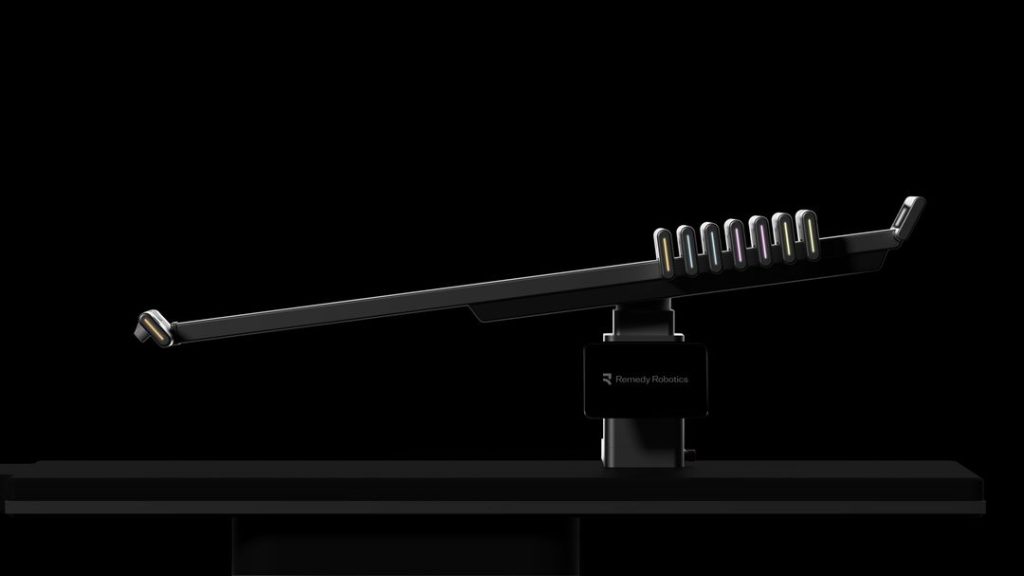
Remedy Robotics has raised $62 million in Series B funding to push its N1 system — an AI-enabled robot built to perform cardiovascular procedures on site, remotely, or autonomously — through a pivotal clinical trial and toward FDA approval. The round is led by DCVC and brings the University of California’s investment office in as a backer.
November 16, 2026
What happened
Remedy Robotics announced the $62 million Series B on Monday, November 16. DCVC led the round, with participation from new investors UC Investments (the University of California’s investment office), Skip Capital and Hostplus, one of Australia’s largest pension funds. Existing investors Build Collective by Tony Fadell, Blackbird, Divergent Capital and KdT Ventures increased their backing.
What the money is for
The capital funds three things: a planned pivotal clinical trial in partnership with the University of California; advancement toward FDA approval for neurovascular intervention; and deployment of prototype N1 systems across Remedy’s clinical-partner network, including through its strategic partnerships with SVIN Mission Thrombectomy — which has selected Remedy as its exclusive robotics partner for N1 testing, development and global rollout — and the Australian Stroke Alliance, which represents 40 health bodies.
What N1 does
The N1 system is an AI-enabled robotic platform and software suite for endovascular intervention — procedures performed from inside blood vessels. Remedy says it uses machine learning to analyze preoperative imaging, simulate cases in advance, provide real-time 3D-2D image registration, and complete entire endovascular procedures robotically. It is designed to operate on site, remotely or autonomously across neurovascular, coronary and peripheral vascular care, and the company says the platform is designed for more than 30 cardiovascular conditions. In October 2025, Remedy announced it had completed what it describes as the world’s first fully remote neurointerventional procedures: a team at St. Joseph’s Health Centre in Toronto operated entirely robotically on patients at St. Michael’s Hospital across the city, with no bedside interventionist required. One important limit, stated plainly by the company: N1 is still under development and is not available for sale or clinical use in any jurisdiction.
Why it matters
Time-critical vascular care — stroke thrombectomy above all — depends on scarce specialists who are rarely where the patient is. A robot that lets an expert intervene from another hospital, and eventually handles more of the procedure itself, attacks a real access problem rather than a convenience one. The $62 million, and UC Investments writing a check ahead of a University of California pivotal trial, say institutional money believes the trial path is real. But “pivotal trial planned” and “FDA approved” are years apart in medical robotics, and autonomous intervention will face the hardest version of that scrutiny. This is a company to track, not a product a hospital can buy today.
Frequently asked questions
How much did Remedy Robotics raise, and who led the round?
Remedy raised $62 million in a Series B announced November 16, 2026, led by DCVC. New investors include UC Investments, Skip Capital and Hostplus; existing backers include Tony Fadell’s Build Collective, Blackbird, Divergent Capital and KdT Ventures.
What is the Remedy N1 system?
N1 is an AI-enabled robotic platform and software suite for endovascular procedures. It uses machine learning for preoperative imaging analysis, case simulation and real-time image registration, and is designed to complete procedures robotically on site, remotely or autonomously.
Can hospitals buy N1 today?
No. Remedy states the N1 system is under development and not available for sale or clinical use in any jurisdiction. The Series B funds a planned pivotal trial and the path toward FDA approval for neurovascular intervention.
Sources: Remedy Robotics release via PR Newswire and BioSpace, Unite.AI