
Rabbet Review 2026: AI Document Routing for Development Budgets and Loan Draws
Updated November 15, 2026 – Tested Intelligence
Quick verdict: Rabbet (sold as Rabbet Development) is financial control software for real estate developers: budgets, anticipated cost reports, cash flow forecasts and lender draw packages in one system instead of a maze of spreadsheets. Its AI document router reads every invoice and pay application that lands in a central inbox, codes it to the right budget line and routes it for approval. Pricing is not published on the vendor’s site – the figures directories carry are per project, per month, and this is an enterprise buy, not a self-serve signup.
What it is
Most development teams run a project across disconnected files: a budget workbook, a separate pivot for estimated cost at completion, a draw log, and folders of invoices waiting on approval. Rabbet replaces that patchwork with one connected platform covering the development lifecycle from land acquisition and feasibility through financing, construction and stabilization. The vendor says over $160B in real estate capital is managed in Rabbet – a vendor-reported figure.
The AI sits in the document flow. Every vendor document arrives in one central inbox, where the AI document router reads each invoice, codes it to the correct budget line and routes it for approval; pay applications are classified the same way, with the team still approving before anything posts. Approved invoices then build the draw package themselves – each draw line links back to the invoices behind it – and missing documents or overdrawn lines are flagged before the package goes to the lender.
Key features
- AI document router: invoices and pay applications are read, coded to budget lines and routed for approval automatically
- Anticipated cost report (ACR) built automatically from budget, commitments, executed and potential change orders and known exposures
- Draw packaging: AIA G702/G703 pay applications, approved invoices, lien waivers and budget updates assembled in the lender’s required format
- Lien waiver management: conditional and unconditional waivers collected and matched automatically to the invoices and draws they cover
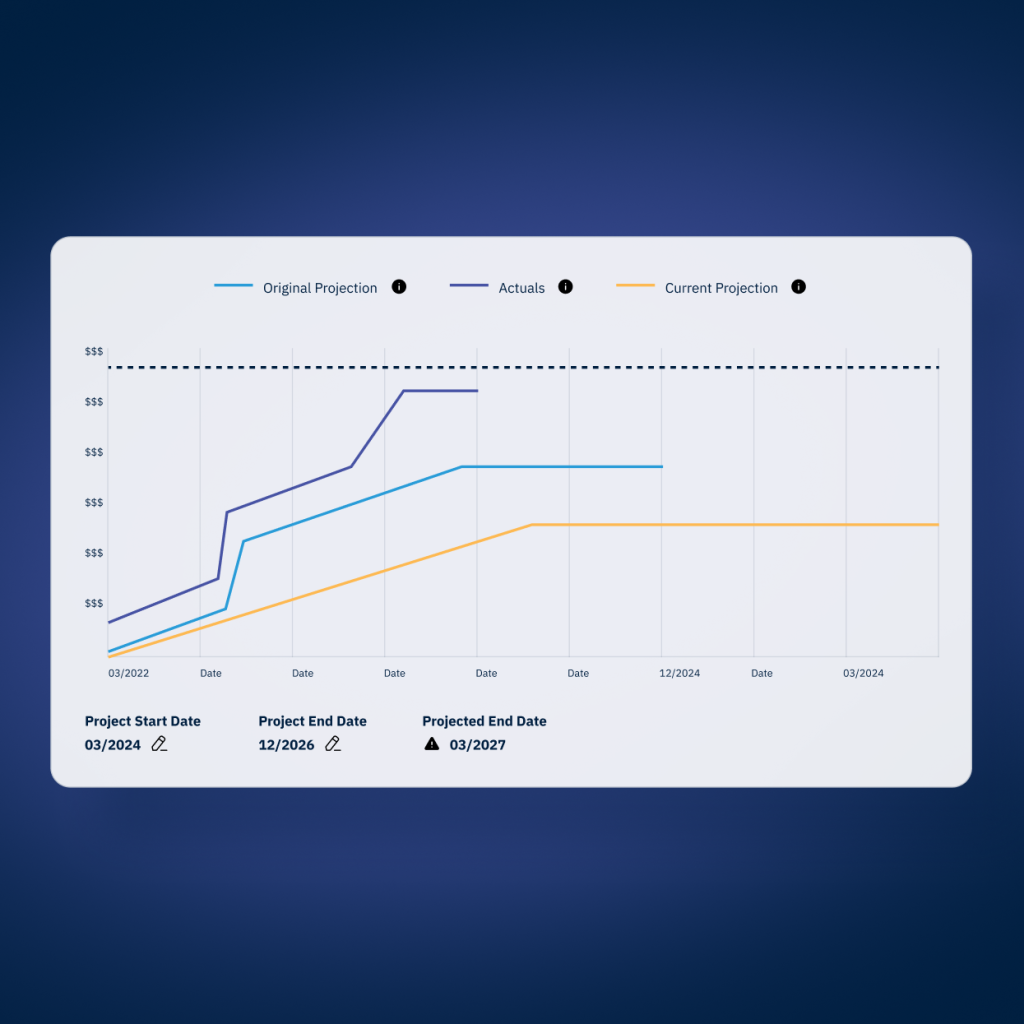
- Cash flow projections using S-curve, linear or manual forecasts that re-forecast as actuals arrive, rolled up to a portfolio capital forecast
- Budget and risk alerts when a project crosses variance conditions the team sets
- Integrations with QuickBooks Online, Yardi, MRI, Bill.com, NexusPayables and AvidXchange
Pricing
Pricing is not public: Rabbet’s own site publishes no prices and sells through its sales process, so get a written per-project quote before budgeting. What the pricing page does not make obvious is that the model is per project, not per seat. Directory-sourced figures, labeled as such and to verify in a quote: G2 lists vendor-provided pricing of $375 per project per month for a Lite tier and $595 per project per month for Standard, and a rival’s comparison page puts typical pricing at $325-$700 per project per month with annual contracts. On a three-project portfolio, even the low end is roughly $1,000 a month – this is priced for active development pipelines, not a single small build. The vendor’s headline outcome claim, 6 days faster funding, comes from its own State of Construction Finance 2025 reporting.
Who it’s for
Developers, owners and asset managers running multiple financed projects with regular lender draw cycles, especially teams whose anticipated cost report currently lives in a spreadsheet pivot table. Lender-side and development finance teams who need every draw line traceable to its invoices will also feel the pull. If your accounting runs on Yardi, MRI or QuickBooks Online, the native integrations keep the draw data and the books in step.
Who should skip it
General contractors and subcontractors: Rabbet is built for the owner’s side of the money, not for field operations, daily reports or project management – G2 reviewers make the same point about its thin field tooling. Single-project builders will struggle to justify per-project enterprise pricing, and teams whose lender insists on its own draw tracking sheet (a real case in G2 reviews, from a housing agency) will pay for a draw workflow they cannot fully use. Confirm your lender will accept Rabbet packages before you sign.
Pros
- The anticipated cost report stays current automatically instead of being rebuilt monthly in Excel
- AI invoice coding plus draw-line traceability attacks the most error-prone paperwork in development
- Missing documents and overdrawn lines are flagged before the draw reaches the lender
- Portfolio view rolls cost to complete and cash requirements up across every active project
Cons
- No published pricing; per-project pricing stacks up fast across a portfolio
- Not a project management or field tool – supers and PMs still need their own system
- Value depends on your lender accepting its draw format and workflow
- Implementation is a sales-led enterprise rollout, not a same-day signup
FAQ
What does Rabbet cost?
Rabbet does not publish pricing. G2 lists vendor-provided figures of $375 per project per month (Lite) and $595 per project per month (Standard); treat those as directory-sourced starting points and confirm your per-project quote, contract term and implementation scope in writing.
Does Rabbet replace our accounting system?
No. Approved invoices sync with the AP and accounting system you already use – QuickBooks Online, Yardi, MRI, Bill.com, NexusPayables or AvidXChange – and your accounting team keeps control of approval and posting.
How does the AI document router work?
Vendor documents flow into one central inbox. The router reads each invoice, codes it to the right budget line and routes it for approval; pay applications are classified the same way. Your team stays in the loop to approve, and every draw line links back to the invoices behind it.
Bottom line
Rabbet is the rare construction finance tool aimed squarely at where development money actually leaks: stale cost forecasts and hand-built draw packages. For a developer running several financed projects, the automatic ACR and AI-routed invoice flow can plausibly pay for the per-project fee. For anyone else – GCs, subs, single-project builders – it is the wrong side of the table and the wrong price bracket. Demo it with your real project data and your lender’s draw format, not the vendor’s sample portfolio.