
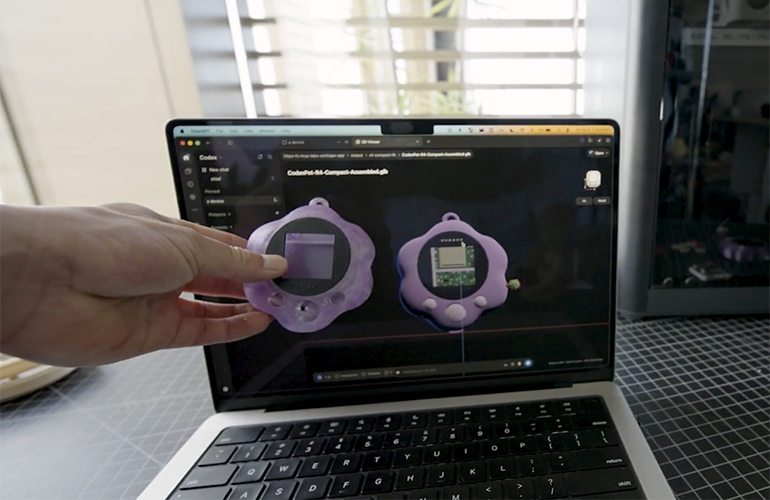
OpenAI says two team members used GPT-6 Astra to design a working hardware device — enclosure, circuit board, and firmware — in under a week, and a contract manufacturer built a small batch of prototypes in under a month. Why it matters: this is one of the first end-to-end demonstrations of a frontier model doing physical engineering, not just writing about it — with OpenAI itself documenting exactly where the model still fell short.
November 3, 2026 — OpenAI described the experiment in a November 3 post on accelerating engineering for the physical world.
What happened?
The device is a small desk companion — researcher Justin Lin calls it a “Codex pet” — with a push-to-talk button and a small display, built so he can check on and talk to his Codex coding agents without opening his laptop. OpenAI labels the images from the project “TamaGPT device experiments” and describes the result as a test device, not a product.
According to OpenAI, Astra defined the functional requirements, designed the enclosure and the internal structures that hold the components, selected the electrical components, and placed and connected them on a printed circuit board sized to fit the case. It also designed the user interface and generated the firmware and software integrations that connect the device to Codex. The two team members worked on it as a side project for less than a week, without directly editing Astra’s design outputs.
Where did the model fall short?
OpenAI is candid about the gap between a complete design and a manufacturable one. Astra did not consistently account for the manufacturer’s production constraints, tolerances, or assembly requirements, so getting the prototypes built took several rounds of review and iteration with the factory. OpenAI says those shortcomings are being used to identify what future models need to improve.
The company also published a benchmark alongside the experiment. On BenchCAD 2.0, which tests whether models can recreate 3D parts and assemblies and determine circuit-board connections, OpenAI reports GPT-6 Astra scored 0.594 at its highest reasoning setting, while a newer internal model scored 0.875. Both figures are company-reported. The same announcement covered expanded engineering work with Chip Ganassi Racing and a new vehicle-design research collaboration with Mazda, and OpenAI says model usage across its hardware teams has grown 23-fold since February.
Why it matters
Strip away the cute form factor and the claim is serious: a general model coordinated industrial design, mechanical design, electronics, and software well enough that a factory could build the result. That is a different capability from generating code or images, and it points at where agent competition is heading next — into CAD tools, simulators, and shop floors. The limits OpenAI disclosed matter just as much: tolerances and assembly are where physical products succeed or fail, and on those, the model still needed humans and a patient manufacturer.
Frequently asked questions
What is the Codex pet?
An internal OpenAI test device with a small display and a push-to-talk button for speaking to and checking on Codex coding agents. It is an experiment, not an announced product.
Did GPT-6 Astra design the whole device by itself?
OpenAI says Astra produced the requirements, enclosure, circuit board, interface, firmware, and integrations without direct human edits to the design outputs — but human review and several rounds of iteration with the manufacturer were still needed before the prototypes could be built.
Will OpenAI sell this device?
OpenAI has not announced any plans to sell it. The company describes it as a test device from an internal side project.
Sources: OpenAI, R&D World, Unite.AI