
LiberAI has launched Liber-0, a “World Action Model” for general-purpose robots pretrained on more than 2.2 million hours of human experience — and in the company’s own zero-shot tests it completed 36% of 60 manipulation tasks it had never been shown on a robot. Why it matters: robot training data is the bottleneck in physical AI, and LiberAI is betting human experience, captured with sensor gloves, is the scalable substitute.
November 4, 2026 — LiberAI, a physical AI startup founded in December 2025, announced Liber-0 on November 3.
What Liber-0 is
Liber-0 is designed to learn the relationships between what a robot sees, the physical actions it takes, and what happens next. Most of its pretraining is large-scale human activity video. The bridge to real action is LiberAI’s LiberSense Glove, a data-collection glove that records hand poses and trajectories while first-person and wrist cameras film the task — giving the model measured physical actions to pair with what it watches, instead of forcing it to guess hand movements from video alone.
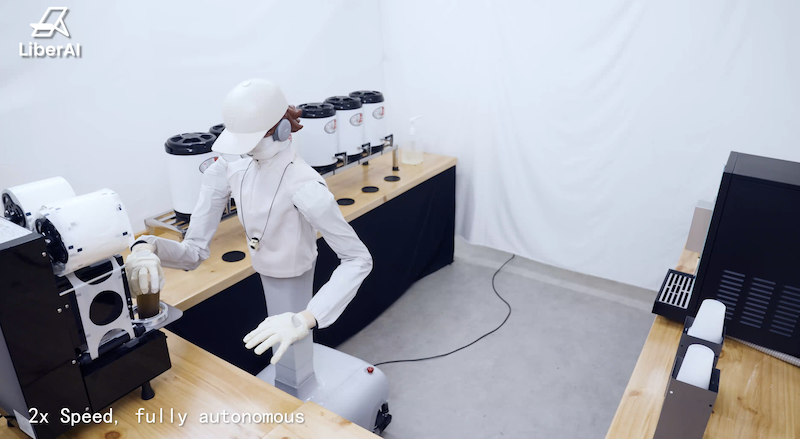
The company’s LEO robot platform mirrors the setup: dexterous hands, articulated wrists and waist, and camera positions aligned with the human data collection, so skills transfer with less translation between bodies.
The test results — company-reported
LiberAI evaluated Liber-0 on 60 tasks proposed by GPT-6 — 20 pick-and-place, 20 other manipulation, and 20 harder long-horizon tasks — each tried 10 times, with no robot demonstrations collected for those specific tasks. The reported success rates were 63.5% on pick-and-place, 34.0% on other manipulation, and 10.5% on the long-horizon group, for 36.0% overall. In a separate eight-task test, a policy trained on just 25% of the robot demonstration pool plus the full glove pool scored 75.6, slightly ahead of the 72.8 scored using the full robot pool alone. All of these numbers come from LiberAI’s own announcement and technical material; no independent evaluation has been published.
Why it matters
Teaching robots has always been limited by how many demonstrations humans can perform on actual robots — slow, expensive, and tied to one machine’s body. Liber-0’s pitch is that the demonstration can happen anywhere, with a glove instead of a robot, and still transfer. A 36% zero-shot success rate will not run a warehouse, and the long-horizon score of 10.5% shows how far general robot competence still has to go. But the direction — foundation models trained on human experience at internet scale, the way language models were trained on text — is the same bet several well-funded robotics labs are now making. Watch for independent replication before treating the numbers as settled.
Frequently asked questions
What is a World Action Model?
LiberAI’s term for a model that learns how visual observations, physical actions, and their outcomes connect, so a robot can generalize physical skills rather than follow task-specific programs.
How did Liber-0 do in testing?
In LiberAI’s own evaluation, it succeeded on 36.0% of 600 trials across 60 tasks it had not been trained on with robot demonstrations — strongest on pick-and-place (63.5%), weakest on long-horizon tasks (10.5%).
Have the results been independently verified?
No. The figures come from LiberAI’s announcement and technical blog. They are plausible and detailed, but company-run.
Sources: LiberAI via ACCESS Newswire, Robotics & Automation News