
Quick verdict
GrayMatter Robotics Review 2026: Physical AI That Scans a Part, Programs Itself and Finishes It
Updated October 25, 2026 – Tested Intelligence
Quick verdict: GrayMatter Robotics sells turnkey robotic finishing cells whose AI scans each part, writes its own program and then grinds, sands, blasts or polishes it — the dusty hand-finishing work that backs up most fab shops. It fits high-mix fabricators whose finishing crew is the bottleneck, but pricing is not public and the cells only finish parts: no cutting, welding or assembly.
What it is
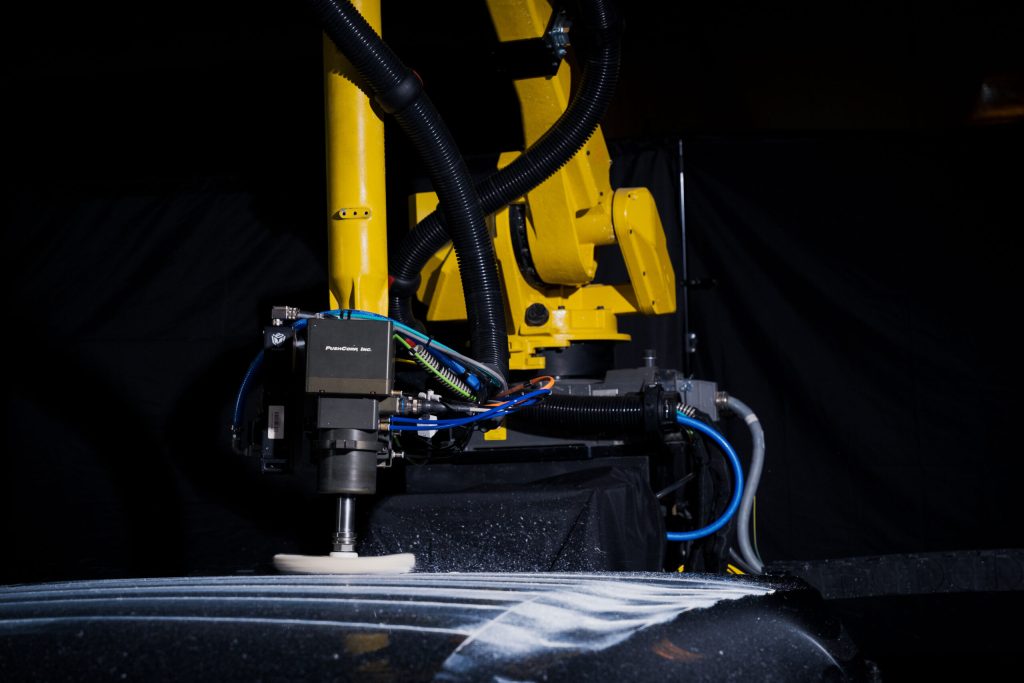
GrayMatter Robotics builds robotic cells for surface finishing and treatment, powered by its Factory SuperIntelligence (FSI) physical-AI architecture — proprietary AI models, domain agents and process optimization. The cells sand, grind, blast, polish, buff, spray and inspect parts in metals, composites and plastics.
Unlike a conventional robot cell, there is no programming, coding or complex fixturing: an operator places a part in front of the robot and presses a button. The system scans the part, models its geometry, plans the toolpath and starts work — from the live scan, no CAD required. For steel fabricators the headline process is grinding: precise material removal across castings and welds, adapting to part variation in real time.
Key features
- Scan-and-run workflow: scans each part and generates its own motion program — no CAD file, no robot programming
- Grinding for fabrication: material removal across castings and welds, adapting force and path to part variation
- Full finishing range: sanding, blasting (rust, scale, coatings — no operator exposure to hazardous dust), polishing, buffing, spraying
- AI inspection: dimensional inspection and defect detection with real-time quality data
- Physics-informed process models: learns each material’s spindle speed, contact force and removal rate
- Flexible formats: single-robot cells on 4, 8 or 12 metre rails, dual-arm cells, a mobile configuration for very large parts
- Robots on Demand: hardware, software, training and 24/7 support in one subscription
Pricing
Pricing is not public. Customers pay a monthly or annual fee covering hardware, software, training and 24/7 support — an operating expense, not a capital purchase, with no heavy upfront CapEx. Buying starts with a demo on your own parts, showing finish, cycle time and capacity gain before quoting. Budget for an ongoing subscription for as long as the cell runs.
Who it’s for
Steel and metal fabrication shops — structural, shipbuilding, heavy equipment, specialty vehicle — where grinding welds and polishing eat skilled hours and quality varies by operator. Because the cell programs itself from a scan, part changes do not mean days of reprogramming, where traditional automation has failed job shops. Its cells already target structural fabrication, including an HII shipbuilding pilot.
Who should skip it
Shops whose bottleneck is welding or cutting, not finishing. Low-volume shops with a small, stable part set should also compare a conventional fixed cell or staffing the work: a self-programming subscription earns its keep on variety and throughput.
Pros
- No programming barrier: new parts run from a scan, about a day of operator training per the vendor
- Attacks the worst jobs: grinding and blasting move dust, vibration and strain off your finishers
- Consistency on high-mix work: one process model per part, where manual quality drifts
- Subscription removes the capital hurdle: hardware, software, training, support in one fee
- Self-contained: Modern Machine Shop notes programs are generated on a machine-side computer, no cloud required
Cons
- No published pricing: real cost emerges only from a demo-and-quote process
- Finishing only: cutting, fit-up, welding and assembly still need people or other automation
- You never own the cell: the subscription runs as long as you use it
- Rail cells up to 12 metres are a real floor-space commitment
- Headline gains are vendor figures: prove them on your own parts in the demo
FAQ
What does GrayMatter’s AI actually do?
Five jobs, per the company’s explanations in Modern Machine Shop: build a 3D model of the part from a scan (fabricated parts often differ from CAD), identify where work is needed, plan the robot’s motion, monitor force feedback and stop safely on a fault, and learn a process model for each new material.
How much does GrayMatter Robotics cost?
Pricing is not public. It is sold as a subscription — a monthly or annual fee covering hardware, software, training and 24/7 support — not a capital purchase. Expect a demo on your own parts first, then a quote based on configuration and processes.
Does GrayMatter replace our welders or fabricators?
No. The cells take over surface finishing — grinding, sanding, blasting, polishing, buffing, spraying, inspection. Fit-up, welding and assembly stay with your crew; the robot does the repetitive, ergonomic-worst passes.
Bottom line
GrayMatter earns a serious look when finishing — not welding — is your fab shop’s constraint: parts queue in front of grinders, quality depends on who holds the tool, and variety has kept conventional robots out. The scan-and-run AI removes the programming excuse; the subscription removes the capital excuse. Send your ugliest, highest-mix parts for the demo, judge it against your crew’s numbers, then talk terms.