
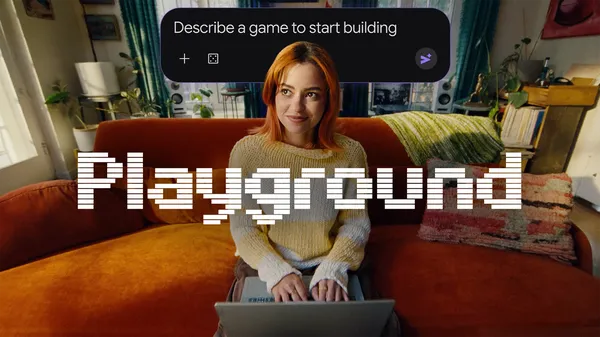
October 8, 2026 — San Francisco. Google and Unity launched Playground, a new experimental AI platform that turns natural-language prompts into playable video games — no coding required — and will be followed by Unity Spark, a more advanced AI creation environment built around the Unity runtime.
What happened
Google launched the first layer, Playground, in the U.S. on October 7. It’s a browser-based platform for users 18 and older that lets anyone start from a blank canvas, remix an existing prompt, or use guided assistance, then modify physics, rules, characters, and environments conversationally while testing the result immediately.
Playground isn’t just a game generator — it combines creation, play, discovery, and distribution in one service. Games can stay private, be shared through a link, or be published to a Playground Explore gallery, where Google uses player ratings and activity to surface popular or novel creations.
The Unity half of the deal
The second layer is Unity Spark, planned for later in 2026 as a more advanced creation environment built around the Unity runtime. Unity describes Spark as a new product rather than a simplified version of the traditional Unity Editor; it’s currently in testing with a closed beta planned soon, intended to let creators refine ideas through the same prompt-driven workflow while gaining substantially more control.
Unity CEO Matt Bromberg told GamesBeat that Spark will connect to the Unity Asset Store, so creators can use tens of thousands of artist-produced 2D and 3D assets rather than depending entirely on AI-generated content. Games built with Spark will also be publishable through Playground, preserving the same discovery layer as creators move from simple generated experiences toward more complex projects.
Details worth knowing
Because games run in a browser, players can access them on phones and laptops without installing a game client. Selected genres support multiplayer, and integration with Google Play Games lets users adopt a gaming handle, compete on leaderboards, like games, and follow creators. Google says every publicly published game undergoes automated safety screening against its community guidelines, supplemented by user reporting.
Creation access will vary by Google One membership — tiered access is rolling out based on users’ subscriptions, though Google hasn’t published the specific creation quotas for each tier. The companies haven’t said which AI model stack powers Playground, and Unity hasn’t finalized Spark’s commercial model.
Why it matters
The AI game-creation demo is a familiar one, but the Google–Unity partnership is structured differently: Playground is a mass-market entry point with built-in distribution, and Spark is the bridge from casual AI-generated games toward professional-grade development on the engine that powers much of the industry. That’s a deliberate two-stage funnel — player to prompt-based creator to Unity developer — and a new acquisition pipeline for Unity among people who never thought of themselves as developers. The open question is engagement: can prompt-created games hold players beyond short experiments? The Spark beta later this year is the real test.
FAQ
What is Google Playground?
An experimental browser platform (U.S., 18+) where you describe a game idea in plain language and get something playable, then tweak it conversationally.
What is Unity Spark?
A separate, upcoming AI creation product built around the Unity runtime for deeper mechanics and higher-fidelity 3D — a step up from Playground, not a replacement for the Unity Editor.
Do I need to know how to code?
No — that’s the point. Playground is designed for people with no game-development experience.
How do games find players?
Through the Playground Explore gallery and Google’s own consumer network, which Google says will promote standout creations.
What does it cost?
Creation access is tiered by Google One membership; specific quotas haven’t been published yet.
Sources: Google blog, Unity partnership announcement, GamesBeat, Financial Times via Traders Union, AI Industry Today.