
Quick verdict
Giatec Review 2026: SmartRock Concrete Sensors With Roxi AI and Giatec 360
Updated November 17, 2026 – Tested Intelligence
Quick verdict: Giatec is a concrete intelligence platform built around one practical question: is the concrete in the structure strong enough yet, right now? Its SmartRock sensors are embedded in the pour, report temperature and estimated in-place strength every 15 minutes using the ASTM C1074 maturity method, and feed the Giatec 360 dashboard and the Roxi AI assistant. For GCs and concrete crews whose schedule turns on form removal, reshoring and post-tensioning, that replaces waiting on break tests with auditable data. The trade-offs are real: pricing is not public, and every sensor stays in the concrete for good.
What it is
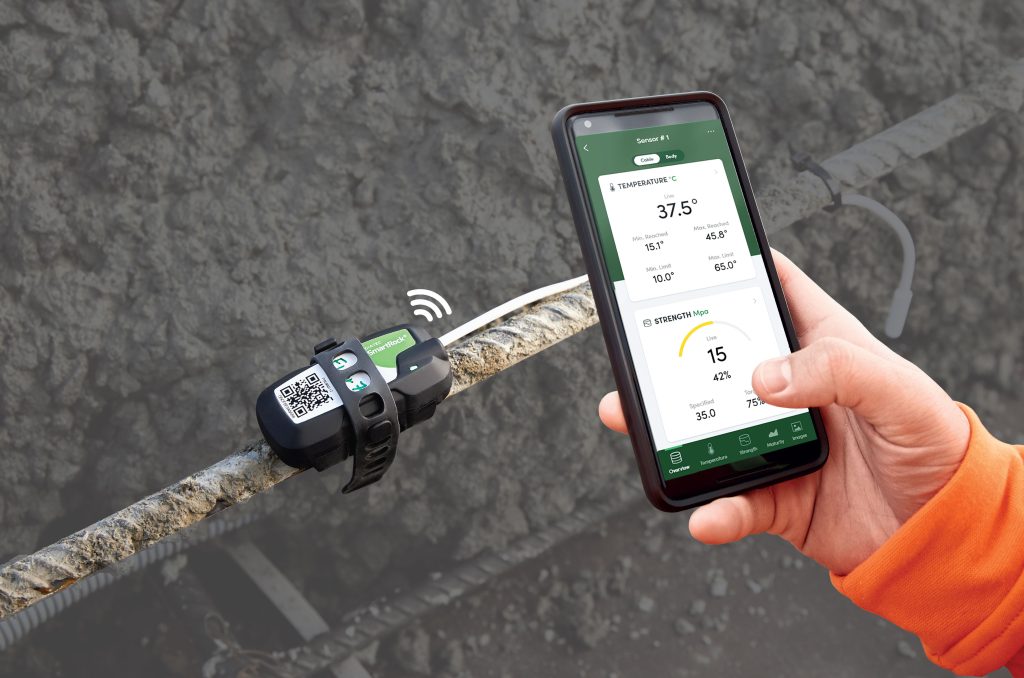
Giatec Scientific, founded in 2010 and headquartered in Ottawa, Canada, sells intelligent concrete testing technology: wireless jobsite sensors, producer software, and lab and non-destructive testing instruments. The jobsite core is SmartRock, a fully wireless sensor clipped to rebar and embedded in fresh concrete. It logs temperature from the sensor body and a cable probe, calculates maturity and estimated strength, and syncs to a free mobile app and the Giatec 360 cloud dashboard. On the producer side, SmartMix manages mix quality and submittals, with Roxi – the AI program Giatec launched in 2019 – analyzing mix and sensor data to flag errors and recommend adjustments. SmartRock Long Range adds a gateway, including a solar option, so large or remote sites stream data continuously instead of relying on someone walking within Bluetooth range.
Key features
- SmartRock embedded sensors: temperature and estimated in-place strength updated every 15 minutes, per ASTM C1074
- Two-point sensing: readings at the sensor body and at the tip of a cable probe, in short and up-to-10 ft cable versions
- Giatec 360 dashboard: pours, sensors, alerts, thermal modeling and reports across projects in one web hub
- Roxi AI assistant: strength predictions, anomaly detection in calibration data, and automatic pour-time detection
- SmartRock Long Range and SmartHub: gateway monitoring for unlimited sensors across a site, with a solar gateway for off-grid work
- SmartMix for ready-mix producers: mix management and optimization using the same Roxi engine
- Integrations: a direct Procore connection and an open API, per the vendor
Pricing
Pricing is not public. Giatec does not publish a rate card for sensors, gateways or Giatec 360 on its own site; the platform is sold by quote, and sensors are also sold through distributors, commonly in packs of 10, at distributor prices that vary by cable length and range version. Directory listings describe Giatec 360 as a free Basic plan plus a Premium plan at custom pricing – treat that structure as directory-sourced and to-verify, and get the sensor count, gateway and software lines priced together in writing.
What the pricing page doesn’t make obvious: the sensor itself has a hard working window, spelled out in Giatec’s own FAQ. A SmartRock logs a reading every 15 minutes for 2 months of data; its battery lasts up to 4 months, so you get about two extra months to retrieve readings after memory fills. The transmitter also has to sit no more than 2 inches (5 cm) from the concrete surface or the wireless signal suffers. Plan sensor placement and retrieval around those limits, not around the pour schedule alone.
Who it’s for
General contractors, concrete subcontractors and testing firms working structural pours where a day of uncertainty is expensive: high-rises, bridges, data center foundations and mass concrete. Giatec’s own Long Range page puts delayed formwork and post-tensioning decisions at $10,000-$15,000 a day – a vendor figure, but the right order of problem. Ready-mix producers get a second use case through SmartMix and Roxi on the plant side.
Who should skip it
Small flatwork and residential crews whose pours are verified fine with standard cylinder breaks and a thermometer will be buying embedded hardware and a dashboard they do not need. Skip it, too, if you want reusable sensors: SmartRock is embedded permanently, so sensor cost is a per-pour consumable cost, and if nobody on the team will act on maturity data – stripping, loading and scheduling from it – the readings change nothing.
Pros
- Measures the concrete actually in the structure, not a field-cured cylinder cured in different conditions
- Strength updates every 15 minutes, with alerts at curing milestones, instead of days waiting on a lab
- Long Range gateway and solar option remove the Bluetooth walk-by problem on big and remote sites
- One platform spans field sensors, the 360 dashboard and producer-side mix AI
- ASTM C1074 method is recognized under ACI 308, ACI 347 and CSA A23.1, with time-stamped, auditable records
Cons
- No public pricing – sensors, gateways and software all require a quote or a distributor
- Sensors are single-placement and stay embedded; the cost repeats on every pour
- Data collection stops at 2 months per sensor, with retrieval only while the up-to-4-month battery lasts
- Transmitter must be within 2 inches of the surface, which constrains placement on thick elements
- Standard sensors need someone within Bluetooth range unless you buy the Long Range gateway system
FAQ
How does SmartRock estimate strength without breaking cylinders?
It uses the maturity method in ASTM C1074: the sensor logs the concrete’s temperature history over time, and the system converts that time-temperature record into an estimate of in-place strength using a calibration for that mix. Giatec positions it as more representative than field-cured cylinders because it measures the element itself.
How much does Giatec cost?
Pricing is not public. Sensors, SmartHub gateways and Giatec 360 Premium are quoted, and distributors sell sensor packs at their own prices, which vary by model. Budget per pour – sensors are embedded and not recovered – and ask for the full sensor, gateway and software quote in writing.
Can one gateway really cover a whole site?
For SmartRock Long Range, Giatec says a single SmartHub gateway manages unlimited sensors across one jobsite and streams data to the cloud continuously; a Solar SmartHub does the same job where site power is unavailable. Standard SmartRock sensors, by contrast, talk to a phone by Bluetooth at short range.
Bottom line
Giatec earns its place on structural work where schedule decisions wait on concrete strength: embedded sensors, a 15-minute maturity feed, and AI that watches the pour and calls the milestones. Go in clear-eyed – no public price, sensors you never get back, and a 2-month data window per sensor. If your pours carry real schedule money, ask Giatec for a per-pour cost on a live project and compare it against the cost of one idle day.