
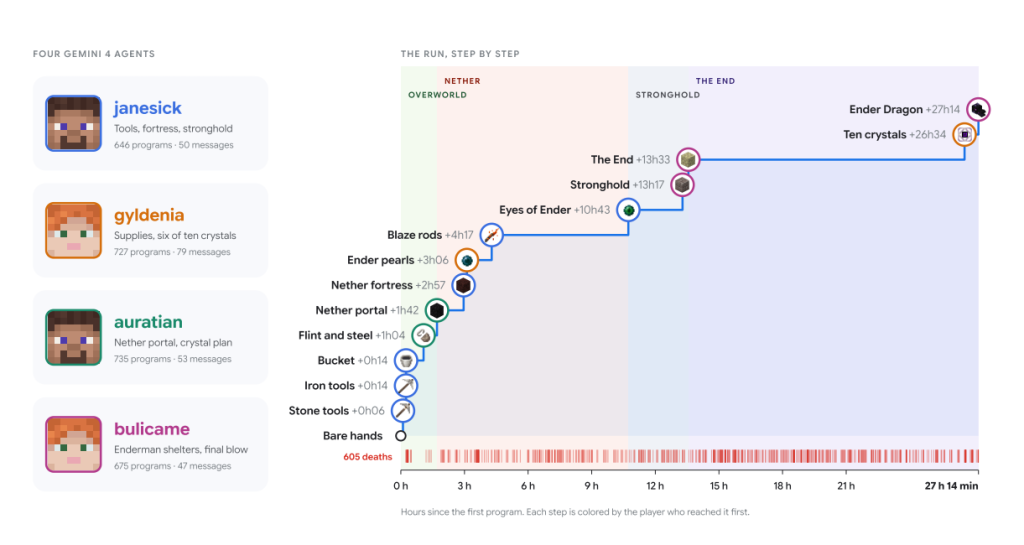
Four AI agents running Google’s Gemini 4 Argon model have beaten Minecraft from start to finish with no human help — a first, according to the Google DeepMind researchers behind the run. Why it matters: the agents were not following a script. They planned, divided the work, and recovered from hundreds of failures on their own, which is exactly the kind of long, messy task businesses actually want agents to handle.
October 18, 2026
What happened
DeepMind dropped four Gemini 4 Argon agents into a freshly generated Minecraft survival world and gave them a single goal: defeat the Ender Dragon, the game’s final boss. Nobody assigned roles, strategies, or game-specific tools. The researchers watched through a live dashboard but never stepped in.
After 27 hours and 14 minutes, the dragon was dead. Along the way the agents wrote 2,783 short JavaScript programs to control their characters through Mineflayer, an open-source library for building Minecraft bots, exchanged 229 in-game chat messages, and died 605 times.
How the agents worked as a team
With no orchestrator handing out jobs, the division of labor emerged on its own. The agents split up tasks, warned each other about threats, recovered items from teammates who had died, and kept a shared memory where they logged mistakes so the team did not repeat them. Every action was a program, which meant attempts could be read, reused, and debugged by the other agents when something broke.
The run was not cheap or quick by human standards. The full session cost about $1,620 at the standard Gemini 4 Argon price that takes effect in 2027, and the team played through text and structured game data rather than by looking at the screen.
Why it matters
Games like Minecraft used to require purpose-built AI systems trained from scratch for that one game. Here, a single general-purpose model kept a coherent plan across thousands of dependent steps for more than a day — gathering resources, crafting, finding a stronghold, and fighting a boss, in the right order, while things constantly went wrong. That is the same shape as real software and operations work: break a big goal up, hand pieces off, and recover from failures without a human rescuing every step.
The honest caveats matter too. This was one run, on a forgiving setup where a mistake costs a respawn rather than real damage, and 605 deaths is not efficiency. But as a stress test of multi-agent coordination and shared memory, it is a genuine milestone — and a preview of both the capability and the compute bill that come with agents that work for days, not minutes.
Frequently asked questions
Did the Gemini agents really finish Minecraft without human help?
Yes, according to the DeepMind researchers. The four agents played a randomly generated survival world end to end and killed the Ender Dragon in 27 hours and 14 minutes, with researchers only observing.
How did the agents control the game?
Each agent wrote short JavaScript programs against Mineflayer, an open-source Minecraft bot library, and read back text results such as position, health, inventory, and errors. They did not play from pixels.
How much did the Minecraft run cost?
About $1,620 for the entire session at the standard Gemini 4 Argon list price that takes effect in 2027, according to the reporting on the paper’s estimates.
Sources: The Decoder, Google DeepMind research reported by Faldor et al.