
Quick verdict
Fernride Review 2026: Human-Assisted Autonomy That Runs Terminal Tractors Without a Driver in the Cab
Updated October 13, 2026 – Tested Intelligence
Quick verdict: Fernride is the supervised-autonomy play for yard and port tractors, with a proof point few rivals match: certification for driverless operation in Europe. Its tractors drive themselves on routine moves, and a remote operator supervising several vehicles steps in only for situations autonomy cannot call. Pricing is not public, and it is a terminal system, not a general site vehicle.
What it is
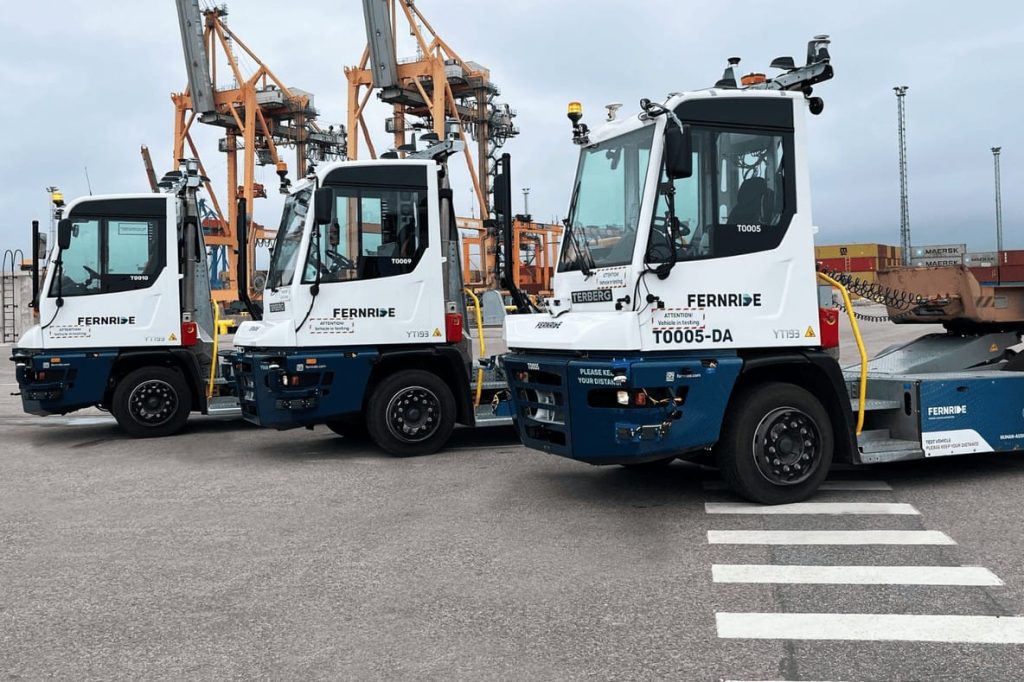
Fernride is a Munich company built on more than a decade of research at TU Munich, applying what it calls human-assisted autonomy to yard trucking – the repetitive tractor moves that shuttle trailers and containers around ports and large sites. Rather than selling a new vehicle, it supplies sensors, computers and software as a kit fitted to conventional terminal tractors. Trade reports describe Terberg tractors carrying the kit under a partnership running since 2021.
In July 2025, Fernride and HHLA began the transition to driverless operation at the HHLA TK Estonia terminal near Tallinn, after its safety concept and system design were certified by TUV SUD and approved by the Estonian Transport Administration. Fernride says it was first to receive TUV SUD certification for an autonomous terminal tractor under the EU Machinery Directive, covering safety, cybersecurity and reliability. Three tractors were in use as driverless working began.
For operators, the job changes rather than disappears: the driver becomes a remote supervisor, taking over only when a tractor asks for help.
Key features
- Human-assisted autonomy: self-driving moves with remote takeover on demand
- Remote operators supervise multiple tractors – a one-to-four ratio reported in current operations
- TUV SUD-certified autonomous terminal tractor platform under the EU Machinery Directive (vendor and trade reports)
- Vehicle kit with radar, lidar and cameras, fitted to drive-by-wire tractors
- Powertrain-agnostic: reported to work with diesel and electric tractors, including retrofits
- Edge-case data fed back into the system via over-the-air updates (trade reports)
Pricing
Pricing is not public. Trade coverage reported an annual software-as-a-service subscription, but no figure, kit price or per-vehicle rate has been published. Expect an enterprise quote built around tractor numbers, kit, teleoperation staffing and support. The comparison that matters is cost per yard move: tractors working across shifts, with one remote operator covering work that would otherwise need several drivers.
Who it’s for
Port terminals, intermodal yards and large logistics sites running terminal tractor fleets on repetitive routes inside a controlled yard. It suits operators facing driver shortages, and sites that want driverless moves today but still want a named human able to take control. Construction-adjacent yards – precast plants, materials terminals, project logistics hubs – are the closest fit here.
Who should skip it
General construction fleets. Fernride is built for terminal tractors in defined yards, not excavators, road dump trucks or one-off haulage. Skip it if you run a single tractor occasionally, your yard layout changes daily, or you need open-road autonomy – it is certified for controlled terminal ground, and that boundary is part of why it works.
Pros
- Certified driverless operation in live European terminal service, not just demos
- Human backup on edge cases keeps the system working instead of stranded
- Retrofit kit protects the tractor fleet you already run
- One remote operator covering several tractors targets the driver shortage directly
Cons
- No public pricing; subscription and kit costs only on quotation
- Terminal tractors in controlled yards only – not a general construction solution
- Driverless approval is jurisdiction-specific; the Estonian clearance does not transfer
- Needs connectivity, control setup and teleoperation staff training
FAQ
Is Fernride fully driverless?
In certified operation the cab is empty. The tractors drive themselves, and a remote operator supervising several vehicles can issue commands or take full control when a tractor meets a situation it cannot resolve.
What vehicles does Fernride work with?
Terminal tractors fitted with its vehicle kit, including Terberg tractors under the companies’ partnership. Trade reports say the system is powertrain-agnostic and can be retrofitted; confirm your model in scoping.
How much does Fernride cost?
Pricing is not public. Trade reports describe an annual software subscription model; expect an enterprise quote based on fleet size and deployment scope.
Bottom line
Fernride earns its place on evidence: a certified system, live driverless tractors and a human in reserve rather than in the cab. If yard tractors stand idle for want of drivers, it is one of Europe’s most credible autonomy options – provided your work really is terminal work.