
Quick verdict
TL;DR: Clairic-flash is Cloudflare’s new 9-billion-parameter extraction model: you send it text, images, or PDF pages and a list of fields, and it returns typed values — with confidence scores and character spans — instead of a paragraph of chat text. On Workers AI it costs $0.10 per million input tokens and output tokens are not charged at all. The weights are open on Hugging Face, so you can also run it yourself for free. For developers pulling structured data out of receipts, invoices, leases, and tickets at volume, it undercuts general-purpose LLMs on both price and latency. It does one job only — extraction — and Cloudflare’s accuracy numbers are its own internal evals, not public benchmarks.
What is Clairic-flash?
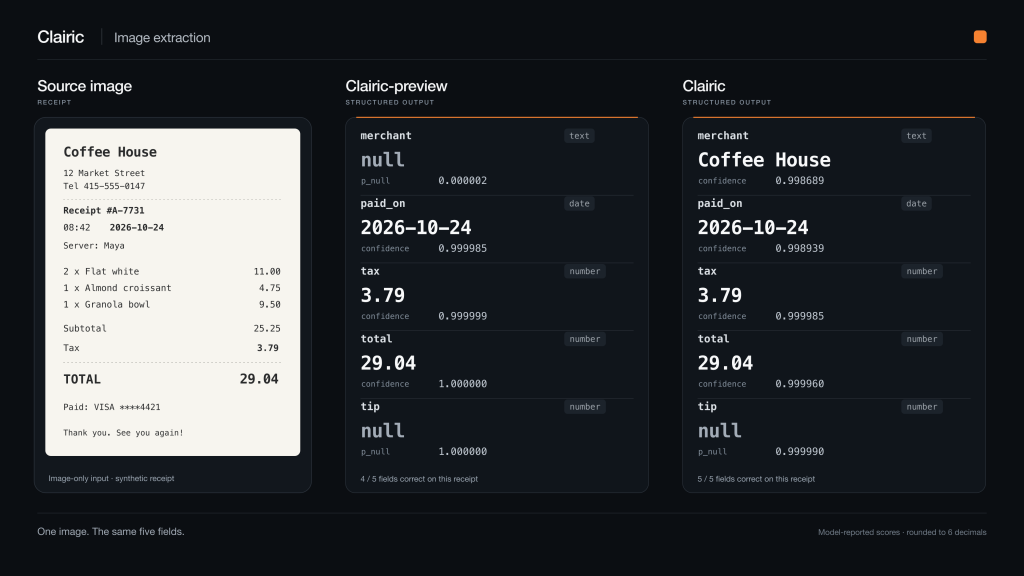
Cloudflare announced Clairic-flash on November 18, 2026, alongside a redesigned 27B Clairic, in a post on the Cloudflare blog. Both come from the new Workers AI superintelligence team and both are “System One” models in Cloudflare’s framing: small, fast, cheap models built for one specific task instead of general chat. That task is extraction — reading unstructured input and returning specific fields. We covered the original Clairic preview in our news coverage of the first Clairic release; this release redesigns the architecture, adds PDF and image reading, and splits the family into the 27B Clairic and this 9B flash variant.
The redesigned Clairic uses what Cloudflare calls parallel slot autoregressive generation: each requested field generates its value using its own tokens, all fields advance together, and special heads handle computation-style fields — estimates, forecasts, durations, calculated dates, and explicit arithmetic. Every response keeps the typed interface from the preview: values come back with confidence scores, character spans showing where in the source each value came from, and probabilities.
What does Clairic-flash do well?
- Reads text, images, and PDFs in one request. Ask for the supplier, line items, and total from an invoice PDF even when they sit on different pages; line items return as rows that keep description, quantity, and price together.
- Sub-second responses. In Cloudflare’s latency tests, Clairic-flash answered text-field requests at a 155 ms median and image-field requests at 305 ms — far faster than a general LLM round-trip.
- Grounded answers. Character spans tie each extracted value back to its source location, which makes automated checking and human spot-review practical.
- Open weights. Both models are published on Hugging Face, so teams can self-host, fine-tune, and experiment without per-token costs.
How much does Clairic-flash cost?
| Option | Price | Notes |
|---|---|---|
| Clairic-flash (9B) on Workers AI | $0.10 per million input tokens | Output tokens are not charged — Cloudflare covers generation cost |
| Clairic (27B) on Workers AI | $0.24 per million input tokens | Promotional $0.10 rate for both models until December 1, 2026 |
| Self-hosted open weights | Free (your infrastructure) | Full weights for both models on Hugging Face |
What the pricing page doesn’t make obvious
Two details from Cloudflare’s own launch post. First, the billing is genuinely input-only: the model does generate output tokens, but Cloudflare says it eats that cost — your bill scales with the size of the documents you send, not the number of fields you ask for. Second, there is a hard input cap that matters for document pipelines: you can include up to four images or PDF pages in total per request. A 30-page contract does not go in one call; you will be chunking it yourself. And note the calendar: the 27B model’s $0.10 promotional price ends December 1, 2026, when it rises to $0.24 — Clairic-flash stays at $0.10.
Strengths
- Purpose-built beats general-purpose on this job. Typed fields with confidence and spans are what extraction pipelines actually need; tools like Firecrawl solve the neighboring problem of getting web content in, and Clairic-flash is the matching piece for getting values out of documents.
- Price and latency together. $0.10 per million input tokens with sub-second responses makes per-document costs effectively negligible at moderate volumes.
- No lock-in. Open weights mean the hosted API is a convenience, not a cage — you can move the same model in-house.
- Computation heads. Fields that need arithmetic, date calculation, or estimation are handled by design rather than by hoping a chat model does the math.
Weaknesses
- The accuracy claims are self-reported. Cloudflare is explicit that no public extraction benchmarks exist yet; its tables (including a jump from 207 image-reading errors to 0 on its internal set) are directional, by its own admission.
- Four pages or images per request. Long documents need your own chunking and reassembly logic.
- Extraction only. It will not summarize, reason over, or converse about your documents — pair it with a general model if you need that too.
- Preview users were migrated in place. If you built on the preview endpoint, your calls now hit the redesigned 27B model — better by Cloudflare’s evals, but behavior changes under existing code deserve a regression pass.
Who is Clairic-flash for?
Developers and product teams extracting structured fields from receipts, invoices, support tickets, leases, and forms at any real volume — especially teams currently paying a frontier chat model to do a job it is slower and more expensive at. It is not for end users: there is no app, no chat window, just an API (endpoints @cf/cloudflare/clairic-flash and @cf/cloudflare/clairic on Workers AI) and open weights.
Verdict
Clairic-flash is a clean example of where AI tooling is heading: small specialist models doing one job measurably cheaper than the giants. The input-only pricing, grounded spans, and open weights make it easy to test and hard to get trapped in. Test it on your own documents before trusting the headline accuracy — but at $0.10 per million input tokens, the test costs almost nothing.
FAQ
Is Clairic-flash free?
The model weights are free to download from Hugging Face and self-host. The hosted Workers AI version costs $0.10 per million input tokens, with no charge for output tokens.
What is the difference between Clairic and Clairic-flash?
Clairic is the larger 27B model and scored highest on Cloudflare’s internal extraction evals; Clairic-flash is the 9B model — somewhat lower accuracy on those same evals, roughly twice as fast, and cheaper at $0.10 versus $0.24 per million input tokens.
Can Clairic-flash read PDFs and images?
Yes — new in this release. You can include up to four images or PDF pages in total per request, and extract fields that appear on different pages in a single call.
How accurate is Clairic-flash?
Cloudflare’s internal evals show it close behind the 27B model and ahead of the preview version, but the company states plainly that no public extraction benchmarks exist yet and its numbers are self-reported. Validate on your own documents.