
Quick verdict
Bobyard Review 2026: Trade-Specific AI Electrical Takeoff and Estimating
Updated October 13, 2026 – Tested Intelligence
Quick verdict: Bobyard’s Electrical Takeoff, launched in June 2026, is AI built only for electrical drawings: it counts receptacles, switches and fixtures, ties circuits to their panels, auto-routes homeruns and estimates wire lengths, then rolls quantities into a built-in estimate. The models are trained per trade rather than borrowed from a generic counter, and named electrical contractors helped build it in beta. Pricing is not public – it is a book-a-demo sale, and the product is young.
What it is
Bobyard is an AI takeoff and estimating platform for trade contractors, founded in 2023 in San Francisco. Each trade gets its own model suite, trained by its in-house computer-vision team on construction drawings and blueprint annotations. Electrical is its expansion trade: upload E-series drawings, panel schedules, riser diagrams, symbol legends and spec books, and the AI extracts the takeoff in minutes, grouped by system, with a confidence score on detections for estimator review.
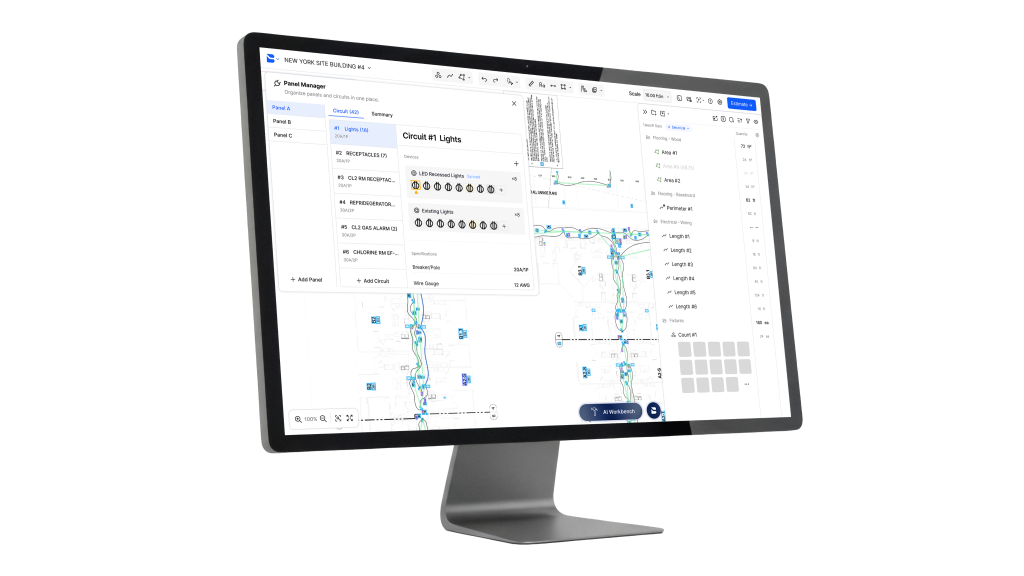
The electrical depth is the pitch. Panel schedule intelligence pulls frame size, circuit count, wire size and breaker size and ties them back to devices on the plan. Riser counting handles transformers, switchboards and generators and connects them to feeder routing. Homeruns are auto-routed from panel location, building geometry and circuit logic, with linear feet of wire calculated per circuit, including multi-floor risers and drops. A spec and RFI chatbot – ask it about anything in the specs, drawings or RFI log – rounds out the review work.
Key features
- Auto-detection and counting of devices, fixtures, panels and equipment
- Circuit-to-panel identification directly from the drawings
- Conduit and wire auto-routing with homeruns and wire-length estimates
- Panel schedule intelligence: frame, circuit, wire and breaker sizes
- Riser and equipment counting tied to feeder routing
- Quantities flow into a built-in estimate table with material and labour
- Spec and RFI chatbot, plus a dedicated customer success manager (vendor)
Pricing
Pricing is not public. Bobyard sells through demos – it will run a live takeoff on one of your own projects – and publishes no rates. The company says contractors report 50-90% faster takeoffs on its site, and its launch release cites an average 65% takeoff-time reduction and 3-5 times more bids per estimator across its existing platform. Those are vendor-reported figures from its earlier trades, so judge the electrical product on your own demo drawings, not the headline.
Who it’s for
Commercial electrical contractors and estimating teams turning away bids for lack of counting hours. That is literally the launch story: Wells Electrical, quoted in the release, said work was being left on the table for want of bid time, and Banister Electrical partnered through the beta. Small shops chasing more bids per week and large teams scaling a pipeline without adding estimators are both named targets.
Who should skip it
Residential service electricians – this is plan-set, commercial new-construction software. Also be cautious if you need a long track record: Electrical Takeoff only launched in June 2026, so the electrical-specific proof is months old, however strong the company’s landscaping and sitework base is.
Pros
- Models trained specifically on electrical drawings, symbols and schedules
- Goes beyond counts: circuits, panels, homeruns and wire lengths
- Takeoff and estimate in one workflow, no export-and-rebuild
- Demo runs on your own project before you commit
Cons
- No public pricing
- Electrical product launched June 2026 – short track record in this trade
- Headline speed figures are vendor-reported, largely from other trades
- Estimators still verify every detection before pricing
FAQ
What does Bobyard Electrical Takeoff automate?
Counting receptacles, switches and fixtures, identifying circuits and their panels, routing wires and homeruns, estimating wire lengths, and rolling quantities into a pre-built estimate with material and labour.
How much does Bobyard cost?
Pricing is not published – it is sold by demo and quote. Bobyard offers to run a live takeoff on one of your own projects as part of that process.
Is Bobyard only for electrical?
No. It builds a separate AI model per trade and also supports landscaping, plumbing, finishes and sitework workflows, with more trades in development. The electrical workflow is the one reviewed here.
Bottom line
Bobyard is the new, electrical-obsessed entrant in AI takeoff: deeper in panels, circuits and homeruns than generic counters, and honest about keeping the estimator in the verification loop. It is young and quote-only, so take the demo on a real, messy plan set – if it counts that one right, it earns the next conversation.