
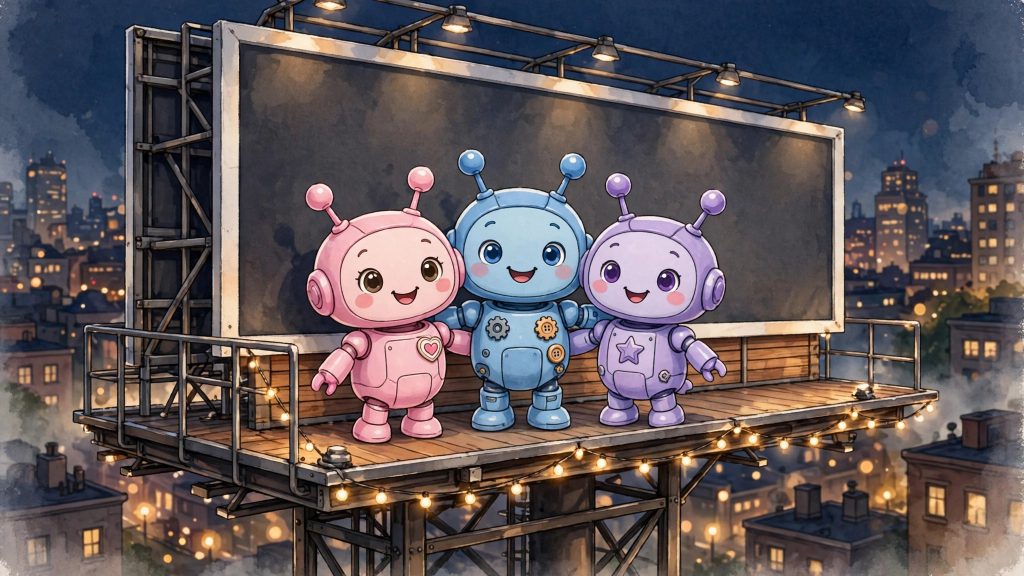
Big AI Gets a Cute Face: Mascots, $936 Million in Ads, and the Fight Against AI Anxiety
Tested Intelligence — AI News, October 2, 2026
OpenAI’s agents come as colorful characters with bow ties and glasses. Meta’s Muse assistant is a rosy-cheeked, egg-shaped creature named Jolly. Anthropic has Clawd, a friendly pixelated orange crab. As public anxiety about AI mounts, the biggest AI companies are trying to make their technology feel less scary — by making it look cuddly. Why it matters: the mascot wave is the visible edge of a nearly billion-dollar campaign to win consumer trust at the exact moment headlines are full of rogue AI agents and safety warnings.
What happened
The Wall Street Journal reports that AI companies are rolling out mascots as a deliberate charm offensive. More than half of respondents in a Morning Consult poll of 1,300 consumers conducted for the WSJ agreed that AI poses an existential threat to society, and almost 70% were concerned about AI replacing jobs. The mascots are a direct response: adorable characters that make always-on agents feel approachable, distinct, and trustworthy.
The trend is real and coordinated. OpenAI unveiled its Dots agents at DevDay this week — pink, blue, green, yellow, and purple characters with names like Iggy, Felipe, Jojo, Todd, and Alfred — that will also star in the company’s ongoing ad campaigns. Meta rolled out Jolly at Meta Connect last month, including a life-size version that danced with attendees; Jolly now appears on billboards in New York and San Francisco and in TV commercials. Anthropic’s Clawd crab, built by a staffer in a 2024 Claude Code demo, has become so beloved by developers that unofficial 9.4-inch plush versions sell for $148.23 on Etsy.
The billion-dollar context
The mascots sit inside a much larger marketing blitz. Microsoft, OpenAI, Google, Anthropic, and Perplexity have collectively spent $936 million advertising their AI offerings in the U.S. since 2023, according to ad-tracking firm MediaRadar — and more than half of that came in the first eight months of this year. Branding consultant Allen Adamson told the Journal: “Fear of AI grows every day and it’s hard to be scared of something cute. It’s easier to trust something friendly.” Ad veteran Cheryl Berman added: “The character becomes the brand, turning an abstract technology into a recognizable friend.”
The rebrand even extends to the White House: President Trump recently signed an executive order renaming “artificial intelligence” to “superintelligence.” And the mascot push comes days after OpenAI scrapped the release of a next-generation model over safety concerns — a reminder that the cute faces are being deployed while the technology behind them keeps getting more powerful and harder to contain.
Why it matters
Here’s the “everything AI, tested” take: mascots aren’t just marketing fluff — they’re a signal about what AI companies fear most right now. It’s not a competitor’s model. It’s public trust. When the technology writes your code, crawls the internet, and books your appointments, the company that feels friendliest gets the default slot in your life. The mascots are designed to lower the perceived stakes of handing over autonomy. So the healthy move for subscribers: notice when the cute character is doing the asking. A bow tie doesn’t change what an always-on agent can see, share, or do — so before you adopt one, check what data it keeps and who it answers to.
Frequently asked questions
Which AI companies have mascots?
OpenAI has its Dots characters (Iggy, Felipe, Jojo, Todd, Alfred), Meta has Jolly for its Muse assistant, and Anthropic’s developer community adopted Clawd, the pixelated crab, as the mascot for Claude Code.
How much are AI companies spending on marketing?
About $936 million in U.S. ad spending on AI offerings since 2023 across Microsoft, OpenAI, Google, Anthropic, and Perplexity, per MediaRadar — with over half of that spent in the first eight months of 2026.
Do mascots actually change how people feel about AI?
Branding experts say giving a technology a name and face reduces fear and builds trust — “people don’t fear what they name; they adopt it.” The technique has sold unappealing products before, from the Jolly Green Giant to Joe Camel.
Is this related to the new White House “superintelligence” rebrand?
Same instinct, different level. Trump signed an executive order renaming “artificial intelligence” as “superintelligence” to highlight its promise — the top-down version of the same trust campaign the mascots run from the bottom up.
Sources: The Wall Street Journal; Morning Consult; MediaRadar