
Quick verdict
Best AI Voice Recorders in 2026: Plaud and the Rest, Compared
Updated October 16, 2026 – Tested Intelligence
Plaud owns the mindshare in AI voice recorders, and its Note Pro and NotePin S are the most polished hardware here – but they are not the whole market. Omi undercuts everyone on price and openness, Amazon’s new Bee Frontier is the cheapest way in, and if your conversations happen on Zoom, an app like Otter may beat any gadget. Budget for the pattern every device here shares: a one-time hardware price plus a transcription subscription.
| Tool | Price | Best for |
|---|---|---|
| Plaud Note Pro | $189 + optional plan | Calls and meetings, most polished app |
| Plaud NotePin S | $179 + optional plan | All-day in-person conversations |
| Omi | $129 (list $179) | Developers, tinkerers, lowest entry price |
| Bee Frontier | $74.99 + Bee Pro $11.99/month | Amazon and Alexa households |
| Mobvoi TicNote | $159.99 + optional plan | An AI agent that works across projects |
| soundcore Work | $159 + optional plan | The smallest, most discreet recorder |
| Otter.ai (app) | Free plan; Pro $8.33/user/month billed annually | Online meetings without new hardware |
Plaud Note Pro
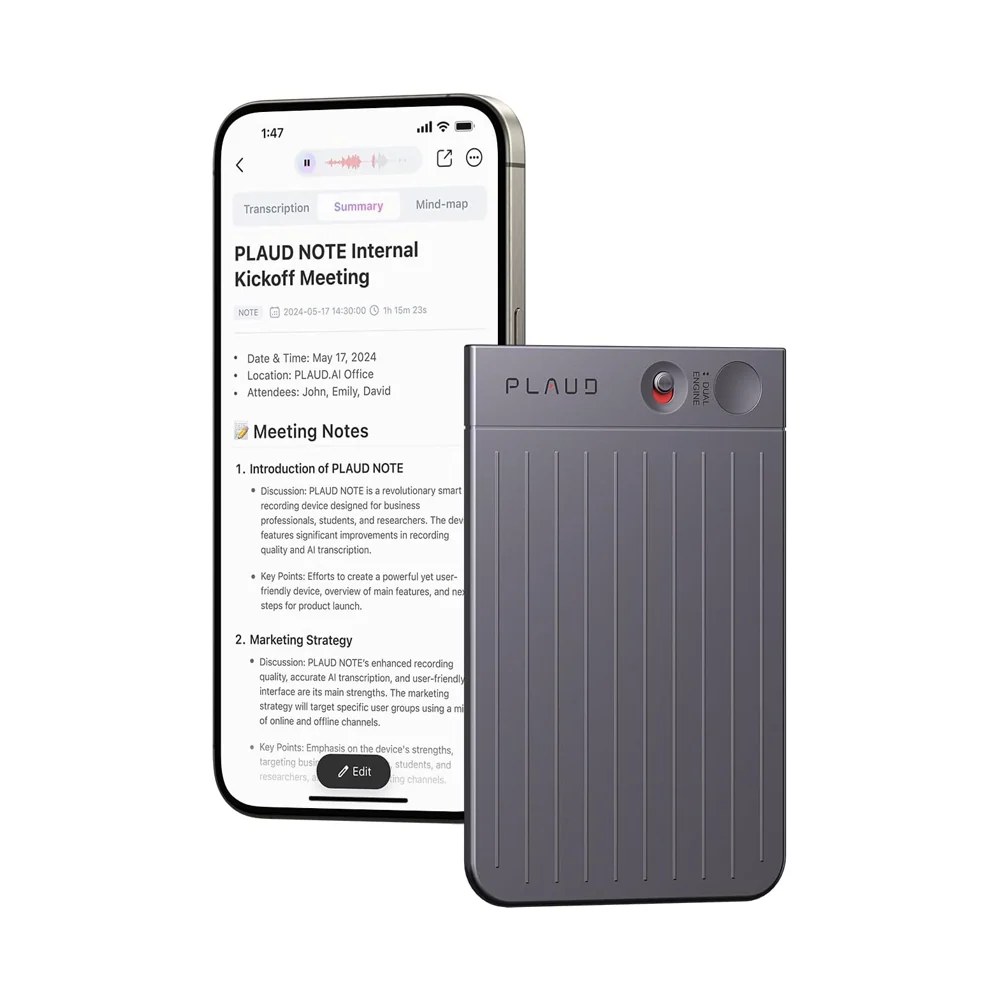
The Note Pro is Plaud’s flagship: a credit-card-sized recorder (about 0.12 inches thin) with a small status display, a four-microphone array and both phone-call and in-person recording modes. It feeds the Plaud app, which transcribes in 112 languages with speaker labels and turns recordings into structured summaries, mind maps and to-do lists from thousands of templates; Ask Plaud lets you query a recording afterwards. It lists at $189 on Plaud’s store. Every Plaud device includes the Starter plan with 300 transcription minutes a month free; Pro raises that to 1,200 minutes for $99.99 a year, and Unlimited costs $239.99 a year. Note the real cost driver: heavy recorders will live on a paid plan.
Best for: Professionals who record a mix of calls and in-person meetings and want the most mature app.
Plaud NotePin S
The NotePin S is the wearable sibling: a small puck you can wear as a pin, clip, necklace or wristband, with a physical button to start recording and mark highlights. It carries 64GB of storage and is rated for about 20 hours of continuous recording per charge, aimed at people whose work happens face to face – clinicians, sales reps, field supervisors, journalists. It records in-person conversations (unlike the Note line, the pins do not do phone-call recording). The NotePin S lists at $179 on Plaud’s store; the original NotePin is $159. Both run on the same Plaud plans as the Note Pro: 300 free minutes a month, then Pro at $99.99 a year or Unlimited at $239.99 a year.
Best for: All-day, in-person capture where pulling out a phone is awkward.
Omi
Omi is the open-source pendant: a small wearable that captures conversations and syncs them to an app for transcription, summaries and searchable memories. Omi’s own store currently lists it at $129, down from $179. The free plan is unusually workable – unlimited transcription processed on your phone plus 300 cloud transcription minutes a month – and Omi’s help center lists Plus at $19/month (1,500 listening minutes) and Unlimited at $29/month or about $269 a year. Because the software is open, developers get an API, webhooks and a large library of community apps and integrations (Omi advertises 1,000+), which no closed rival matches. The trade-off is polish: this is the enthusiast’s option.
Best for: Developers and tinkerers who want their recordings feeding their own tools.
Bee Frontier
Bee is Amazon’s entry in this category – Amazon acquired the startup in 2025 and relaunched the line in October 2026. The Bee Frontier is a wrist-worn or clip-on wearable priced at $74.99, the cheapest hardware here, with a phone-attaching sibling, the Bee Eclipse, announced at $99.99. The free tier covers conversation summaries, recaps and 14 days of memory; Bee Pro at $11.99 a month (or $99 a year) adds unlimited summaries, daily memories, suggested tasks, a personal assistant and Alexa+ and Amazon integrations. Amazon says Bee processes audio in real time and deletes it rather than storing recordings, keeping encrypted transcripts and summaries. It is a personal-memory product more than a meeting tool.
Best for: Amazon and Alexa households curious about always-on personal memory, at the lowest price.
Mobvoi TicNote
TicNote is a card-style recorder from Mobvoi (the TicWatch maker) that sticks magnetically to the back of a phone and sells for $159.99 on Mobvoi’s store. Its pitch is the AI agent, Shadow: beyond transcribing in 120+ languages and producing summaries and mind maps, Shadow organizes recordings into projects and can run research across everything in a project, connecting points between meetings. The included free plan provides 300 credits a month for transcription and AI features; the Pro plan raises that to 1,500 credits a month (Mobvoi sells it as a monthly or annual subscription, with extra credit packs available). If you think in projects rather than single meetings, TicNote’s structure will feel natural.
Best for: Consultants and PMs who want insights across a whole project’s recordings.
soundcore Work
Anker’s soundcore Work is the smallest recorder here: a coin-sized disc about 0.91 inches across and roughly 10 grams, worn on a clip or lanyard, with a tap to record and a double-tap to mark a moment. It is rated for about 8 hours of recording, or 32 hours with its charging case, and transcribes in 100+ languages with speaker separation. Anker’s privacy approach is to process audio in the cloud and delete it after transcription, keeping transcripts and audio in the app. It lists at $159; a free starter allowance is included and the Pro plan adds a larger monthly transcription allowance (soundcore’s Amazon listing puts Pro at 1,200 minutes a month, with the subscription around $16 a month at launch).
Best for: Anyone who wants the recorder to disappear – one tap, no screen, no fuss.
Otter.ai
The app-only pick. If most of your conversations are Zoom, Teams or Google Meet calls, Otter records them with a meeting bot (or its desktop app, without a bot), produces a live collaborative transcript, and generates summaries and action items – no hardware to charge. The free Basic plan includes 300 transcription minutes a month with a 30-minute cap per conversation. Pro costs $8.33 per user per month billed annually ($16.99 monthly) for 1,200 minutes and 90-minute meetings; Business is $19.99 billed annually. Otter will not help in a hallway or on a site walk – that is the hardware’s reason to exist – but for desk-based meetings it is the cheapest serious option here.
Best for: Desk workers whose meetings are already online.
FAQ
Do I need a subscription with an AI voice recorder?
Usually, for anything beyond light use. Plaud, TicNote and soundcore all include a starter allowance (around 300 minutes or credits a month), and Omi’s free plan goes further with unlimited on-phone transcription. Price the device plus a year of the plan you will actually need.
Is it legal to record conversations with these devices?
It depends where you are. Some US states allow one-party consent; others require everyone in the conversation to agree, and rules differ again internationally and in workplaces. These devices are discreet by design, which makes it your job to announce the recording and get consent where required.
What happened to the Limitless Pendant?
Limitless was an early favorite at $99, but the company was acquired by Meta and stopped selling the pendant to new customers, so it is not a pick here. Existing owners have largely been pointed toward alternatives such as Omi.
Where do my recordings go?
Almost all of these products transcribe in the cloud; Plaud lists compliance certifications including SOC 2 and HIPAA on its product pages, while Bee and soundcore emphasize deleting audio after processing. Omi is the outlier that can process transcription on your phone. Read the privacy page of whichever you choose before recording anything sensitive.
Bottom line
Buy the Plaud Note Pro if calls and meetings both matter and you want the safest all-round package; buy the NotePin S if your work is face to face. Buy Omi if price and openness matter most, Bee Frontier if you are deep in Amazon’s ecosystem, and skip hardware entirely for Otter if your day is already spent on Zoom. Whichever you pick, decide based on the subscription you will be paying in month thirteen, not the box price.