
Quick verdict
Avvir Review 2026: Scan-to-BIM Verification That Flags Work Built in the Wrong Place
Updated November 24, 2026 – Tested Intelligence
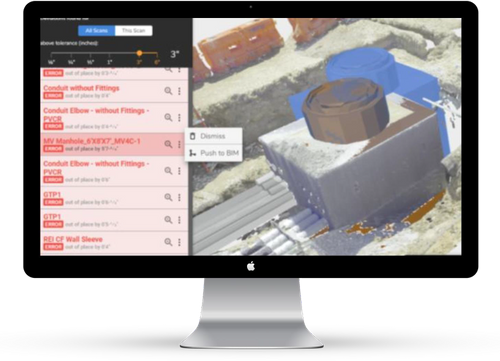
Quick verdict: Avvir compares laser scans and photos of the work actually installed against the BIM model and flags what is missing, misplaced or out of tolerance, then updates the model toward a true as-built. It has been part of Hexagon since October 2022, and it is aimed at owners and GCs on model-driven projects — not at teams without a BIM workflow. Pricing is not public, and the AI does not catch everything: small items still need human eyes.
What it is
Avvir, founded in 2017 and headquartered in New York, is a reality analysis platform for commercial, infrastructure and industrial construction. Hexagon AB acquired the company in October 2022 and folded its AI-powered technology stack into Hexagon’s construction portfolio. The core job is verification. Crews or a capture service collect laser scans and 360-degree photos as work goes in; Avvir aligns that reality data with the BIM model, element by element, and reports where the built work deviates from the design — a column off its gridline, ductwork installed at the wrong elevation, an element that simply is not there yet. The same comparison drives progress tracking, because an element shown as installed is one you can bill for. Avvir also sells capture itself through its Onsite service for customers who do not want to run it in-house.
Key features
- Automated scan-to-BIM comparison: laser scan and photo data aligned against the model to detect deviations
- Deviation reporting that flags missing, misplaced and out-of-tolerance elements for QA/QC follow-up
- Progress tracking based on what the capture shows as actually installed, rather than self-reported percentages
- As-built model updates: verified reality data pushed back into the BIM model toward a working digital twin
- Avvir Onsite: vendor-run data capture (360 photos, LiDAR scanning, drone imagery) for teams without capture staff
Pricing
Pricing is not public. Avvir publishes no per-project rates, seat prices or square-foot figures on its site; buying starts with a sales conversation, and the Onsite capture service is priced on top of the software if you use it. Budget accordingly: this is enterprise reality-capture tooling sold to project teams, not a subscription a superintendent puts on a card.
What the pricing page doesn’t make obvious: there is no pricing page to misread — but there is a capability limit most coverage skips. As RICS noted in its profile of the platform, Avvir’s algorithms are accurate but cannot detect 100% of anomalies, and human operators are still required to identify smaller items such as pipes and electrical conduits. The scan comparison narrows the QA/QC hunt; it does not eliminate the human pass.
Who it’s for
Owners and GCs on BIM-driven jobs who already scan — or will start — and want deviations caught while the responsible trade is still on site.
Who should skip it
Teams without a usable BIM model: scan-to-BIM comparison has nothing to compare against. Small builders and residential contractors will find the enterprise sales process and capture overhead out of proportion to the job, and anyone expecting fully automatic QA should re-read the human-review limit above.
Pros
- Catches misplaced and missing work early, while fixes are still cheap
- Progress claims rest on captured reality, not on reported percentages
- Backed by Hexagon since 2022, with capture services available if you lack scanning staff
- Verified as-builts carry value into handover and facilities management
Cons
- Pricing is not public; procurement is a sales cycle, not a signup
- Detection is not complete — small-bore pipe and conduit still need human checking
- Value depends on regular, disciplined reality capture on site
- Useless without a current, coordinated BIM model to compare against
FAQ
Who owns Avvir?
Hexagon AB acquired Avvir in October 2022 and integrated its AI-powered reality analysis technology into Hexagon’s construction solutions portfolio.
Does Avvir capture the scans itself?
It can. Customers can submit their own scan and photo data, or use the Avvir Onsite service, where Avvir staff and partners collect 360 photos, LiDAR scans and drone imagery for you.
Does Avvir replace QA/QC inspections?
No. Its algorithms flag deviations between the scan and the model, but smaller elements such as pipes and electrical conduits can be missed, so human verification remains part of the workflow.
Bottom line
Avvir is a verification layer for model-driven construction: it turns routine reality capture into an early-warning system for work built wrong or not at all. Buy it for deviation detection and defensible progress data, keep humans in the QA loop, and expect a quoted enterprise price rather than a published one.