
Quick verdict
Asite Review 2026: A Common Data Environment That Now Scores Your P6 Schedule
Updated November 11, 2026 – Tested Intelligence
Quick verdict: Asite is an enterprise common data environment (CDE) for capital projects, built since 2001 around one governed record for documents, contracts and spend. Its new Asite PMIS, launched November 3, 2026, scores a Primavera P6 programme against all 14 DCMA checks and uses Asite AI to draft month-end commentary. Pricing is not public, and this is owner and Tier-1 territory, not small-builder software.
What it is
Asite, founded in 2001 and based in the UK, brings everyone on a large capital project onto the same documents, drawings and blueprints, with commenting, mark-up and a full audit trail. Around that CDE core sit contract management, project financials, supplier prequalification and tendering, and the Adoddle Field app for site tasks and punch lists.
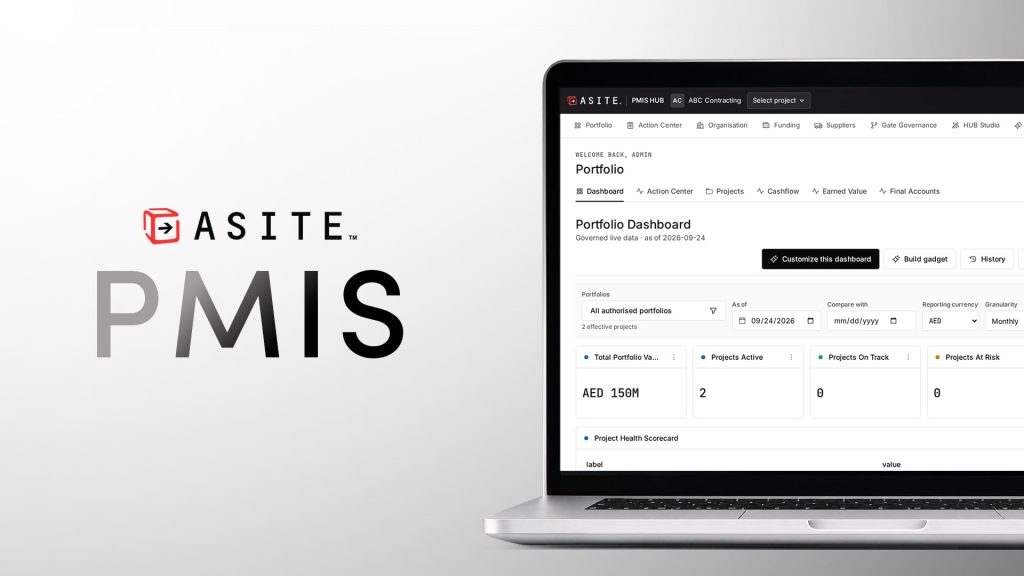
PMIS is the newest layer. Instead of the board pack being stitched together by hand each month – schedule in one tool, costs in a spreadsheet, approvals in email – PMIS puts schedules, budgets, contracts, change and risk in one data model, so every figure traces back to the budget line behind it.
What the launch announcement does not make obvious: Asite AI is switched off on records that are locked or in review. It drafts commentary, variation justifications and risk mitigations only from unlocked PMIS data, and every draft passes the same approval workflow as human work. Sensible – but the AI cannot polish periods you have already locked.
Key features
- Common Data Environment: one controlled home for documents, drawings and models, with mark-up, workflows and audit trail, built around ISO 19650
- Asite PMIS (November 3, 2026): period cost reporting – budget, commitments, variations, accruals, forecast – with the work breakdown structure imported from the live P6 schedule
- Schedule health scoring: PMIS scores an uploaded P6 programme against all 14 DCMA checks, flagged activities, 0-100 health score
- Asite AI drafting: first drafts of schedule commentary, variation justifications and risk mitigations – human-approved, off on locked records
- Locked periods: monthly cost periods lock on approval; reopening creates a versioned revision with a mandatory comment, original untouched
- Adoddle Field for Site: app for tasks, inspections and punch lists; earned value (SPI, CPI) from locked data
Pricing
Pricing is not public. Asite publishes no price list; the route in is a demo and a quote, priced by modules taken and programme scale. Directories list conflicting starting figures (directory-sourced, to-verify), so do not budget from them. Get the module list and pricing basis in writing before comparing Asite with Aconex quotes.
Who it’s for
Owners, Tier-1 contractors and programme managers on major capital projects where dozens of organisations work from one governed record, contracts run under NEC4 or FIDIC, and reporting must survive audit.
Who should skip it
Small and mid-sized builders. A CDE with programme-level controls is heavy machinery for a handful of jobs: implementation and a sales-led quote before you file your first drawing. A simpler platform gets your team working this week.
Pros
- One governed record, documents through cost and schedule, with database-level locking and audit trail
- PMIS scoring against all 14 DCMA checks catches a weak programme before anyone reports against it
- AI drafting properly fenced: human approval required, off on locked records
- Standards teams need: ISO 19650, NEC4, FIDIC, NRM2, POMI, DCMA 14-point
Cons
- No public pricing, and directory figures conflict – evaluation starts with a sales process
- Enterprise weight: module choices and implementation are a project in themselves
- PMIS is brand new (November 2026); the AI drafting has no long public track record yet
- Oversized for single-project or small-team use
FAQ
What is a common data environment, and why does Asite lead with it?
A CDE is the single controlled source for project information, so every party works from the current version with an audit trail. Asite has built its business around it since 2001; ISO 19650 names a CDE as the standard for multi-party projects.
What does Asite AI actually do?
Inside PMIS it drafts schedule commentary, variation justifications and risk mitigations from the project’s own data for a person to approve. It is off on locked or in-review records, and also extracts supplier PDF invoice data into the buyer ERP.
How much does Asite cost?
Pricing is not public. Asite sells by demo and quote, priced by module and programme scale. Directory figures conflict and are labelled directory-sourced, to-verify; ask Asite for the basis and modules in writing.
Bottom line
Asite is a serious governed-record platform, and PMIS gives it a credible controls story: score the P6 programme, lock the period, let AI draft commentary a controller then owns. If your problem is board numbers nobody can trace, shortlist it next to Aconex; if it is three remodels at once, it is far more system than you need.