
Quick verdict
Amper Review 2026: AI Production Monitoring That Clips Onto Any CNC Machine
Updated November 17, 2026 – Tested Intelligence
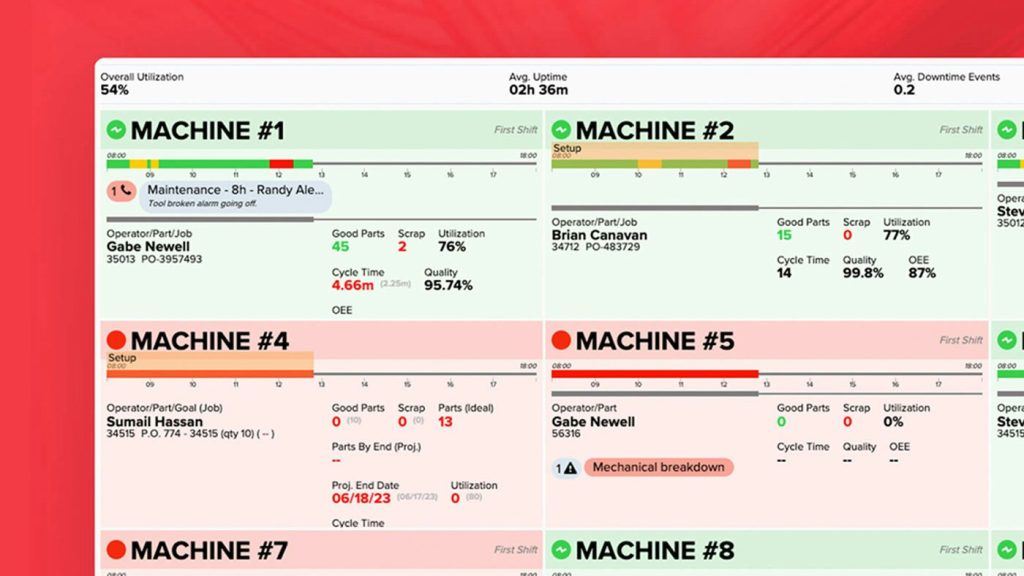
Quick verdict: Amper — now part of ECI Software Solutions — is a production monitoring and intelligence platform built for machining job shops: non-invasive sensors clip onto a machine’s power supply, learn its electrical signature, and report uptime, downtime, cycle counts and OEE for equipment of any age or brand, with an AI layer that briefs you daily, watches trends and answers plain-language questions about your floor. It trades the deep control-level data of rivals for the fastest retrofit in the category. Pricing is not public on the vendor’s site, and several headline features are add-on modules, so the quote needs line-item attention.
What it is
Amper started as machine monitoring built around a simple idea: instead of integrating with each CNC control, read the machine’s current draw. A sensor hooked to the power supply — Production Machining describes it placed on a CNC machine’s spindle circuit, installed by a maintenance manager — feeds an algorithm programmed to read current draw and report whether the machine is running, idle or down, with data sent through a Wi-Fi or cellular gateway. On top of that signal Amper, sold today by ECI Software Solutions as part of its manufacturing software family, builds its FactoryOS-style platform: live machine, job and operator visibility, downtime tracking with operator-entered reason codes, scheduling, and AI summaries. Trade coverage shows the model working in real machining shops: Production Machining profiled Global Precision Parts and Mitotec Precision running Amper across CNC and multi-spindle equipment, with Mitotec reporting $1.4 million saved in 11 months from downtime reduction — a shop-reported figure, but from a shop that machines for a living.
Key features
- Universal IoT sensors: non-invasive, clip-on current sensing that works on virtually any electrically powered machine regardless of age or brand, with no PLC integration and no production interruption to install
- Automated machine monitoring: real-time uptime, downtime and cycle counts captured automatically, replacing manual tally sheets and end-of-shift reporting
- OEE and downtime tracking: downtime reason codes entered by operators at a touchscreen, so Pareto charts of lost time are built from the floor, not guessed in a meeting
- AI Daily Briefing: a daily snapshot of factory performance — output versus potential, what drove the gaps, what changed, and where to focus next
- AI Trend Analysis and natural-language questions: AI watches margins, demand, delivery and supply trends, and a “talk to your data” interface answers questions in seconds with no report building or query language
- AI continuous-improvement assistant: analyzes historical downtime and performance data and automatically suggests the improvement projects with the most impact (per ECI’s solutions pages)
- Smart scheduling: ERP work orders connected to live floor data, auto-generated job completion forecasts, and drag-and-drop schedule adjustment
- Issue and maintenance management: tickets auto-created from live machine data, routed and assigned in real time
- ERP integrations: pre-built connections link jobs, parts and production standards from the ERP directly to machine signals
Pricing
Pricing is not public. ECI’s Amper pages describe plans and modules but publish no prices, and buying runs through a demo and quote; new customers can trial the platform, and existing ECI customers follow a separate integration path. Directory sites list figures in the $30,000–$50,000 per year range — treat those strictly as directory-only figures, not ECI’s rate card, and get the real number per machine and per module in writing.
What the pricing page doesn’t make obvious: ECI’s own FAQ splits the platform in two. All plans include ERP integrations, universal hardware, OEE and downtime tracking, real-time alerts and dashboards, and custom reporting — but Smart Scheduling, the Operator Interface, Issue Management and Maintenance Management are add-on modules. The scheduling forecasts and the operator touchscreen that headline the product page are therefore not necessarily in the base quote; price the configuration you actually saw in the demo, module by module.
Who it’s for
Machining job shops and contract manufacturers running a mixed-age fleet — late-model CNCs next to legacy machines no monitoring vendor wants to integrate — where the first problem is simply knowing, hour by hour, which machines are cutting and why the others are not. Shops that have tried control-connected monitoring and stalled on integration get Amper’s appeal immediately: sensors on in minutes, visibility first, and AI briefings that give a small leadership team the summary an analyst would otherwise build. It also suits multi-plant machinists, since the same sensor model works at every site.
Who should skip it
Shops that need engineering-grade, control-level data — per-part cycle benchmarking against the G-code, tool and feed detail — should look at Datanomix or MachineMetrics, both reviewed here previously; a current signal can tell you a machine stopped, but not everything the control knew when it did. Very small shops with a handful of machines and an owner standing on the floor may find a platform priced through enterprise quoting more system than they need. And if your ERP data is too messy to link jobs and standards to machines, fix that first — Amper’s scheduling and AI layers lean on it.
Pros
- Fastest credible retrofit in machine monitoring: clip-on sensors, any age or brand, no control integration project
- AI layer is practical — daily briefings, trend watching and plain-language questions, not a chatbot bolted on
- Proven in machining shops in trade coverage, including multi-spindle and Swiss environments
- One sensor model across every plant and machine type simplifies rollout
- Now backed by ECI, with pre-built paths into its manufacturing ERP family
Cons
- No public pricing — and directory figures put it at enterprise money, so quote carefully
- Smart Scheduling, Operator Interface, Issue Management and Maintenance Management are add-on modules, not all-plan inclusions
- Current-draw data is shallower than a direct CNC control connection — less detail per alarm and per cycle
- Scheduling and AI features depend on clean ERP job and standards data to be worth much
- Vendor performance claims (such as a 50 percent productivity increase in 30 days) are customer-reported, not independently measured
FAQ
How does Amper monitor a machine without connecting to its control?
With current sensing. A non-invasive sensor on the machine’s power supply measures electrical draw, and Amper’s software learns the machine’s electrical signature — the patterns that mean cutting, idle and stopped — then reports status, cycle counts and downtime from that signal. Production Machining describes the sensor installed on a CNC spindle circuit by a maintenance manager, with data leaving through a Wi-Fi or cellular gateway. The tradeoff is depth: you get reliable state and timing on any machine, but not the control’s internal detail.
How much does Amper cost?
Pricing is not public on ECI’s site; sales runs through a demo and quote, with a trial available for new customers. Directory listings showing roughly $30,000–$50,000 per year are directory-only figures, not a published rate card. Whatever the quote, check it module by module: Smart Scheduling, the Operator Interface, Issue Management and Maintenance Management are add-ons on top of the all-plans core.
Does Amper work on old machines?
Yes — that is the product’s founding use case. Because it reads electrical current rather than control data, Amper works on legacy and manual electrically powered equipment as well as new CNCs, which is why trade coverage shows it on multi-spindle screw machines alongside modern machining centers. The vendor says setup takes minutes with no interruption to production; phased rollouts starting with one bottleneck cell are its own recommended pattern.
Bottom line
Amper is the monitoring platform for the machinist whose fleet is too mixed, too old or too busy for a control-integration project: clip sensors on, get honest uptime and downtime data on everything, and let the AI briefing tell you each morning where yesterday’s hours went. Enter the quote with the module list open — the base plan covers monitoring, OEE, alerts and reporting, while scheduling, the operator interface and maintenance are add-ons — and it can be the fastest route from guessing about capacity to knowing.