
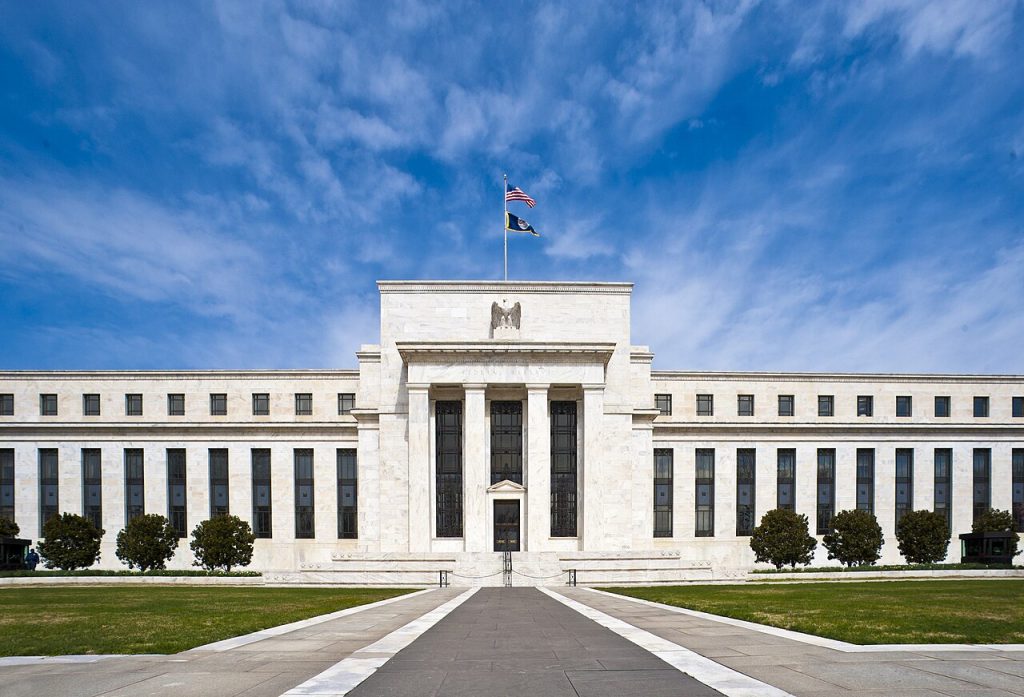
AI is now the top financial-stability risk in the Federal Reserve’s own survey. In the Fed’s semi-annual Financial Stability Report, released Friday, 87% of contacts cited risks tied to artificial intelligence as a salient threat to the financial system — up from 50% in the May version of the survey. Why it matters: the central bank is no longer treating the AI buildout mainly as a growth story; it is treating its financing as a systemic risk to monitor.
November 13, 2026
What happened
The Federal Reserve released its latest Financial Stability Report on Friday, November 13. The survey behind the report, conducted in September and October, found AI at the top of respondents’ worry list. Contacts pointed to three concerns in particular: cyberattacks, the complex forms of financing now funding AI infrastructure, and the possibility that an AI earnings slowdown could trigger a broad market correction.
Other leading concerns also carried an AI angle. A broad correction in risk assets was cited by 52% of respondents, higher long-term interest rates by 48%, and cyberattacks specifically and fiscal debt sustainability by 43% each.
The debt behind the buildout
The report devoted significant attention to how fast borrowing for advanced computing has grown. Debt issuance tied to data centers and other advanced computing infrastructure reached $680 billion by October 2026 — already five times all such issuance in 2023. That borrowing now accounts for nearly a third of all nonfinancial investment-grade corporate debt issuance, up from less than 6% three years ago.
Counting debt, guarantees, and leases that have not yet commenced, the Fed put total exposure tied to this infrastructure at potentially more than $3 trillion. The report compared the investment cycle to the broadband telecom boom of the late 1990s, while noting the current cycle may soon surpass that era.
The circular-financing warning
The Fed focused on arrangements in which long-term contracts, leases, and guarantees let large firms support financing for projects run by smaller third parties, with chip designers and hyperscalers often adding equity as well. It said such “circular financing” could help the largest firms absorb losses in a downturn, limiting damage to the wider system — but it could also mean those firms’ true exposure is substantially larger than their on-balance-sheet liabilities suggest.
The report also noted that asset valuations remain high in part because of enthusiasm for AI, that AI investment has been a significant driver of US economic growth this year, and that leverage among the largest hedge funds remains at the highest levels recorded since the Fed began gathering that data in 2013. The survey was taken before Nvidia chief executive Jensen Huang stepped down on Thursday and before the recent midterm elections.
Why it matters
For readers of Tested Intelligence, this is the other side of the AI boom we cover every day. The same data center buildout that powers new models is now large enough, and financed in complicated enough ways, that the Fed names it the financial system’s top-cited risk. That does not mean a crash is predicted — the report frames this as a vulnerability that “necessitates close monitoring,” in its words. It does mean an AI earnings disappointment would no longer be just a tech story; in the Fed’s assessment, it could tighten credit and weigh on the whole economy. Everything AI, tested — including its balance sheet.
Frequently asked questions
What did the Fed’s Financial Stability Report say about AI?
It found AI was the top-cited salient risk in its survey, named by 87% of contacts, up from 50% in May. Respondents cited cyberattacks, complex AI-related financing, and the risk that an AI earnings slowdown sparks a broad market correction.
How much debt is tied to AI data centers?
The Fed found advanced computing-related debt issuance reached $680 billion by October 2026, five times the total for all of 2023. Including guarantees and not-yet-commenced leases, exposure could exceed $3 trillion.
What is circular financing in the AI buildout?
It describes arrangements where contracts, leases, guarantees, and equity from large firms such as hyperscalers and chip designers support financing for infrastructure built by smaller third parties. The Fed said this could cushion a downturn but may also hide how exposed the largest firms really are.
Sources: Reuters