
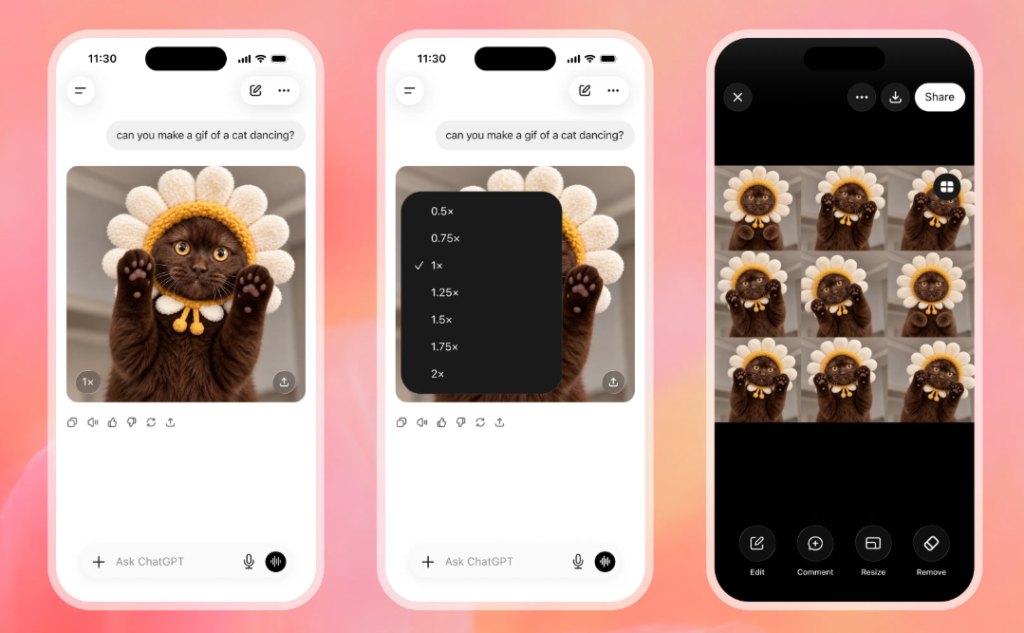
ChatGPT can now create animated GIFs in one step. OpenAI’s new Images 2.6 model turns a text prompt or an uploaded photo into a looping animation, with controls to adjust playback speed and edit individual frames — and it is rolling out to all ChatGPT and Codex users.
November 4, 2026 — Why it matters: GIFs are how a lot of the internet actually communicates, and until now ChatGPT could not make one natively. That gap is closed.
What happened
OpenAI is adding native GIF creation to ChatGPT alongside its Images 2.6 model, The Verge reports. You describe what you want, or upload a photo, and ChatGPT returns an animated GIF instead of a single still image. OpenAI demonstrated the feature with a simple prompt — asking for a GIF of a cat dancing — which produced several slight variations of the same character strung together flipbook-style.
That consistency across frames is the technical point. Earlier image models tended to change a character’s look too much from one frame to the next for the trick to work. Images 2.6 appears to hold the subject recognizable across the sequence, which is what makes a short loop read as animation rather than a slideshow of different pictures.
The details
After a GIF is generated, users can change how quickly it plays, inspect the individual frames, edit specific frames, and share the result — all inside ChatGPT. The rollout covers ChatGPT and Codex users on web, desktop, and mobile apps.
Beyond GIFs, OpenAI says Images 2.6 speeds up image generation overall. For developers, there are two API models: GPT-Image-2.6 Flare, positioned for faster, more efficient generation, and GPT-Image-2.6 Sunburst, positioned for higher-quality output. Both variants were first introduced with Images 2.5.
OpenAI also put a scale number on image use: users now generate well over four billion images per week across ChatGPT and the API, up from three billion in September. That figure comes from OpenAI itself and has not been independently verified.
Why it matters
For everyday users, this removes a small but real friction: making a reaction GIF or a quick animated explainer no longer means leaving ChatGPT for a separate tool. For creators and small teams, frame-level editing inside the same chat where the image was made shortens the loop from idea to shareable asset.
For developers, the split between a speed model and a quality model is the more durable signal — OpenAI is treating image generation as a high-volume utility where cost and latency matter as much as fidelity. Four billion images a week, by OpenAI’s own count, explains why.
Our take: this is not a video model and does not replace one. It is a short, editable loop format added to a tool people already use daily — exactly the kind of unglamorous upgrade that tends to stick. Everything AI, tested: we will be watching whether the frame editing holds up on subjects more complex than a dancing cat.
Frequently asked questions
Can ChatGPT make GIFs now?
Yes. With Images 2.6, ChatGPT can generate an animated GIF from a text prompt or an uploaded photo, then let you adjust speed and edit individual frames.
Who gets Images 2.6?
OpenAI is rolling it out to all ChatGPT and Codex users on web, desktop, and mobile, according to The Verge’s reporting.
What are GPT-Image-2.6 Flare and Sunburst?
They are the two developer API models in this release: Flare is built for faster generation, Sunburst for higher-quality output.
Sources: The Verge via The Decoder, XDA Developers