
Quick verdict
Urbint Review 2026: AI Worker Safety That Predicts Risk Before the Job Starts (Now Itron Worker Safety)
Updated October 29, 2026 – Tested Intelligence
Quick verdict: Urbint – now sold as Itron Worker Safety – uses AI to flag the jobs, tasks and conditions most likely to cause a serious injury before crews start work, then pushes that risk into daily job safety briefs. It is enterprise safety tooling for utilities and large infrastructure operators, not an app a small contractor buys off the shelf.
What it is
Urbint built an AI field-risk platform for critical infrastructure: worker safety, damage prevention for buried assets, and emergency preparedness. Its worker safety product – originally Urbint Lens for Worker Safety – analyzes work data, historical safety records and environmental conditions to predict where high-energy hazards are hiding in upcoming work.
The ownership changed recently: Itron signed a definitive agreement to acquire Urbint for $325 million on October 6, 2025, and completed the acquisition in Q4 2025. The product now appears as Itron Worker Safety, a solution for serious injury and fatality (SIF) prevention built around Smart Job Safety Briefs and High Energy Observations. Itron cites National Grid as identifying 35% more hazards with it.
Key features
- AI risk engine: scores likelihood and severity using project data, historical records and environmental modeling
- High-energy hazard focus: built on Energy Theory and the Energy Wheel, targeting the tasks behind serious injuries and fatalities
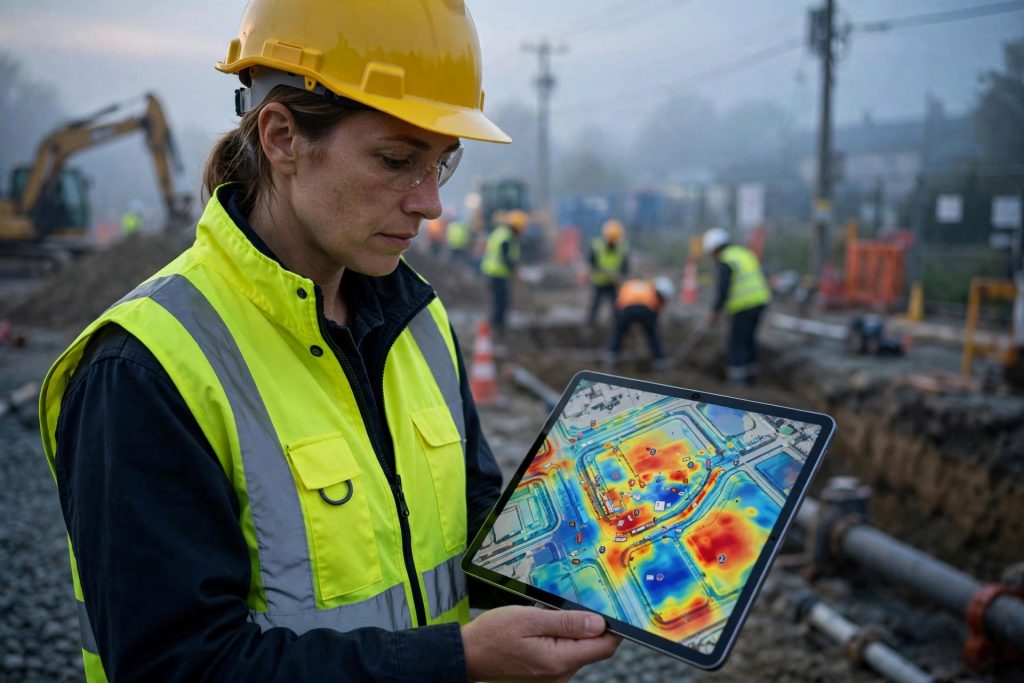
- Risk heat map: predicted hazards and site conditions visible up to two weeks ahead (per marketplace listings)
- Smart Job Safety Briefs: hazard analysis built into the daily brief, flagging high-energy hazards crews miss
- High-Energy Controls Assessments: standardized field inspections and observations to reduce observer bias
- Damage prevention: companion product that scores excavation tickets for strike risk on buried infrastructure
- Portfolio risk tracking: safety KPIs and trends across projects, tasks and contractors
Pricing
Pricing is not public. Urbint/Itron sells on enterprise quotes; third-party directories describe custom, quote-based annual subscriptions scoped to territory size, number of field crews and modules deployed. There is no self-serve tier, no published per-user price and no free trial we could verify. A contractor evaluating it should expect an enterprise sales cycle and enterprise pricing.
Who it’s for
Utilities, energy and infrastructure operators – and the large construction organizations building and maintaining their assets – with hundreds of field workers, formal safety programs and enough historical incident data to feed the models. If your safety team already runs job safety briefs and observations and wants them targeted by predicted risk instead of habit, this is aimed at you.
Who should skip it
Small and mid-size general contractors should skip it: the buyer is a utility or major asset operator, pricing is enterprise and unpublished, and predictions improve with large historical datasets. A 30-person firm will get more from a digital JHA platform it can buy today. Also skip it for camera monitoring – Urbint predicts risk from data; it does not watch your site.
Pros
- Attacks serious injuries and fatalities specifically, not just recordable paperwork
- Risk lands inside the daily job safety brief, where crews actually see it
- Now backed by Itron, a large public utility-technology company, after the $325M acquisition
- Damage prevention pairs naturally with safety for excavation-heavy operators
- Named utility customers including National Grid, with a published hazard-identification result
Cons
- Pricing is not public and the sales motion is enterprise-only
- Built for utilities and infrastructure operators first; general construction is adjacent, not the core
- Predictions depend on the quality and volume of your historical safety and work data
- Post-acquisition product naming and packaging are still settling under the Itron brand
FAQ
Is Urbint still an independent company?
No. Itron agreed to acquire Urbint for $325 million on October 6, 2025 and completed the deal in Q4 2025. The product is now sold as Itron Worker Safety.
How is this different from camera-based safety AI?
Camera systems watch work as it happens. Urbint works earlier: it scores upcoming jobs and tasks for predicted risk from work, incident and environmental data, so supervisors can intervene in planning and in the morning brief.
What does it cost?
Pricing is not public. Directories describe custom annual subscriptions scoped by territory, crews and modules. Expect an enterprise quote from Itron.
Bottom line
Urbint/Itron Worker Safety is one of the few safety products aimed squarely at preventing the high-energy incidents that kill people, using prediction instead of observation. If you run field crews at utility scale, it belongs on the evaluation list. If you are a typical GC, admire the approach – and buy something sized for you.