
Quick verdict
ESAB ROBBI AI Review 2026: A Physical-AI Cobot That Generates Its Own Weld Path
Updated October 29, 2026 – Tested Intelligence
Quick verdict: ESAB ROBBI AI is a collaborative robot welding system, launched in October 2026, that uses camera and laser sensing to assess a joint, generate its own weld path and adjust motion and parameters while it welds MIG or TIG. It targets the work conventional robots struggle with — low-volume, high-mix runs and variable fit-up, including pipe fabrication. Pricing is not public, and it is a brand-new system with no production track record yet.
What it is
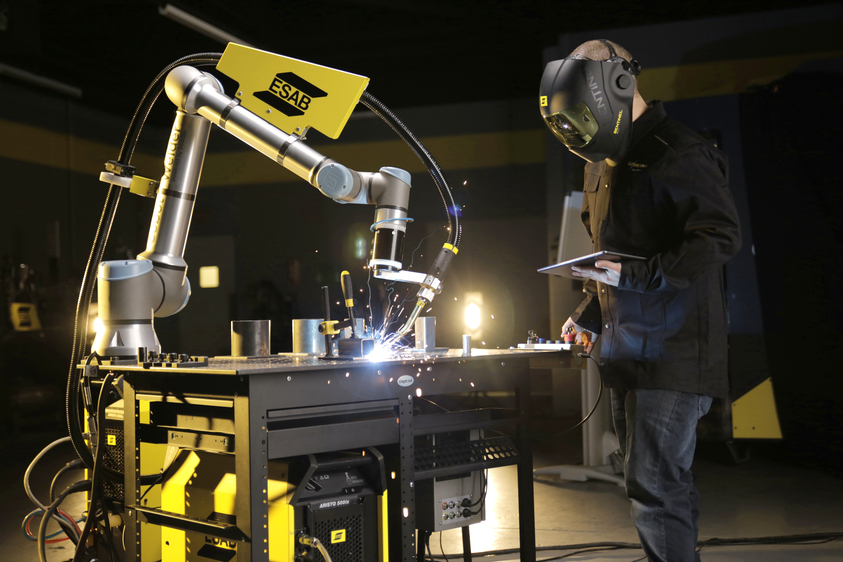
ROBBI AI is ESAB’s new cobot welding system, built around a Universal Robots UR10e or UR20 arm, offered in a 7th-axis configuration for extra reach or on a wheeled cart so it can move around a shop. ESAB calls its approach physical AI: instead of following a predefined path and sequence, the system perceives the actual joint in front of it and makes decisions as welding progresses.
Rather than teaching every path point, the operator positions the cobot near the joint, enters the parameters from the applicable welding procedure specification (WPS) — consumables, material type and weld type such as butt, fillet or pipe — and starts the weld. The AI identifies the joint and proceeds within those limits, which ESAB says also removes path teaching when several parts are fixtured on one table.
Key features
- Self-generated weld paths: camera and laser sensing assess the joint, so no manual path teaching is required
- Real-time adaptation: if a joint gap opens or closes, the system adjusts travel motion, oscillation or welding parameters within the WPS
- Defect response: designed to learn from every weld, recognize conditions that can lead to defects, adjust parameters or stop the weld when needed
- Local AI processing: decisions run on a computer inside the customer’s facility, not a cloud connection, and weld data and video are recorded for review
- Procedure guardrails: ESAB’s InduSuite software keeps AI-driven decisions inside predefined WPS and qualification requirements
- Power source choice: works with the EWM Titan XQ, EWM Tetrix XQ or ESAB Aristo Edge power sources, for MIG and TIG work
Pricing
Pricing is not public. ESAB’s launch announcement gives no list price, and the system is sold as configured welding equipment, not a subscription. Expect a quote to depend on the arm (UR10e or UR20), the 7th axis or cart, and the power source. Get the full configured price, including any InduSuite licensing, in writing.
Who it’s for
Steel fabrication shops running low-volume, high-mix work where fit-up varies — pipe fabrication, TIG work and other jobs that need hard-to-find skilled welders and have resisted conventional automation. ESAB points to pipe fabrication for data centers and infrastructure, where demand is high and capacity constrained.
Who should skip it
Shops running stable, high-volume parts on programmed robots gain little — a fixed path is cheaper when the joint never changes. Very small shops should also pause: this is configured capital equipment with no public price and, as an October 2026 launch, no long-term production users to check references against yet.
Pros
- Attacks the real blocker in robotic welding — programming time and fit-up variation — not just the speed of a fixed path
- Stays inside the WPS: adjustments are bounded by the procedure the operator supplied
- Learning and records stay onsite, with weld data and video to review after a defect or a stopped weld
- Flexible hardware: two arm sizes, a 7th-axis option, a wheeled cart, and three power source families for MIG and TIG
Cons
- No public pricing — every evaluation starts with a configured quote
- Brand new: announced October 22, 2026, so no independent long-term reliability or weld-quality record exists yet
- The operator still owns the procedure: a wrong WPS input bounds the AI to the wrong limits
- Performance claims in the launch material come from ESAB, not independent shop testing
FAQ
How is ROBBI AI different from a normal cobot welder?
A normal cobot follows taught paths, and larger fit-up changes usually mean reprogramming. ROBBI AI generates the path itself from camera and laser sensing, then adjusts motion and parameters in real time as conditions change, within the WPS provided.
What power sources and robots does it use?
A Universal Robots UR10e or UR20 arm, with a 7th-axis configuration or wheeled cart, paired with an EWM Titan XQ, EWM Tetrix XQ or ESAB Aristo Edge power source, for MIG and TIG.
How much does ESAB ROBBI AI cost?
Pricing is not public. Cost comes from a configured quote covering the arm, axis or cart options and the power source — get it in writing.
Bottom line
ROBBI AI is the most interesting idea in fab-shop welding this year: a cobot meant to handle the variable joints that kept automation out of high-mix steel work, while staying inside a qualified procedure. Because it launched days ago with no public price and no independent production record, the sensible move is a demo on your own worst fit-up parts — and a quote that prices the whole cell, not just the robot.