
Quick verdict
The short answer
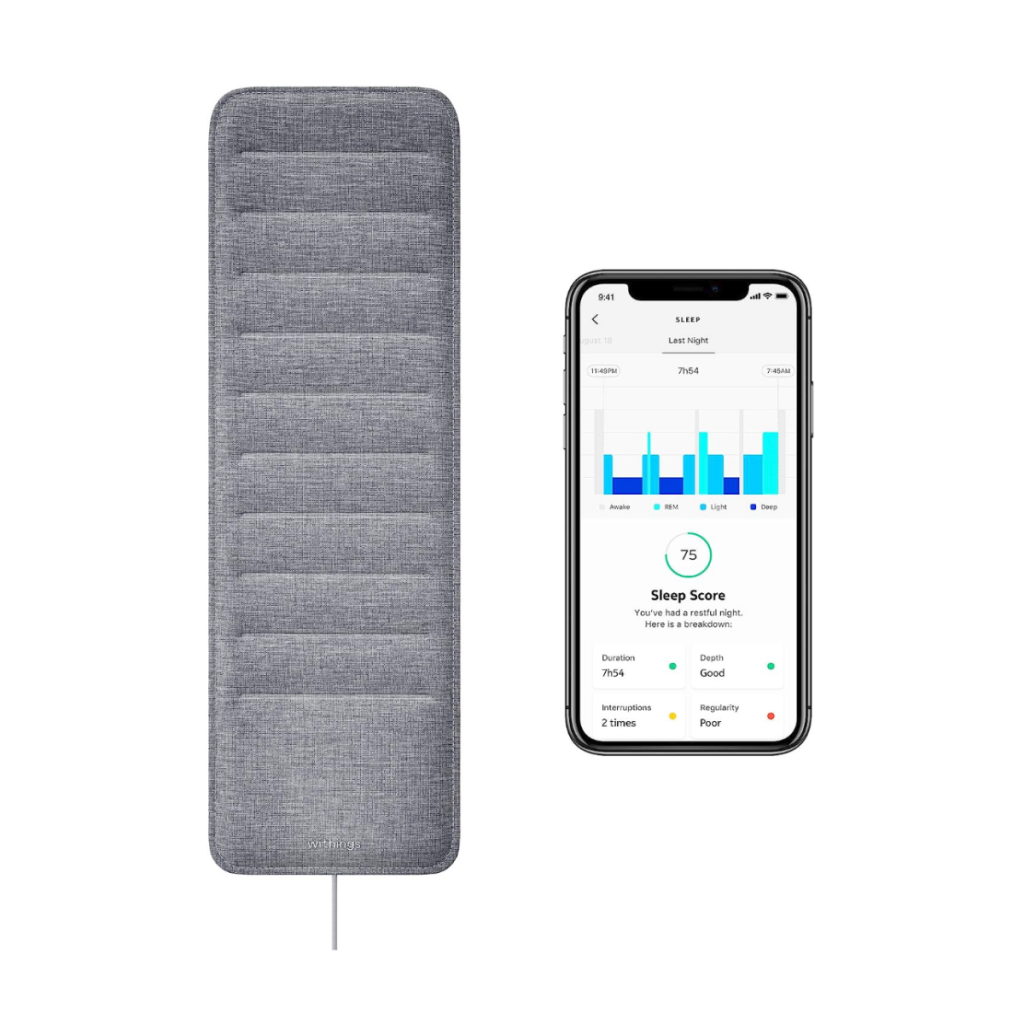
The Withings Sleep Analyzer is the best under-mattress sleep tracker you can buy: a slim mat that slides beneath your mattress and tracks sleep stages, heart rate, breathing, and snoring — plus clinically validated sleep-apnea screening — with zero wearables, zero charging, and zero subscription. At $199.95 it’s one of the best value propositions in sleep tech. The trade-offs are real though: it tracks one person per mat, it can mistake quiet wakefulness for light sleep, and partner or pet movement can contaminate the data. If you hate wearing things to bed, this is your tracker.
This is a research-based review. We have not tested the Withings Sleep Analyzer hands-on; every fact below comes from the manufacturer’s published specs, pricing, and independent reporting. Prices and specs checked September 30, 2026.
Key specs
| Spec | Withings Sleep Analyzer |
|---|---|
| Type | Under-mattress sleep tracking mat (~5 mm thick) |
| Tracks | Sleep stages, sleep duration, heart rate, breathing rate, snoring, movement |
| Sleep apnea | Clinically validated detection with severity classification (low/mild, moderate, severe) per AASM criteria; tested against clinical polysomnography |
| Sensors | Pneumatic (pressure/movement) and sound sensors |
| People tracked | One person per mat (two sleepers need two mats) |
| Connectivity | Wi-Fi and Bluetooth; Withings app with sleep score and trends |
| Power | Mains powered — never needs charging |
| Subscription | None — app and data storage are free |
| Extra | Auto-generated sleep diary exportable to your doctor |
Price and availability
Withings lists the Sleep Analyzer at $199.95 in the US, available direct from Withings and major retailers. There is no subscription and the Withings app is free, so the purchase price is the total cost of ownership. It comes in one color (grey) — irrelevant, since it lives under your mattress. Discounts appear periodically; confirm the current price on withings.com.
What it’s good at
- True set-and-forget tracking. Slide the mat under your mattress at chest level, plug it in, calibrate once, and never think about it again. No nightly wearable, no charging ritual, no app to open before bed. For compliance alone, this beats every ring and watch: the best tracker is the one you can’t forget to use.
- Clinically validated sleep-apnea screening at home. This is the Analyzer’s killer feature and a worldwide exclusive: its algorithm analyzes thoracic and cardiac activity to detect breathing cessations and classifies severity using the Apnea–Hypopnea Index per American Academy of Sleep Medicine standards. With an estimated 80% of obstructive sleep apnea sufferers undiagnosed, a non-invasive home flag is genuinely valuable — as a screening prompt to see a doctor, not a diagnosis.
- Broad sleep data without a subscription. Sleep phases, depth, interruptions, overnight heart rate, respiratory rate, and snoring detection all feed a nightly sleep score plus long-term trends, with unlimited data storage — no Oura-style monthly fee to see your own numbers.
- The sleep diary for your doctor. The app auto-generates a shareable sleep summary you can send to a physician, a practical bridge between consumer tracking and actual medical conversations.
- Comfort is a non-issue. At 5 mm thick, reviewers report being completely unable to feel it under the mattress. It works with slatted bases too (Withings recommends a flat, sturdy surface for full contact).
Where it falls short
- One sleeper per mat. Two people need two mats ($400 total), and a partner’s or pet’s movement on a shared bed can contaminate one person’s data — a genuine limitation in couple households.
- Still-awake-in-bed looks like sleep. Multiple reviewers note the mat scores quiet wakefulness — reading or scrolling in bed — as light sleep, since its logic is movement-based. The “bed is for sleep” discipline advice exists partly because of sensors like this.
- No real-time feedback. There’s nothing to look at in the morning except the app. If you like glancing at a watch or ring timeline, or want on-device alarms, the mat offers none of that.
- Placement matters. It needs to sit at chest level with good mattress contact, and there’s a long power cable to route. Setup is easy but not zero-effort, and thick memory-foam toppers can dampen the pneumatic readings.
Who should buy it
Anyone who refuses to wear a tracker to bed but wants real sleep data. People with snoring, witnessed breathing pauses, or morning headaches who want a validated home screening prompt for sleep apnea (then see a doctor). Data-curious sleepers who want trend tracking without a subscription tax. Solo sleepers or couples willing to buy two mats.
Who should skip it
Restless co-sleepers whose partner’s movement would swamp the signal — get one mat per side or a wearable instead. People who want temperature control or active sleep intervention (this only measures; look at Eight Sleep). Anyone who reads or watches TV in bed for long stretches will get noisier data.
Setup and living with it
Slide the mat under your mattress at chest level, plug in the power cable, and run the in-app calibration — about ten minutes total. Withings recommends a flat, sturdy surface under the mat for full contact; on slatted bases, owners report the cardboard packaging sleeve works fine as a shim. After that, there’s literally nothing to do: go to sleep, and the data is in the app by morning.
The ownership experience is defined by what you don’t do: no charging, no wearing, no nightly app ritual. The app presents a nightly sleep score with stage breakdowns, heart-rate and breathing trends, snoring episodes, and the apnea screening result. The auto-generated sleep diary can be exported to your doctor — a feature owners with diagnosed sleep issues call out specifically. Two caveats worth internalizing: the mat tracks one person, so couples need two ($400 total), and quiet wakefulness in bed (reading, scrolling) can be scored as light sleep. The practical fix is boring but effective — use the bed for sleep, and treat the score as a trend instrument rather than a nightly grade.
Alternatives worth considering
The Oura Ring 4 (~$349 + subscription) and Ultrahuman Ring Air are the wearable alternatives: more granular daytime data (readiness, activity, HRV trends) at the cost of wearing something nightly and paying a subscription (Oura). Eight Sleep’s Pod 5 tracks sleep contactlessly too — but it’s a $2,849+ temperature-control system, not a $200 tracker. For apnea screening specifically, nothing at this price competes; clinical home sleep tests run hundreds of dollars and require a doctor’s order. The Sleep Analyzer’s pitch is narrow and honest: the best sleep tracker for people who won’t wear one, with a validated apnea flag no wearable offers at this price.
Verdict
The Sleep Analyzer is the easiest sleep tracker to live with and one of the cheapest per year, since the sub is $0. The apnea screening alone may be worth $200 for the right person. Accept the single-sleeper caveat and it’s an easy recommendation. 4.2/5
FAQ
Can the Withings Sleep Analyzer diagnose sleep apnea?
No. It provides clinically validated screening — detecting and classifying likely apnea severity — but a diagnosis requires a clinical sleep study. Use a positive flag as a reason to see a doctor.
Do my partner and I need two mats?
Yes. Each mat tracks one person; with two sleepers, movement crosses over and contaminates the readings.
Does it need charging?
No — it’s mains powered, so it never needs charging. It does need a nearby outlet.
Is there a subscription?
No. The Withings app, sleep scores, trends, and data storage are all free.
Where to buy
As an Amazon Associate we earn from qualifying purchases.