
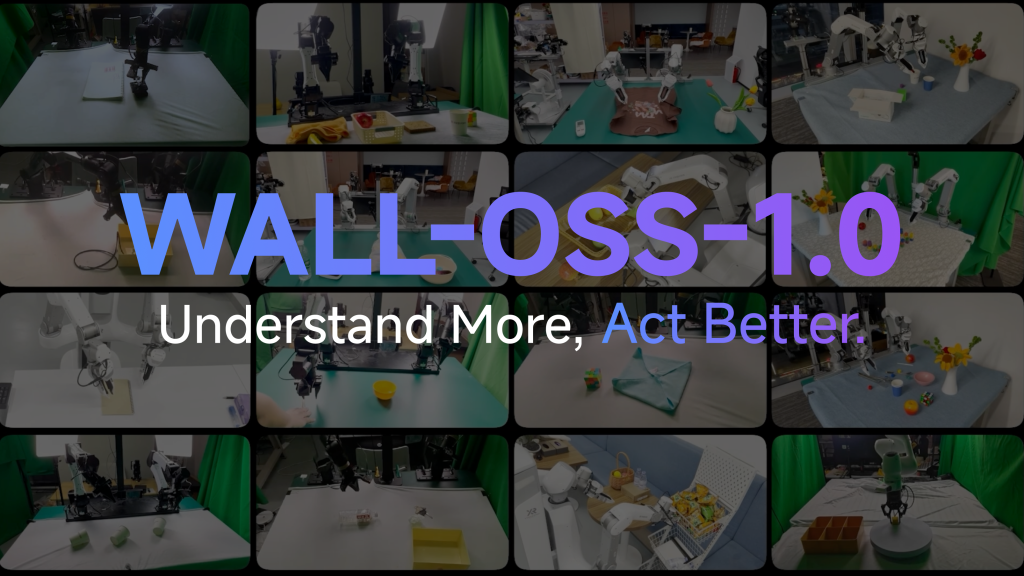
X Square Robot unveiled WALL-OSS-1.0 on November 23, 2026 — a vision-language-action (VLA) foundation model that handled 312 real-robot tasks it had never been trained on, with a 55.1% zero-shot success rate. Why it matters: robots that can walk into an unfamiliar setting and follow a new instruction without task-specific retraining are the missing piece between today’s single-purpose machines and general-purpose robot help.
November 23, 2026 — Shenzhen, China
What happened
The Shenzhen-based company announced WALL-OSS-1.0 alongside two companion products: XR Harness, an agentic framework that connects high-level planning with physical execution, and WALL-API-1.0, an interface intended to make the company’s embodied AI capabilities accessible to developers and enterprises. In the company’s open-ended real-robot evaluation, evaluators freely chose 312 unique tasks — covering unfamiliar objects, tool use, two-handed coordination, and multi-step manipulation — and the model attempted each one without demonstrations or fine-tuning for that task.
How it differs from other robot models
Most VLA models start from a pretrained vision-language model and bolt robot actions on afterward. WALL-OSS-1.0 instead uses what the company calls native VLA pretraining: starting from a Qwen3.5 base, language, vision-language, and robot-action data are trained together from the start, with an improved action tokenizer that converts continuous movements into compact token sequences. The training objectives go beyond imitation — the model also learns to evaluate proposed behaviors and correct its own errors.
On benchmarks, the company reports WALL-OSS-1.0 scored 1,101 of 1,500 points on ManipArena, a real-world benchmark of 15 tabletop tasks, straight after pretraining — a 50.67% success rate, compared with 24.0% for the π0.5 baseline. In simulation on the X2Real benchmark it scored 67.55 out of 100. These are the company’s own reported figures, not independently verified results.
The product family and the logistics test
The release is a family, not a single model. WALL-OSS-1.0-Lite (4B) and Nano (2B) are smaller variants for cheaper adaptation and inference — the company says Nano supported 18 robots on a single NVIDIA Blackwell GPU in its tested serving setup. WALL-OSS-1.0-Gen learns from broader visual experience, including first-person human video, and WALL-OSS-1.0-AR explores faster autoregressive action generation. The company says code and model weights will be open-sourced soon.
The most concrete claim is industrial: a parcel-sorting policy built on WALL-OSS-1.0 for a logistics customer retained more than 90% of its original-site sorting speed and success rate when moved to a new site, while a policy trained without the pretraining saw its success rate drop by more than 90% across sites.
Why it matters
For anyone watching embodied AI, the headline is not another benchmark — it is transfer. Retraining a robot policy for every new warehouse, table, or lighting setup is what keeps robots expensive and narrow. If a pretrained foundation model really carries most of its skill across sites and tasks, deployment economics change. The honest caveat: every number here comes from X Square Robot’s own announcement. The promised open-source release will be the real test, because outside researchers can then run the same tasks themselves. That is the “everything AI, tested” standard — promising launch, verification still to come.
Frequently asked questions
What is WALL-OSS-1.0?
It is a vision-language-action foundation model from X Square Robot that turns language instructions and visual input into robot actions, pretrained natively on language, vision, and robot-action data together.
What does the 55.1% figure mean?
In the company’s evaluation, the model succeeded at 55.1% of 312 real-robot tasks chosen by evaluators, with no task-specific demonstrations or fine-tuning beforehand.
When can developers try it?
A developer preview of the XR Harness framework is available now, WALL-API-1.0 is the new access interface, and the company says code and model weights will be open-sourced soon.
Sources: GlobeNewswire (X Square Robot announcement, November 23, 2026)