
Quick verdict
The short answer
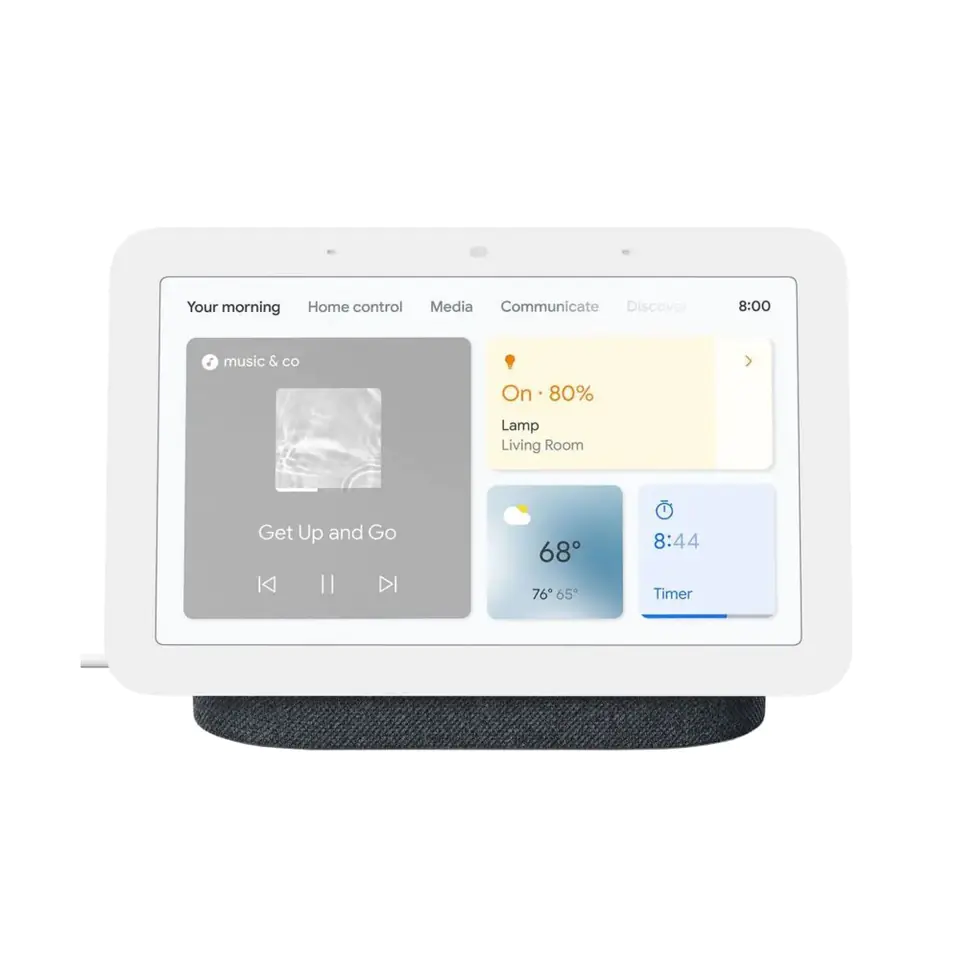
The Google Nest Hub (2nd Gen) is the best bedside smart display you can buy: a 7-inch touchscreen with no camera (a privacy feature, not a missing one), surprisingly full audio with 50% more bass than the original, and a Soli radar chip that enables touch-free gestures and genuinely useful sleep tracking. At $99.99 list — and routinely $50–$80 on sale — it’s the cheapest way to put Google Assistant, a photo frame, and a smart home dashboard on your nightstand.
The compromises are its age (launched 2021) and its simplicity: no camera means no video calls, the 1024×600 screen is soft by 2026 standards, and Google’s AI future is aimed at newer hardware. But as a clock, photo frame, sleep tracker, and smart home controller, it remains superb value — especially under $70.
There’s also a quieter reason the 2nd Gen has aged well: Google got the fundamentals right for a bedroom device. The auto-dimming Ambient EQ display, the sunrise alarm, and the ultrasound-based presence sensing (the screen brightens with detailed info as you approach, then relaxes to a clock from afar) are the kinds of thoughtful touches that don’t go stale with new chip generations. Newer hardware may bring sharper screens and smarter assistants, but for the specific job of “make my nightstand smarter without a camera staring at me,” the formula hasn’t been beaten — which is why Google hasn’t needed to replace it.
This is a research-based review. We have not tested the Google Nest Hub (2nd Gen) hands-on; every fact below comes from the manufacturer’s published specs, pricing, and independent reporting. Prices and specs checked September 30, 2026.
Key specs
| Display | 7-inch LCD touchscreen, 1024 x 600, with Ambient EQ (auto brightness/color matching) |
| Camera | None — no camera by design |
| Audio | 1.7-inch (43.5 mm) full-range driver; 50% more bass than 1st gen |
| Microphones | 3 far-field microphones; physical mic mute switch |
| Voice assistant | Google Assistant with Voice Match |
| Sensors | Soli radar (Sleep Sensing + Quick Gestures), ambient light sensor, temperature sensor, ultrasound sensing |
| Processor | Quad-core 64-bit 1.9 GHz ARM with ML hardware engine |
| Connectivity | Wi-Fi 802.11a/b/g/n/ac (2.4/5 GHz), Bluetooth 5.0, Thread, Matter-enabled |
| Power | Proprietary 15W adapter |
| Size / weight | 178.5 x 118 x 67.3 mm (7 x 4.7 x 2.7 in); 558 g (1.2 lb) |
| Colors | Chalk, Charcoal, Mist, Sand |
| Sustainability | Housing made with 54% post-consumer recycled plastic |
Price and availability
Google lists the Nest Hub (2nd Gen) at $99.99, but it lives on sale: $50–$80 is the normal discounted range, and it has dropped to $50 at carriers and big-box retailers during clearance pushes. At $50–$70 it’s an impulse buy; at full $99.99, wait for the inevitable promotion.
Availability note: as a 2021 product in a lineup Google hasn’t refreshed with new display hardware, stock can be spotty — some retailers show it intermittently out of stock, and Google’s own 2026 smart home announcements have focused on the new Google Home Speaker and cameras rather than a Nest Hub successor. It’s still sold new today, but if you want one, don’t assume it’ll be around forever. Confirm availability at checkout.
What it’s good at
- Perfect bedside design: No camera means zero bedroom privacy anxiety, Ambient EQ dims and warms the display to match the room (no 3 AM face-blast), and the sunrise alarm gently brightens the screen before the audio alarm. It’s the rare gadget designed for where you’ll actually put it.
- Sleep Sensing that works: The Soli radar tracks sleep duration, quality, snoring, and coughing with no wearable required — just say “Hey Google, how did I sleep?” for a morning summary. It’s the standout feature and genuinely useful for spotting patterns.
- Surprisingly good audio: The re-engineered 1.7-inch driver with 50% more bass punches above its size for podcasts, white noise, alarms, and casual music — not a party speaker, but excellent for a nightstand or kitchen counter.
- Quick Gestures: Wave a hand to snooze alarms or pause media without touching the screen or speaking — oddly delightful at 6 AM or with messy cooking hands.
- Google Photos frame + smart home dashboard: As a digital photo frame it’s best-in-class (automatic curation from your library), and the home view gives touch control of lights, locks, thermostats, and cameras.
- Thread and Matter support: The Thread radio keeps it relevant as a smart home controller for modern Matter accessories, extending its useful life beyond its years.
Where it falls short
- No camera, no video calls: The privacy-first design is a deliberate trade-off, but it means no Duo/Meet video calls and no using it as a security camera — the Echo Show 8 does both.
- Low-resolution screen: 1024×600 on 7 inches was modest in 2021 and is soft in 2026. Fine for clocks, photos, and dashboards; less great for video or reading.
- Aging hardware, uncertain future: Google’s Gemini for Home push and new 2026 hardware (Google Home Speaker, new cameras) leave the 2nd Gen Hub’s long-term feature support an open question. Some advanced features increasingly tie into Google’s subscription tiers.
- Sleep Sensing caveats: It needs calibration and correct nightstand placement to be accurate, it only tracks the person closest to the device, and detailed historical trends may involve Google’s subscription offerings — check current terms.
- Proprietary power adapter: A 15W barrel-style plug instead of USB-C, so a lost cable means ordering a Google-specific replacement.
Who should buy it
Anyone who wants a smart display on a nightstand or dresser — the no-camera design, auto-dimming screen, sunrise alarm, and sleep tracking make it purpose-built for the bedroom. Also great as a kitchen photo frame and smart home dashboard for Google households, and at $50–$70 on sale it’s cheap enough to put one in several rooms.
Who should skip it
Anyone who wants video calling (get an Echo Show 8 or Nest Hub Max if you can find one), households that need a large shared-family display, and buyers who want the newest Google AI features — wait to see what Google’s 2026 speaker lineup brings. If it’s out of stock everywhere, don’t overpay third-party sellers.
Verdict
4.4 / 5 — The best bedside smart display for the money, with unique sleep tracking and a privacy-first design. Age and a soft screen keep it from perfection, but under $70 it’s one of smart home’s great values.
FAQ
Does the Nest Hub 2nd Gen have a camera?
No — and that’s intentional. Google omitted the camera for bedroom privacy. You can’t make video calls or use it as a security camera; for those features, look at the Echo Show 8 or the camera-equipped Nest Hub Max.
How does Sleep Sensing work?
The Soli radar chip detects motion and breathing patterns through the night (no wearable needed), and the microphones can detect coughing and snoring. In the morning, ask “Hey Google, how did I sleep?” for a summary of duration, quality, and disturbances. It works best with the Hub on your nightstand, calibrated to your side of the bed.
Can it control my smart home devices?
Yes — it works with thousands of Google Home-compatible devices (lights, thermostats, locks, cameras, plugs) via touch or voice, and its Thread radio supports modern Matter accessories.
Is a Nest Hub 3rd Gen coming?
Nothing announced as of September 30, 2026. Google’s 2026 smart home news has centered on the new Google Home Speaker ($99) and new Nest cameras/doorbell rather than a Hub refresh. The 2nd Gen remains the current model.
Where to buy
As an Amazon Associate we earn from qualifying purchases.