
What happened: Tether AI Research introduced BotPsy, a 0.8-billion-parameter model built for running AI agents directly on a device — no cloud account required — and reports that it roughly doubles the agentic benchmark scores of the Qwen3.5 model it was trained from. Why it matters: if numbers anywhere near these hold up, routine agent tasks like searching, booking, filing and messaging may not need a frontier cloud model at all.
November 11, 2026
What BotPsy is
BotPsy is a “personal assistant” model designed for function calling and agentic workflows: web search and research, travel, commerce and finance, business operations, device and vehicle control, files and documents, calendar, and email and messaging. Tether is explicit that, at 0.8 billion parameters, it is best suited to tasks of low to medium difficulty. It was post-trained from Qwen3.5-0.8B in four stages — supervised fine-tuning, multi-teacher on-policy distillation from three specialist Qwen3.5-4B teacher models, and two rounds of reinforcement learning. Tether says BotPsy will be released with open weights under the Apache 2.0 licence for research and educational use, in bf16, Q8 and Q4 precisions, as Hugging Face safetensors and as GGUF files for the QVAC SDK and llama.cpp.
The benchmark claims — all Tether’s own
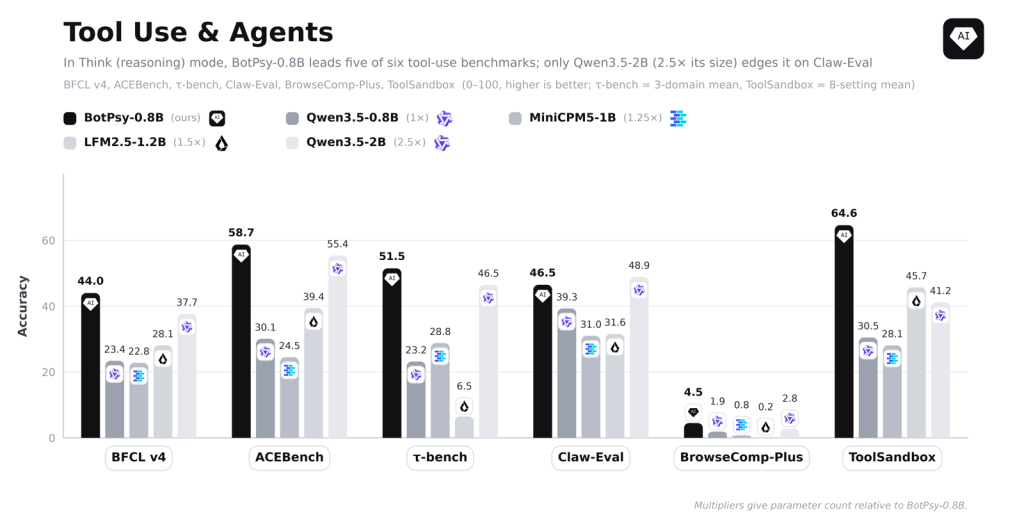
Every figure here comes from Tether AI Research’s own evaluations, run against the comparison models the team chose, so treat them as vendor-reported until independent testing lands. On that basis: BotPsy roughly doubles its base model on key tool-use benchmarks, with BFCL v4 rising from 23.4 to 44.0, ACEBench from 30.1 to 58.7, and tau-bench from 23.2 to 51.5. It posts the highest score of the five models tested on five of the six agentic benchmarks — ahead even of Qwen3.5-2B-Think, a model 2.5 times its size — with the larger model edging ahead only on Claw-Eval (48.9 to 46.5). Tether also reports it is better at knowing when not to call a tool, scoring 86.1 on BFCL v4’s tests for declining when no appropriate tool exists, and that instruction following jumped sharply, with IFEval rising from 59.7 to 90.8.
On safety and efficiency, Tether reports unsafe responses in automated red-teaming fell to 21% of the time, versus 36% for the base model, and that BotPsy reaches correct answers with roughly three times fewer reasoning tokens on GPQA Diamond questions all five tested models answered correctly — the kind of saving that decides whether an on-device agent feels instant or sluggish.
Why it matters
The pitch is the local-first one: an agent that runs on your own hardware keeps your data on your hardware, keeps working without a subscription, and cannot be repriced, rate-limited or deprecated by a cloud provider. Tether is candid about the limits — BotPsy still makes mistakes and is not intended for high-stakes use, its knowledge still trails larger models (it is designed to call tools for facts rather than memorise them), and its stated roadmap items like peer-to-peer search and local fine-tuning through QVAC Fabric are plans, not shipped features. The honest test comes when the weights are public and developers rerun these benchmarks on their own tool sets — but a sub-billion-parameter agent that can hold its own on tool use is exactly the shape of model that makes private, on-device assistants plausible.
Frequently asked questions
What is BotPsy?
BotPsy is a 0.8-billion-parameter AI model from Tether AI Research, post-trained from Qwen3.5-0.8B and specialised for function calling and agentic tasks — search, travel, files, calendar, email and device control — on local hardware.
Is BotPsy open source?
Tether says it will be released with open weights under the Apache 2.0 licence for research and educational use, in three precisions (bf16, Q8, Q4), as Hugging Face safetensors and GGUF files for the QVAC SDK and llama.cpp.
How well does BotPsy perform?
In Tether’s own testing, it leads every model of up to 1.2 billion parameters it tested on all six tool-use and agentic benchmarks, and beats the 2.5-times-larger Qwen3.5-2B-Think on five of the six. Those are the developer’s own results and have not been independently verified.
Sources: Tether AI Research (via Hugging Face / QVAC), Lets Data Science