
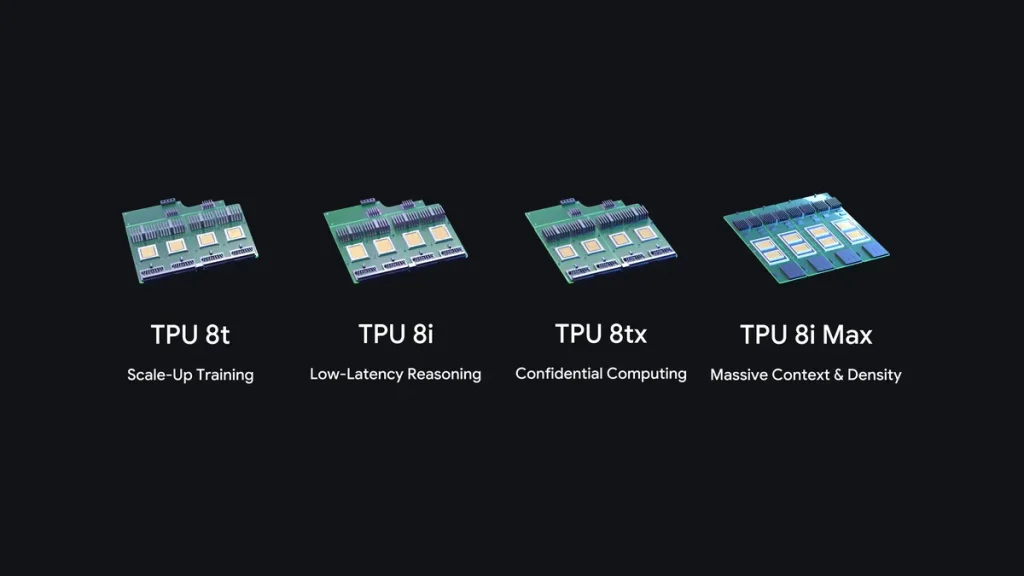
Google expanded its eighth-generation TPU portfolio on November 9, 2026, adding two new systems: TPU 8tx, built for secure and confidential inference, and TPU 8i Max, built for massive context windows and the highest compute density per rack. Why it matters: this is the first time Google has introduced four TPU systems in a single year, and it signals a shift from one general AI chip to specialized systems for each stage of agent work.
November 9, 2026
What happened
At Google Cloud Next in April, Google introduced the first two systems of this generation: TPU 8t for large-scale training and TPU 8i for real-time reasoning. Google says the 8t delivers up to 2.7 times better training performance than the previous generation, while the 8i offers 80% better inference price performance. The two systems announced today are new configurations built on that same silicon — Google is explicit that a new system is not a new chip, but a new way of packaging compute, networking, storage and security around the chip, which lets it ship specialized configurations in months rather than years.
Google says TPUs are now a rapidly growing business with nearly 100 customers, including frontier labs, trading firms, retailers and universities — a notable change for hardware that began, more than a decade ago, as an internal project for voice recognition and translation.
TPU 8tx: security built into the hardware
TPU 8tx is optimized for confidential inference and small-scale training, aimed at regulated enterprises and governments running frontier or proprietary models and autonomous agents next to sensitive data. Data is normally encrypted in storage and in transit but has to be unlocked in memory while it is processed. Built on the same silicon as TPU 8t and paired with 5th Generation AMD EPYC CPU hosts, the 8tx keeps sensitive data and model weights protected and isolated even during active use, according to Google. It also uses the same low-latency Boardfly network built for real-time reasoning, which Google says delivers up to twice lower latency than TPU 8t with a near-zero performance penalty. Because it pairs training-grade compute with that fast inference network, teams can fine-tune models on private data, distill large models into smaller ones, and train agents with reinforcement learning on a single system, without moving sensitive data between clusters.
TPU 8i Max: two chips, one package, aimed at the memory wall
TPU 8i Max attacks a different bottleneck. When dozens of agents work together across an entire codebase or hours of video, memory bandwidth runs out first. Google combined two TPU 8i chips onto a single package, which it says doubles the compute, SRAM and HBM bandwidth of the 8i while fitting twice the silicon into the existing rack footprint — more computing power per square foot and per watt. Bloomberg reported that both new systems are reconfigurations of this year’s existing processors, shaped by customer requests, and are expected to be available next year.
The software layer shipping alongside
Google paired the hardware with a set of software releases meant to make TPUs easier to adopt: the open-source TorchTPU, which lets PyTorch code and Hugging Face models run natively on TPUs; an Agent Compute Engine that automatically suspends idle agent sessions to cut wasted compute; the open-sourced TPU Sync model-state layer; and general availability of Cloud Pathways and GKE dynamic slicing for orchestrating and reshaping TPU clusters. Google says its native vLLM-TorchTPU stack achieved state-of-the-art price-performance on the InferenceX and AgentX benchmarks — its own reported results, not independently verified here.
Why it matters
The practical read: Google is betting that the agent era rewards specialization — one system for training, one for reasoning, one for confidential work, one for giant contexts — and a faster system-design cycle to match. For buyers, that means more TPU options outside Nvidia’s ecosystem, and for regulated industries, a credible path to running frontier models on sensitive data without decrypting it in memory. The honest caveat is timing and proof: the new systems are reconfigurations rather than new silicon, Google published no core counts or memory sizes for them, and availability is reported for next year. Everything AI, tested — we will be watching for independent benchmarks once the hardware reaches customers.
Frequently asked questions
What are TPU 8tx and TPU 8i Max?
They are two new systems in Google’s eighth-generation TPU lineup, announced November 9, 2026. TPU 8tx targets secure, confidential inference; TPU 8i Max targets massive context windows and maximum compute density per rack.
Are these brand-new chips?
No. Google describes them as new systems — new configurations of packaging, networking and security built on the same silicon as the TPU 8t and 8i introduced in April 2026.
When will they be available?
Google’s announcement does not give a date. Bloomberg reported both systems are expected next year.
Sources: Google (blog.google), Bloomberg via Reuters, Unite.AI