
Quick verdict
Samotics SAM4 Review 2026: AI Predictive Maintenance Read From the Motor Control Cabinet
Updated November 6, 2026 – Tested Intelligence
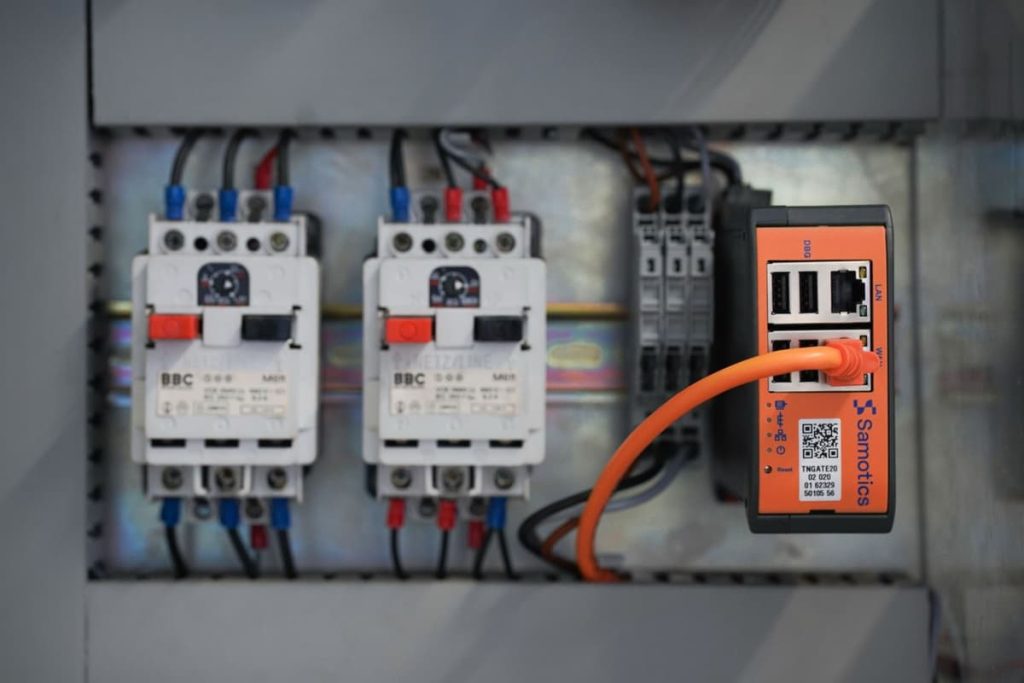
Quick verdict: Samotics SAM4 is an AI predictive maintenance system with a fundamentally different sensor strategy: nothing mounts on the machine. Current transformers clip around the phase wires inside the motor control cabinet, and AI-driven electrical signature analysis (ESA) reads mechanical and electrical faults from the motor’s current and voltage. For maintenance teams whose critical assets are submerged, buried, hot or simply unreachable, that cabinet-first design is the whole argument.
What it is
Samotics, founded in the Netherlands, sells SAM4 as a condition monitoring service for AC motors and rotating equipment — pumps, fans, conveyors, gearboxes, compressors and agitators. Sensors install in the motor control cabinet, not on the asset, and stream current and voltage data over cellular or local network to the SAM4 platform. AI models learn each asset’s normal electrical fingerprint, classify deviations into specific fault types, and issue alerts with severity and a recommended action.
The field record is unusually public for this category. Samotics says SAM4 detects over 90 percent of developing failures up to five months in advance. Southern Water signed a £7 million, six-year framework in September 2025 after a trial monitoring 1,458 assets across around 600 sites detected 63 failures, avoiding an estimated £5 million in damage and penalties. At zinc producer Nyrstar, Samotics reports 800 percent ROI in 11 months.
Key features
- Electrical signature analysis: current and voltage read at the MCC reveal bearing damage, imbalance, belt wear, gearbox faults, cavitation, winding issues and supply problems
- AI fault classification: alerts name the asset, fault type, severity and recommended action, with human-in-the-loop expert validation — Samotics cites 97 percent fault-classification accuracy with under 1 percent false positives at Southern Water
- No process-floor sensors: nothing to survive heat, dust, submersion or hazardous areas, and no sensor replacement cycle on the asset
- Fast install: under 60 minutes per asset in typical configurations, including a brief de-energisation of the cabinet
- Energy performance monitoring alongside health: degraded motors show up as energy waste as well as failure risk
- Dashboard, email and CMMS alert routing, with a feedback loop — recorded maintenance outcomes train the model on your assets and conditions
Pricing
Pricing is not public. Samotics publishes no per-asset rate, plan tiers or self-serve trial; deployments are quoted through sales, and third-party directories such as Capterra list SAM4 pricing only as “contact vendor.” The one public anchor is the scale of real deals: Southern Water’s framework is £7 million over six years covering thousands of assets — enterprise condition monitoring economics, not a per-seat SaaS purchase.
What the pricing page doesn’t make obvious: SAM4’s own fit criteria, published in its industry documentation, quietly define who should not buy it yet. The strongest fit is AC motor-driven assets that run often, for stretches longer than 20 seconds, with a reasonably stable load. Non-standard motor configurations, complex drive topologies, unstable loads or unusual duty cycles need an engineering asset-fit review first — and SAM4 states it needs no historical data to start, building its baseline from live measurements within weeks. Quote requests should therefore start with the asset-fit review, not the asset count: paying to monitor short-cycle, unstable-load motors is the documented weak spot, however good the AI is on steady runners.
Who it’s for
Maintenance technicians and reliability teams responsible for motor-driven assets they cannot easily reach: submersible pumps, underground fans and dewatering pumps, hot smelter and mill drives, remote conveyors, and any fleet where vibration routes cover only the biggest machines. It is also the natural complement, not replacement, for an existing vibration program — ESA adds the electrical fault modes vibration cannot see.
Who should skip it
Teams whose main need is work-order management should buy a CMMS such as MaintainX or Limble, reviewed here — SAM4 monitors and alerts; it does not run your maintenance operation. Plants whose critical assets are not AC motor-driven, or whose motors run in short, unstable bursts, fall outside the published fit. And if your assets are easily accessible and already well covered by mounted sensors such as Augury or Nanoprecise, the cabinet-first advantage matters much less.
Pros
- Monitors unreachable assets — submerged, underground, hot or hazardous — from a safe, climate-controlled cabinet
- Detects electrical faults vibration analysis misses, as well as mechanical degradation
- Under-60-minute install per asset, monitoring-only with no control commands sent to equipment
- Public, named, large-scale proof: Southern Water and Nyrstar deployments with stated outcomes
- Energy waste insight comes with the health data, giving maintenance a second savings case
Cons
- No public pricing — every deployment is an enterprise sales process
- Published fit limits: short runs under 20 seconds, unstable loads and non-standard drive topologies need review or do not fit
- Covers AC motor-driven rotating equipment only; it is not a general plant monitoring platform
- Detection and ROI figures are vendor- and customer-reported, not independently verified by us
FAQ
What does SAM4’s AI actually do?
It analyzes real-time current and voltage signals using electrical signature analysis, learns each motor system’s normal fingerprint, and classifies deviations into specific fault types — for example a blockage, cavitation or bearing damage — with severity and a recommended next action. Samotics supports alerts with human expert validation.
How much does Samotics SAM4 cost?
Pricing is not public. It is sold through sales-quoted deployments; the largest public reference is Southern Water’s £7 million, six-year framework covering around 600 sites and, at signing, 1,458 monitored assets, scheduled to grow.
Does SAM4 replace vibration monitoring?
No — Samotics says so itself. On assets where vibration sensors are installed and surviving, ESA adds electrical fault detection and energy data vibration cannot provide. On assets too hot, remote or submerged for mounted sensors, SAM4 becomes the primary monitoring source.
Bottom line
SAM4 earns its shortlist place wherever the honest answer to “why isn’t that pump monitored?” is “because we can’t put a sensor on it.” Start with a small fleet of high-consequence, hard-to-reach motors, insist on the asset-fit review up front, and judge it on planned repairs replacing emergency callouts — the outcome its public customers actually report.