
Quick verdict
Vectis Automation Review 2026: Cobot Welding With AI Path Optimization for Structural Steel Shops
Updated November 6, 2026 – Tested Intelligence
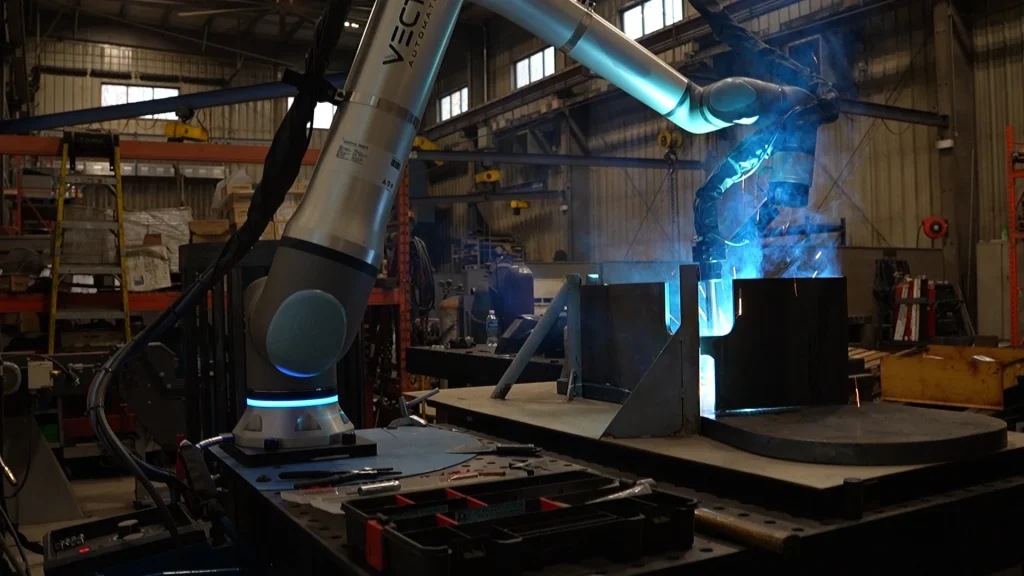
Quick verdict: Vectis Automation builds collaborative robot welding and plasma cutting tools around Universal Robots arms, aimed squarely at fabrication shops that cannot justify a traditional robot cell. Its AI Path Optimization applies consistent weld angles across a full path and auto-detects and smooths corner transitions, while ArcPilot through-arc seam tracking steers the weld in real time. Unusually for this category, pricing is published: most systems cost $95,000 to $140,000 all-in.
What it is
Vectis Automation, based in Loveland, Colorado, sells cobot welding and cutting systems for metal fabrication, with dedicated packages for structural steel fabricators. The systems pair a Universal Robots six-axis cobot arm with welding packages from brands such as Miller, Lincoln Electric and Fronius, or a Hypertherm package for plasma cutting. Vectis says more than 800 of its systems are deployed across North America, from small job shops to Fortune 50 manufacturers.
The structural steel case is the Rover deployment: an ultra-portable system on heavy casters that brings the cobot to large assemblies instead of forcing the part to a fixed cell. Central Texas Iron Works, a structural fabricator in Waco and San Antonio, runs two Rover systems on complete joint penetration (CJP) groove welds, reporting welds that meet AWS D1.1 ultrasonic testing requirements. KYJO Steel in Ontario reports weld time cut by two to three times on key applications.
Key features
- QuickTeach + AI Path Optimization: program at the cobot wrist, then apply consistent weld angles to full paths with auto-detected, auto-smoothed corner transitions
- ArcPilot Through-The-Arc Seam Tracking: monitors arc electrical characteristics and steers the path to stay centred in symmetric fillet and bevel joints
- Touch sensing: searches the part with the torch nozzle and offsets programmed paths to the joint’s actual location
- MultiPass software: teach the root pass only; bead-stack recipes calculate subsequent passes for heavy welds
- Pattern, Stitch and ArcScribe tools: duplicate taught welds in patterns, lay out stitches without manual measuring, and weld text part IDs directly onto parts
- Deployments for every shop layout: Grid Carts, Rover remote fabrication, Slide linear tracks up to 50 feet, Park’N’Arc range extenders, MagBase magnetic mounting and plasma cutting configurations
Pricing
Vectis publishes its pricing spectrum on its own site. The majority of systems cost $95,000 to $140,000 all-in, depending on configuration. Vectis states that figure includes full plug-and-produce integration, shipping, a two-year warranty, a lifetime software licence and a 30-day return policy, and that customers often find it 25 to 40 percent below the all-in cost of a traditional robot cell. The company also states there are no subscription fees.
What the pricing page doesn’t make obvious: the all-in figure is doing real work here. Because the lifetime software licence and shipping are already inside the $95,000 to $140,000 range, there is no separate software subscription to budget for later — a sharp contrast with AI welding platforms sold as an add-on licence on top of the cobot hardware. Vectis also publishes its economic batch window: most customers see returns on batches of 20 to 1,500 parts, with payback typically reported at two years or less. If your typical run is under 20 identical parts, that published window — not the headline price — is the number to test in an application evaluation first.
Who it’s for
Structural steel and heavy fabrication shops losing capacity to the welder shortage on boring, high arc-on work: moment connections, bracing plates, base plates and repetitive CJP welds. It also fits high-mix shops that need one system to move between cart work and large assemblies, and shops whose best welders should be on fit-up and complex joints rather than long straight runs.
Who should skip it
Shops needing fully adaptive welding on badly varying fit-up should compare vision-first systems such as Novarc or Lincoln Electric’s XpertLINC on Cooper cobots, both reviewed here — Vectis is explicit that part and fixturing consistency is the primary factor in weld quality, and its adapting tools are compensations, not a cure for inconsistent upstream work. Very low-volume one-off repair shops, and shops with no internal champion willing to own programming, will also struggle; Vectis itself names the missing champion as a common failure mode.
Pros
- Published all-in pricing with shipping, two-year warranty and lifetime software licence included
- AI Path Optimization and through-arc seam tracking address the two real cobot pain points: programming time and joint variation
- 30-day return policy and no subscription fees lower the adoption risk versus traditional cells
- Proven on structural work, including AWS D1.1 CJP welds at a named structural fabricator
- Mobile deployments let the cobot go to oversized assemblies instead of the other way round
Cons
- Still a $95,000-plus capital purchase; the published range is wide enough that configuration choice matters
- Weld quality depends on consistent parts and fixturing — the vendor says so plainly
- No prior joint scanning or CAD-driven path generation comparable to vision-first AI welding systems
- Productivity and payback figures are vendor- and customer-reported, not independently verified
FAQ
What does Vectis’s AI actually do?
AI Path Optimization applies consistent work and travel angles across a full taught path and automatically detects and smooths corner transitions, removing the need for the programmer to hand-tune every segment. Separately, ArcPilot monitors the arc’s electrical characteristics during the weld and steers the path to stay in the middle of the joint.
How much does a Vectis cobot welder cost?
Most systems cost $95,000 to $140,000 all-in, per Vectis’s published FAQ. That includes integration, shipping, a two-year warranty, a lifetime software licence and a 30-day return policy, with no subscription fees. Formal quotes are configuration-specific.
Can it handle structural steel code work?
A named customer, Central Texas Iron Works, reports using Rover systems on CJP groove welds meeting AWS D1.1 requirements and passing ultrasonic inspection. That is a customer case study, not a Vectis guarantee — your WPS, operator qualification and inspection regime still govern code compliance in your shop.
Bottom line
Vectis is the low-drama way into cobot welding for structural shops: published pricing, no subscription, a return policy, and software — including genuine AI path optimization — built around how fabricators actually program. Bring consistent parts and a committed champion, start on the boring arc-on work, and let your scarce CJP welders spend their hours where a human still wins.