
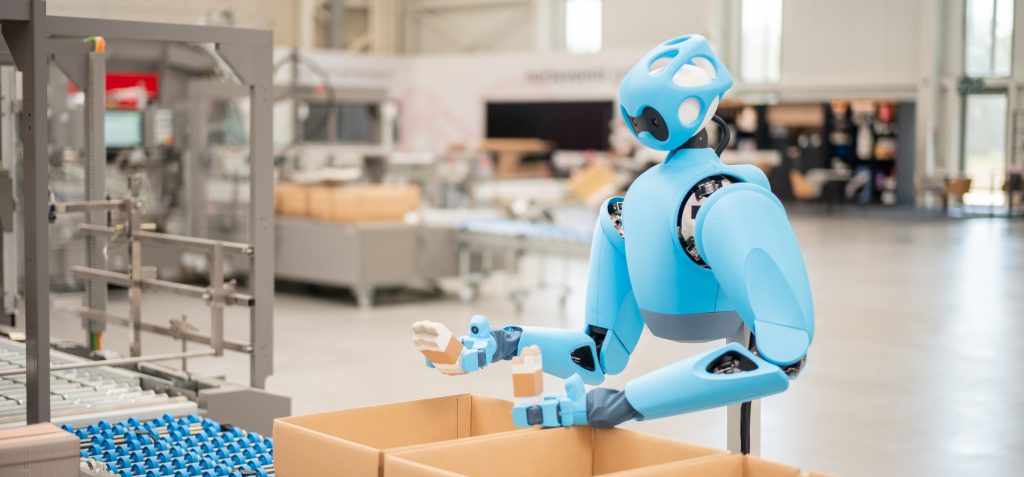
Swiss robotics company Embodied AI has unveiled AIR, a humanoid robot designed to be physically safe beside factory workers — and to learn each new job from a human operator, typically within a month. AIR was unveiled on November 6, 2026 at Humanoid Europe 2026 in Munich, after just nine months of development, and is already being tested with global manufacturers. Why it matters: AIR’s pitch is not a stronger robot behind a cage, but a compliant one that can share the factory floor as it is.
November 6, 2026
What happened
Embodied AI, an EPFL spin-out headquartered in Lausanne with an office in Rome, says AIR takes on repetitive manual tasks that change too often for conventional robots, so the people already on the line can focus on work that needs their skill. The company says it went from research to an industrial humanoid in nine months, has signed contracts with major OEMs globally, and is starting plans for scaled production. The OEMs were not named in the announcement.
The context it cites is a labor gap: as many as 1.9 million US manufacturing jobs could go unfilled by 2033, according to Deloitte and The Manufacturing Institute.
How AIR is built — and how it learns
AIR uses a tendon-driven architecture: motors, gearboxes and electronics sit in its torso, its arms are light and moved by tendons, and the arms give way on contact. It runs on wheels rather than legs, because factory floors are flat and wheels are more stable. The company says safety comes from how the robot is built, not from software holding it back. AIR is designed under ISO/TS 15066:2016, with CE marking planned for 2027.
For learning, AIR starts every job under a human operator, so it is productive from its first shift. Every run is recorded, and the company’s AI stack learns from those demonstrations until AIR can do the task itself — typically within a month, it says — with the operator on hand for anything new. What one robot learns, the next can use. Its existing two-arm cell reached 98% reliability against a 90% goal in a manufacturer’s cable-handling test; that result is company-provided.
Why it matters
Most humanoids are still demonstrations, and most industrial robots work behind cages. AIR is a test of the opposite approach: build the safety into the hardware, learn on the job instead of in a lab, and sell usefulness on existing factory floors rather than a future redesign. The claims that will decide it — the unnamed OEM contracts, the one-month learning timeline and the path from testing to scaled production — are exactly the ones to verify as deployments are named. Everything AI, tested: promising design, company-reported evidence so far.
Frequently asked questions
Why does AIR have wheels instead of legs?
Embodied AI says factory floors are flat, so wheels are more stable than legs for this environment.
How long does AIR take to learn a task?
The company says AIR starts under human operator control, learns from recorded demonstrations, and can typically do the task itself within a month.
When will AIR be certified and produced at scale?
Embodied AI says AIR is designed under ISO/TS 15066:2016 with CE marking planned for 2027, and that it is starting plans for scaled production while testing with global manufacturers.
Sources: Embodied AI via Business Wire.