
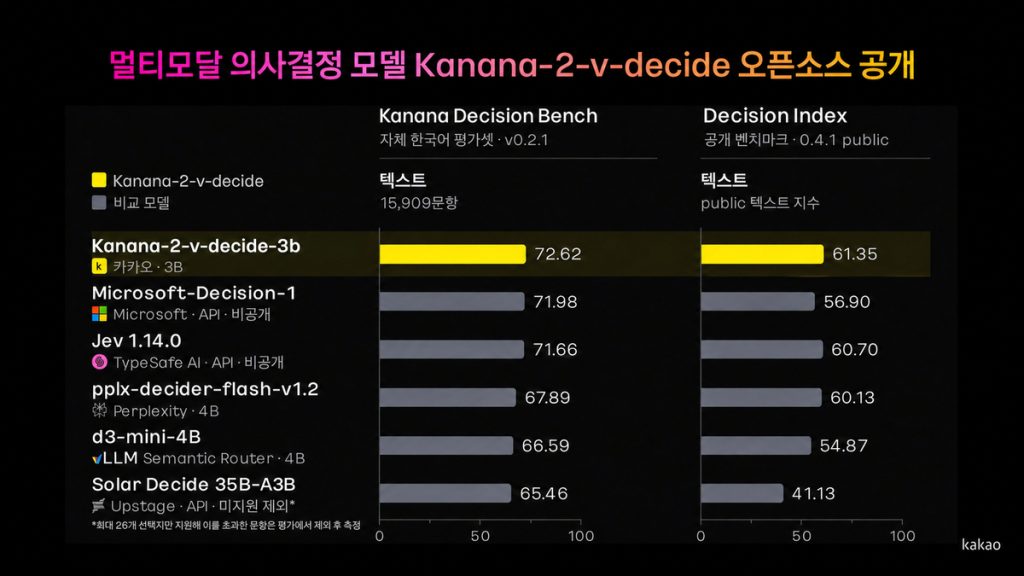
Kakao has released Kanana-2-v-decide, a multimodal decision model that gives AI agents probabilities, choices and scores instead of sentences — and, by Kakao’s own measurement, answers within 0.04 seconds on a single Nvidia H200. Kakao published the model on Hugging Face on November 6, 2026 under the Kanana Open License, which permits commercial and research use. Why it matters: agents spend much of their time making small judgments, and a fast, dedicated decision step can remove a slow detour through a full generative model.
November 6, 2026
What happened
Unlike a typical large language model, which answers in sentences that a service then has to parse, Kanana-2-v-decide returns standardized outputs — for example, the probability that a condition holds, or which option to choose among several. Kakao built it on Kanana-2-v-3b, its own multimodal language model, so it can analyze text and images at the same time.
That combination is aimed at the judgment calls an agent makes at every step: which tool to use, which information to consult and what to do next.
Speed and evaluation claims
Kakao gives a concrete example: if a customer uploads a photo of a damaged product while requesting an exchange, the model analyzes the photo and the inquiry together and expresses whether the product is damaged, the inquiry type and the customer’s emotional state as probabilities or scores. The service can then route the case using its own criteria.
On speed, Kakao reported an average response within 0.04 seconds on a single Nvidia H200 — about 43 times faster than GPT-6 Luna by its own measurements. It said the model topped the models compared on Kanana Decision Bench, its own 15,909-question Korean-language set, and on the public Decision Index set, against rivals including Microsoft’s Decision-1 and Perplexity’s pplx-decider-v1.1-27B. These are Kakao’s reported results, not independent verification.
Why it matters
Kakao plans to apply the model first to internal projects such as web search and automatic classification of product categories, then develop it toward integrating search and judgment into a single model. For builders, a small, openly licensed decision model is a practical pattern worth testing: keep the large model for generation, and let a specialized model handle the constant stream of small choices in between. Everything AI, tested — the claims to test first are the latency and the benchmark lead, both of which come from Kakao itself so far.
Frequently asked questions
What is a decision model?
A decision model returns structured judgments — probabilities, choices or scores — instead of free-text sentences, so an agent or service can act on the result immediately without extracting a conclusion from prose.
Is Kanana-2-v-decide free to use commercially?
Kakao released it on Hugging Face under the Kanana Open License, which the company says permits commercial use as well as research.
How fast is it?
Kakao reported an average response time within 0.04 seconds on a single Nvidia H200, and said that is about 43 times faster than GPT-6 Luna by its own measurements.
Sources: Seoul Economic Daily.